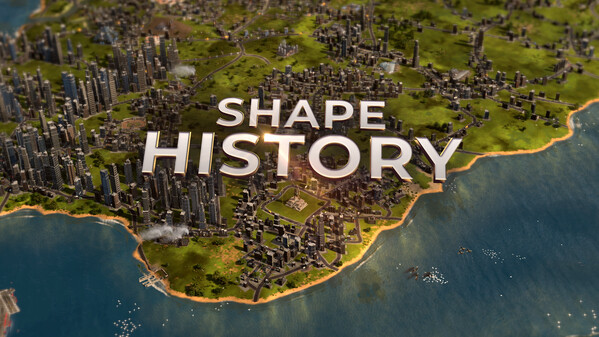
Build a nation starting at any point in human history and compete for supremacy in this epic turn-based strategy game. Engage in diplomacy, fight wars, and go head-to-head with other leaders from history.
Modeled estimate, not a reported figure. How we estimate →
Prices
Each in the currency that store quoted — not converted: the gap between two rows is the publisher's pricing, not an exchange rate.
14 of 15 markets; the rest we haven't asked for this title, not markets where it is unavailable.
Availability
We put this game to every storefront we collect. A market that answered not sold has told us something about the game; a market we never asked has not, and the two are never drawn the same.
About
Ara: History Untold is an evolution in historical grand strategy, featuring beloved classic PC strategy mechanics alongside innovative gameplay like a national crafting economy, true simultaneous turn resolution, a non-linear technology tree, and cloud-backed synchronous/asynchronous multiplayer - all with an expansive and vibrant presentation where you can zoom out from surveying the very edges of your empire all the way down to your citizens living their daily lives. In Ara, there are no pre-set paths to victory, leading to endless possibilities. Your choices will define the world you create, your experience, and your legacy.
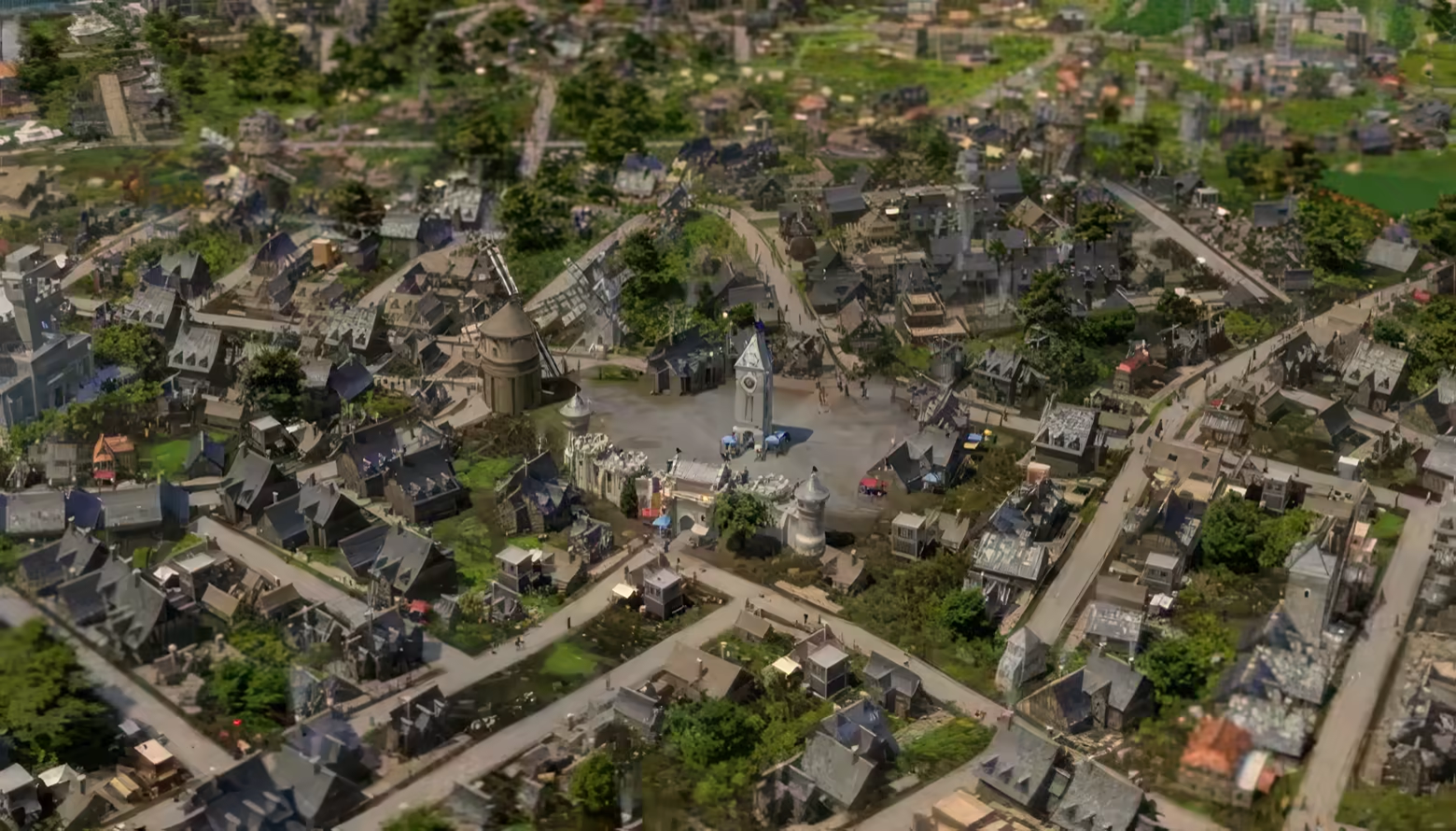
Explore an Immersive Living World:
Explore a dynamic living world filled with life and charm across sweeping landscapes ranging from tropical jungles to sand-swept deserts as you discover the resources you need to develop your nation. Witness the world come to life in vivid, realistic detail as citizens move throughout the world and react dynamically to times of health and sickness, war and peace, wealth and despair with unique biomes, cultures, and eras representing the diversity of human experience.
Build Your Nation:
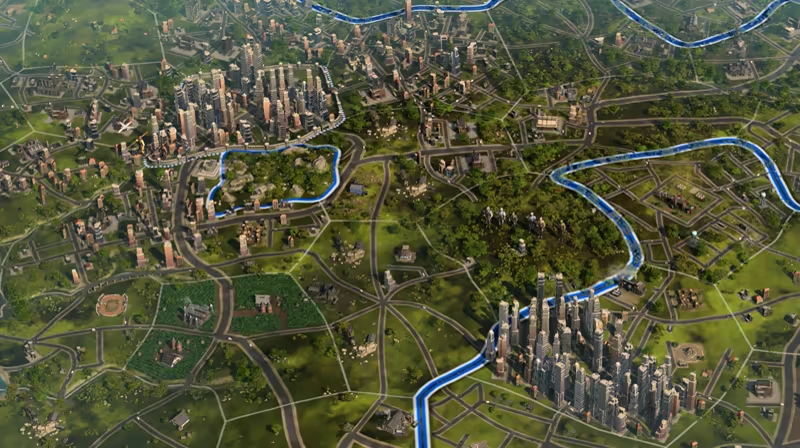
Serve your people and grow your prestige with numerous Improvements, from forges to libraries, citadels to cathedrals, public parks to industrial factories - as well as a global variety of the greatest architectural Triumphs ever conceived and built by human hands.
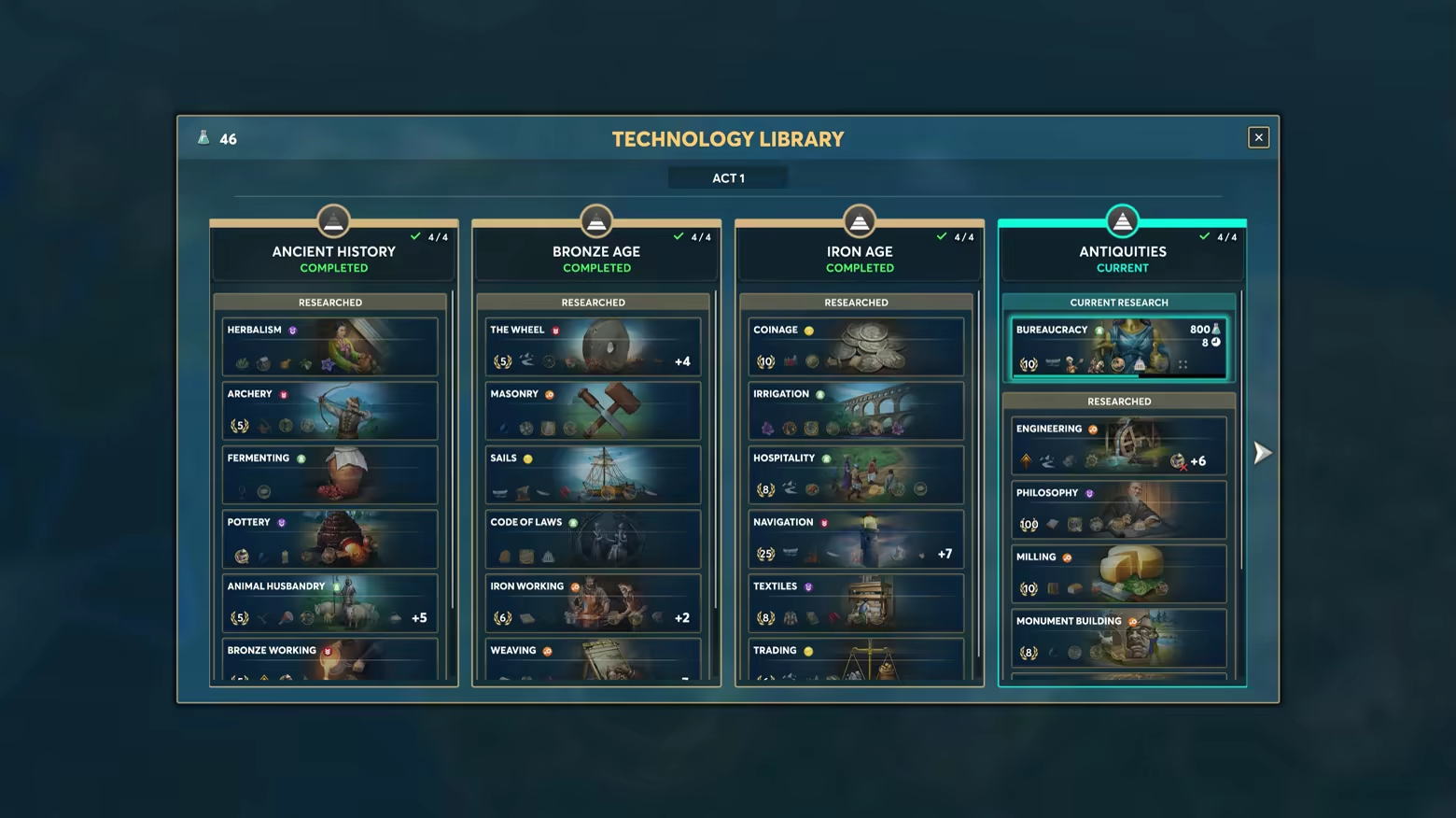
Guide your people through the eras of human discovery:
Nurture your people’s brilliance and invention as you progress your Nation through twelve unique Technology Eras, making the hard choices about where to focus your Nation’s greatest minds. As you near the end of each Era, you’ll have to decide how fast to push your scientists along the path to the future - at the risk of the present.
Oversee a rich and detailed national economy:
Harvest the bounty of the natural world and deploy the labor of your people with a depth-filled National Crafting system. Will you manufacture Amenities - like lavish feasts - to provide your cities and citizens with powerful benefits, or invest in the creation of Equipment - the weapons of war - to prepare your Armies to defend your nation or conquer your rivals? Whatever paths you choose you’ll need to carefully optimize your resources and production to achieve the most efficient systems if you want to outpace your rivals to fortune and lasting glory.
Rule Your Way:
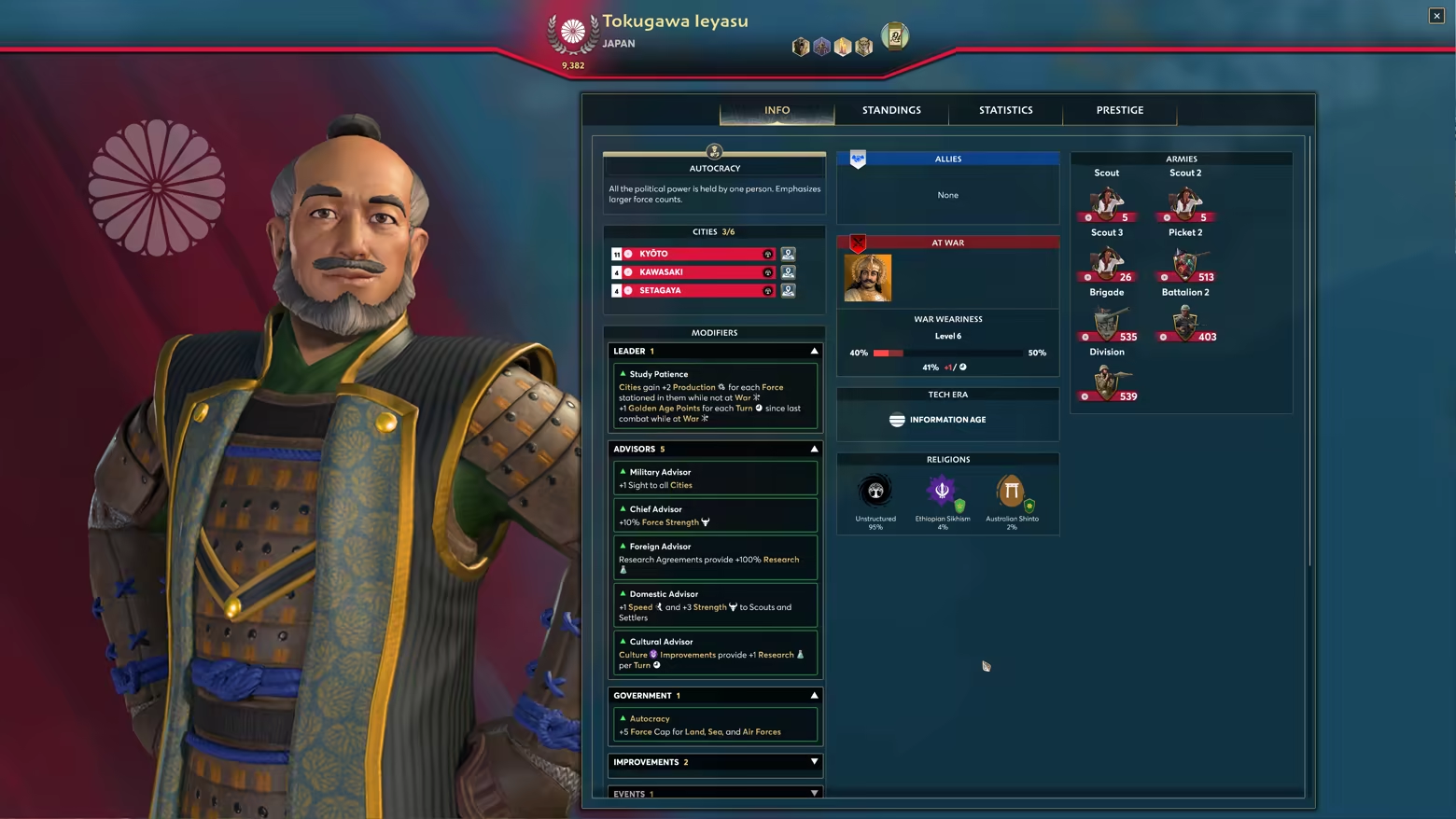
Choose from dozens of history's most influential figures to embody as you reshape the world through your choices. The unique and varied global Leaders and Nations in Ara emphasize a wide variety of different playstyles. Experiment with gameplay-impacting Traits and powerful Leader Abilities drawn from the effect they had on world history. Whether friend or foe, each Leader has a distinct personality based on their historical background that informs their AI behaviors.
Grow your Nation:
Extend your reach and expand your Nation’s borders through claiming new territory, conquering cities, spreading your Religion, or by expending Influence. How your Nation grows and defines new borders is up to you.
Experience True Simultaneous Turns:
Every turn each nation's actions and choices resolve simultaneously, leading to suspense, anticipation, unique outcomes, and surprising twists on the classic turn-based formula. The fate of your people will be determined by your decisions and your ability to predict your opponent’s next move, putting your skill as a leader to the ultimate test.
Defend your people by land, sea, and air:
Warfare in Ara is presented in the Living World, as thousands of years of military conflict reflect the progress and martial prowess of your people. Develop technologies to advance your weaponry against your rivals, hone your wartime economy and industry to gain the edge, and outthink your opponent’s strategies as maneuvers resolve authentically at once thanks to the power of True Simultaneous Turns.
Prove Your Worth in Online Multiplayer:
Combining the speed and surprise of True Simultaneous Turns with the power of the cloud - multiplayer in Ara is fast, seamless, and able to be enjoyed asynchronously with a wide range of options to tailor you and your friend’s experience to the way you want to play together.
A Microsoft Account is required to play online multiplayer.
Updates
Build ids and update times come straight from Steam's PICS — the same source SteamDB reads. Patch history grows as we record new builds.
Engagement
Reviews
Themes across 821 recent reviews and how positive each mention is. A keyword signal, not full sentiment analysis.
Reviews
This is my first experience in this genre where gaining a new population in a city made me wish I hadn't. Many others have described how prohibitively micromanaging the city management can be in Ara, but it's the constant backsliding of "quality of life" meters that is so punishing, even on easy difficulty levels and with no harsh military pressure. Consider the math; there are 5 QOL meters, each visibly measured 0-100, which all decrease by 5 each pop unit (10 once your city is 14). To counter this, you can assign amenities (the best ones MIGHT have 4 additives, but most are only 1 or 2), construct buildings and triumphs (which sometimes positively modify 1 stat, rarely 2, commonly 0...good luck in the modern era when buildings and events begin diminishing these numbers!), and assigning experts (sounds fun and helpful until you realize that in practice, the absolute jumbled mess of icons makes finding a place for them a chore in even a medium-sized city, and that their bonuses cannot possibly keep pace with the relentless lowering of QOL). Add to this the ridiculous amount of food that is required to sustain your citizenry; for example, with 8 cities in the 3rd act I had 31 Industrial farms and 62 Irrigated farms, 40% of which were not working on specific resources, but just food, and barely scraping by enough to not incur the dreaded red-lettered warning on the housing bar. So, 6 stats to maintain for a decent city, with substantially less ways in between pop growth to counter. You might insist, "There has to be a viable strategy!" And there is! I completely ignored City Health (which only governs city growth, which I WANTED to be slow), and in most cities not bordering an adversary, Security. So to sum up, I managed to achieve the unthinkable: cities with 100+ Happiness, Prosperity, and Knowledge, and ZERO (way less than zero in fact, but how much, the UI won't say) Health or Security. Historically accurate, I'd say; not to mention it makes perfect sense when I say it out loud. Try it, you'll see. Some other cautions: --Very demanding on CPU and GPU, even when way above recommended reqs and with settings like shaders lowered to direct shading, frame rate cap, medium textures, etc. --Combat boils down to moving an icon around the map (unless you scroll almost all the way down to see the tiny figures, but then you cannot see which zone you wish to move to), and watching a simple simulation of 100 warriors slashing back and forth or 100 archers firing 3 arrows per second at the exact same spot (or both), followed by a frozen screen with a scant few details of who won (or more likely, who lost fewer HP than the other, necessitating multiple engagements). Exhilarating, I know. --It's certainly reasonable for there to be a resource drain to construct each combat unit, but per active turn as well, even when defending and not fighting at all? Too prohibitive, imo. --Fog of War must be removed every session, as it reappears each login. Thankfully you just have to 'paint' your cursor across the map to re-reveal what you revealed previously. --Game never remembers UI scale between sessions, must always reset --Naming the regions within your cities scratches a little of the creative customization itch that the rest of the game sorely lacks (and no, a scant few different color costumes for the leaders doesn't count for much in this department), but gets very tiresome once you eclipse 100 and more of them, especially when the landscape is so samey and uninspiring. --There are nonsensical restrictions on the number of buildings that can be placed in your empire; like 1! flower field, 3 cobblers, 1 movie theater, etc. The former is particularly glaring when attempting to construct the Hanging Gardens triumph; it requires 10 flowers (made 1 every 4-5 turns), so unless you have access to Saffron to speed this production up, the "early-game" boost the triumph provides quickly becomes not so "early-game." Then there aren't even any visible flowers on the triumph itself!!! --The crafting seems like a good idea at first; but after the 20th time of, "Oh, I need that part! But first I need that resource (which there is only 2 spawned on the entire large map, and my city cap is maxed, and so are my opponent's, and there's no other way to access the resource, but even if I could, I need that building to make another part which will finally accelerate the production of the 1st part to make the building that lowers 2 of my QOL stats so I can have an amenity that raises 1 QOL by 20, ...well, I started to think of the legend of Sisyphus and the boulder, and wanting to just let the stone roll down into the valley while walking away. --Game suffers from the same issue that all 4X have, but is magnified several fold: Mid to late game is onerous, unwieldy, and ultimately not worth finishing for a single splash screen of congratulations and a meaningless Steam achievement. Spreadsheet simulators, even with colorful icons, just aren't my jam. If they're yours, there is a LOT of spreadsheeting to enjoy. Oh, and I hope you like the color orange. Most of the land, buildings and triumphs are some hew of it. Choose a Civ with this as their color scheme to intensify the effect. The artwork in the main menu is top notch though, and the smooth marimba-like tones when cursoring over any of the selections is a nice touch. If only the rest of the game had the same charm. 3/10
Media

Related
Related
Price dynamics, follower growth, revenue and sales trajectories with interactive tooltips
This and every other Pro feature is free until October 20, 2026. A free account is all it takes.
14 on sale1 answered “not sold”0 we did not ask
The 1 “not sold” market is read from the Steam price pass of Aug 31: that day the store answered for this game elsewhere and gave no price there. The 14 priced markets are the same rows as the table above — each the latest price we hold, dated here when it is older than that pass. The 0 marked “not asked” were not put to this store at all — either it has no storefront there or we do not collect it yet, and neither is a statement about the game. A refusal is a refusal on one day; a store can list a title again tomorrow.
Genres
Stats
All-time low is the lowest price we've recorded for this game since we started tracking it.
Languages: English*, French*, Italian*, German*, Spanish - Spain*, Czech, Danish, Dutch, Finnish, Greek, Hungarian, Japanese* +14 more
Hours played at review time, across 822 reviews with recorded playtime.
positive critical· bar length = how often the theme comes up
I'm gonna give this game a guarded "thumbs up." The game (rightly) invites comparisons with the Civilization series. Much is similar - each nation has particular strengths and bonuses (and sometimes maluses). You build cities, and as these cities expand (in Ara through growth-driven annexation of regions, comprised of zones, with one build option per zone) the cities become more powerful. There are some standard features (like Wonders of the World, which Ara calls 'triumphs') and bonus-giving governors (which Ara calls 'paragons' and there's a lot more of them). But it's NOT Civ - the gameplay is much different and you gotta keep that in mind. Some have called it the lovechild of Civ and Anno ... I'm inclined to include Vicky somewhere in the parentage. But the key point is that economic management is MUCH more prominent - and it involves developing chains of industries that will produce ever-more-sophisticated (and powerful) goods. Civ economics is checkers; Ara economics is chess (or perhaps even go). I have found it to be utterly fascinating and absorbing, but YMMV. Gameplay dynamics are different from Civ; you've gotta retool your thinking. (One example: producing more food doesn't directly lead to population growth ... what matters is building structures that enhance the growth rate. These just happen to produce more food, but it's the growth rate not the food that's the primary driver.) This gameplay difference is a major plus - we don't need another Civ clone. Unfortunately, the information needed to retool that thinking is often obscure or unavailable. What's driving the population growth of my city? I'm given partial information (the farm is boosting growth rate 3%, for example) but I'm lacking the complete picture. How many zones are in that region? That's important for city planning, but is only easily available when I can expand my city. What does it take to get another paragon? This thwarts my OCD tendencies to min-max things ... but even more importantly hinders my ability even to build appropriate strategies. I'm not playing blind ... but my game vision is far less than 20/20. So I'll give it a moderately enthusiastic endorsement. If you're looking for a Civ clone you will be disappointed. If you're looking for something simple, this is not the game for you. But if you're looking for a different take on the 4X historical genre, and want to invest some time and effort in discovering and mastering some deep gameplay, then this would be an excellent (albeit suboptimally documented) choice.
I do love this game and lemme tell ya, I had a blast playing it- but there is a LOT of work that needs to be done in order for me to say that this is a good game. One of the biggest issues is perhaps the core gameplay system, its gameplay loop and how the player interacts with it. You've probably heard that the game is very micromanage intensive and that is absolutely true. There have been excellent updates to automate some of this process but the player is quickly overwhelmed by the many, many things they have to keep track of which is somewhat by design. The game is designed to provide the player with the many interwoven pieces of a civilization- and they're responsible for overseeing all of it. I personally enjoy this as a concept but as it is executed in the game, you spend a lot of your time rifling through production lines ensuring everything is in check. People have been saying it compares to Factorio and this is very much true. However, this is like if Factorio was all menus and all of your time was spent interacting with UI's. When playing this game, I rarely feel like I am growing a city: I am instead feeding an excel spreadsheet inputs that causes numbers to increase. Another consequence of the core gameplay design is how little your decisions feel like they have an impact over everything. You go through all of this labor intensive micromanagement improving your production queues and the player doesn't really feel like that much has changed. Most of how you interact with your cities is by plugging in supplies, amenities and goods all of which increase the effectiveness of what ever you are trying to improve by like a small percentage. Eventually, stacking your small percentages is what causes your numbers to skyrocket but there is very little feedback as you build up to that point. The small increments are fractions of a fraction to start and eventually your city production is so high it barely registers in comparison. Every time you unlock a tech and plug it in to your empire, you are rewarded with small increments and this goes on ad nauseum. Because of this, it feels like the player never really decides what direction they are taking their empire, they're just progressing forward one small barely noticeable increment at a time. This also segues into my biggest personal complaint in that build variety just isn't a thing. There aren't really any "builds" in any sense that you may find in other 4X's for a variety of reasons. The first most obvious one is Leader abilities change very little about the game. Just like before, they are all just small little bonuses that stack with all your other small bonuses. There is an equivalent of Governor Titles and Pantheons that Civ VI players will be familiar with, but you can only slot in 5 paragons at a time to give differing empire yields and all of them provide bonuses that are not unique and share a pool of like, 5 different traits. The religion system also lets you improve niche aspects but as with everything else, most of these are just super small fractional bonuses. There are a few exceptions but they are probably part of the balance issues that plague the game. Certain technologies are just far superior compared to other unlockables for the age and multiple runs will see you taking largely the same techs. Although you won't use all the goods/amenities unlocked by techs due to being outclassed by other options, you will probably build every building available to you. Because of this, every run sees the same power spikes, ideal scenarios, and city layouts. So, what improvements would I suggest? Well, individual civilizations really need to have features that are truly unique and aren't just a handful of small bonuses (THAT CAN BE SHARED WITH OTHERS) and an ability to use one or two things 50% better. The leading competitor, Civilization allows leaders to break/create mechanics or introduces new and unique features. The most obvious iteration I think this game could implement is unique amenities. Some leaders could unlock some powerful alternative amenities that shape how they play. Egypt gets a unique grain store that provides bonus production for every arid/floodplain region. Sappho unlocks poetry which improves diplomatic relations and gives QoL for each alliance/trade deal with other nations. There's still more complicated changes that could be made to help with this issue but I think just the introduction of this Leader Amenity mechanic would make them feel significantly more unique than as it is right now. Another improvement would just to have certain items have a use other than "slight improvement to previous technology." How do candles have so many uses and then once you get electricity (2/3 unlocks you can get from another tech option), light bulb's only function is to replace candles as supply and provide just 1 more knowledge? Barrels and Plastic Bottles provide the same value but only some can be used in some buildings while the other can't but often times there is a lot of both. There are some good amenities in the game that deviate from the "increases QoL" such as the stove, eye glasses, and newspaper. However, for every interesting feature, there are 25 boring/uninteresting options. Obviously, there's many other improvements I could suggest but there is no need to go on such a long tangent. Anyways, although I have enjoyed my time playing this game, I've also felt like the game play and its loop is just not simply as fun or interactive as other games, especially others in the same civilization builder 4x genre. Like Humankind, there is something unique here and the potential is massive, it just so happens that the execution of these ideas simply isn't refined in any way and probably needs a massive overhaul to truly stand out as a good game. Post 2.0 Gameplay Addendum: I love that the devs are seriously considering and trying to accommodate the feedback they have been receiving and the game seems to be slowly but surely improving because of it. A lot of the completely egregious issues have been addressed (could not upgrade units from reserve, no automated production quotas) but there is still room for a lot of improvement. Some changes, such as the unique Civ bonuses, have gotten better as before there was very little variance in gameplay decisions but they're still not quite at a level that makes interacting with the gameplay systems feel rewarding or impactful. As many have said, the foundations for an amazing game are here but as it stands right now, the variation that makes 4X games addictive is just not here yet. I will say that early-game gameplay feels a lot better than it was before with the new additions but this makes the lackluster late-game gameplay feel even more empty/trivial. I feel like the great 4X games introduce new gameplay systems or powerful new abilities in their late-games, some of which let you rewrite pre-established systems. In this game, late-game tech is either completely outclassed by mid-game stuff or is a marginal improvement over the previous era of technology. The most egregious example of this is the singularity/speculation era techs all being marginal improvements over previous technology. This is the top level research and the end of game countdown has been activated, how come these techs have less impact than finding out that horses are a thing? This leads to another current issue I've noticed: higher difficulties have a strong emphasis on war. If you have Nation Culling on for the player, any difficulty higher than normal will have you culled by the first age if you do not engage in a successful war since you simply cannot outsim the AI at this stage of the game. This wouldn't be an issue if all of the 1st act military units didn't require horses. Wanna play at higher difficulty but didn't spawn with horses nearby? Gotta remap and reset. You won't be able to build enough war momentum fast enough without a source of horse early.
So the game has better graphics than most turn based games. It wants to be Civ, but play like HumanKind and fails like both. Warfare has taken an absolute backseat and god forbid you can just play the game and figure it out- you get eliminated if you don't have enough "prestige". So by the end game, there are 3 players. I would not recommend this game, save your money for CivVII. I tried to get a refund and couldn't because I was beyond the two hour mark. Everything is micromanaged as far as resources, this is more of a Tycoon than anything. TWO HOURS is nothing for a game like this. Don't waste your time.
Ara: History Untold boldly enters the 4X strategy space — a genre long dominated by titans like Civilization and Humankind — and makes a clear statement: there’s still room for innovation. Developed by Oxide Games and published by Xbox Game Studios, Ara offers a polished, thoughtful take on world-building, management, and historical storytelling. It’s not perfect, but it’s refreshingly different in a genre that often plays it safe. Unlike many 4X titles, Ara isn't obsessed with history as a fixed script. Instead, it’s about shaping an alternate vision of humanity — where you, the player, are less of a conqueror and more of a curator of civilization. Turns are simultaneous, which might be the biggest mechanical shift for veteran players. Everyone takes their actions at the same time, which means no more waiting for dozens of AI opponents to finish micromanaging their cities. It’s fast, efficient, and surprisingly tension-filled, especially in multiplayer. City building feels alive. Rather than being constrained to tiles in a rigid grid, your territory grows organically. Each city becomes a self-contained ecosystem, with infrastructure, production, and citizen happiness all tied to how well you manage growth. This makes every settlement feel distinct — and managing their needs is a juggling act that never becomes boring. Resource management in Ara is more granular than most 4X games, blending crafting mechanics with traditional production queues. Citizens aren't faceless workers — they have professions, preferences, and needs. The game leans into this simulation aspect, making you feel more like a ruler overseeing a living society than a spreadsheet-filling god. Technology and policy development is guided by "inspirations" — discoveries born from your actions, not just a tech tree you blindly follow. This opens up room for more emergent playstyles and rewards curiosity and experimentation. Diplomacy and warfare are functional, if not revolutionary. Alliances and rivalries develop logically, but don't expect Crusader Kings levels of intrigue or Total War-style battlefield tactics. If there's one area that feels undercooked, it’s the military side of the equation — serviceable, but lacking depth compared to the economic and cultural systems. Visually, Ara is bright and painterly — a softer, more inviting art style than many of its genre peers. Maps are richly detailed, with dynamic lighting and seasonal effects that make the world feel responsive and alive. Cities look great at a glance, but the charm fades a bit if you zoom in too closely, where animations and detail can feel limited. The soundtrack leans into hopeful orchestral tones, echoing the theme of rewriting humanity’s future. It’s pleasant, even if it doesn’t particularly stand out — a good background score for long, thoughtful turns. What Could Be Better: -Combat needs more depth. It feels more like a means to an end than a satisfying tactical system. -AI behavior can be erratic. Some leaders are far too passive or make baffling decisions. -UI clutter and tooltip overload. At times, the sheer amount of information gets overwhelming, especially for new players. -Performance hitches on large maps or during late-game turns can be noticeable, though patches have improved things post-launch. Ara: History Untold isn’t just another 4X game. It’s an ambitious and thoughtful attempt to rethink how we play these games — how we shape civilization, how we progress, and how we measure success. It trades micromanagement-heavy complexity for a more elegant, systems-driven approach that rewards planning, experimentation, and immersion. For strategy fans tired of chasing science victories or spamming settlers every 20 turns, Ara offers a much-needed breath of fresh air. It may not dethrone Civ just yet, but it earns its place in the conversation — and lays the groundwork for something truly great. Recommended for fans of Civilization, Old World, Endless Legend, or anyone looking for a slower, smarter, more narrative-driven 4X experience. Rating: 7/10
I'm giving up on this game, it's too aggravating. Having a cow farm on a 4 fertility region (the highest you can normally find) PLUS a plow PLUS a well PLUS an "expert" gets you 0.9 "cows" and naturally you need one for any industry like a butcher or tanner, so it's effectively useless. All of that while at the same time playing as an "agrarian" which is supposedly meant to boost farming output. I'm sick and tired of the nickel-and-dimeing crap. The new 1.4 upgrade makes butchers give a boost to livestock farms, but why is it so hard to have an early economy in the first place?? You shouldn't have to throw five ingredients into the pot just so you can eke out one product.
Ara:History Untold tries to be a 4x, city builder, and industry simulator (a la Anno) all at once, and does none of them well. Imagine 3 poor games combined into one. The core game play is really nothing new or innovative, just tedious and monotonous. Combat is absolutely dreadful, city building and progressing is as color by numbers as it gets, you do not have to interact with any other civilizations after a certain point in the game (hence the city builder aspect) and because of the prestige mechanic for victory, you cannot play how you want or plan, victory just kind of happens once you reach an arbitrary level of prestige. Sometimes with games like this, you can see potential for the future, but with Ara, there is none. The price is absurd, the game is bad, and there is no real path to redemption. If you wanted a game that actually tries to be innovative and is priced reasonably, try Millennia (published by paradox) It is a little clunky, sure, but it actually tries new things, executes them well, and is half the price.
Ara is a really good game. I played first on game pass and bought it here later. No civ clone but an alternative with many different concepts and different focus. Clearly to recommend, but maybe not for all. At first some of the concepts can be confusing, but when you get into it, most makes sense. [b]Resources and Crafting[/b] to produce amenities for your cities and equipment for your units are a main focus. You need some time to understand what is important and how many workshops, potteries, forges, ... you need to build by when so that everything runs smoothly and with limited micro management. If you like creating and optimizing your production chains, this is your game. [b]Era changes [/b] are included with the main impact that the weakest nations are removed (but no, no nation/civ changes). This increases the challenge to survive and works well for me, but I saw also many criticizing it in the beginning, so maybe not for everyone. [b]The map [/b] has no hexes, but is divided in small provinces with 1-6 subregions where you can build farms or buildings. As your cities grow, you claim more. Borders look more natural. [b]Food generation and city production[/b] are not only dependent on the fertility of a province. It depends a lot on city size, improvements and corresponding adjacency boni, city happiness, assigned specialists,... The resulting values can be at first hard to predict, but it makes more sense after a while. [b]Units and warfare [/b] are on a first look more simplified. You build units into a reserve pool and muster them in combined squads (in any city, not only the producing one). Certain combinations inside the squad give you boni. Battles are in the end often decided by who brings more to the battlefield/province maybe including supporting fire from squads with archers etc from neighboring provinces. If you want a more complex battle simulation, be cautious here. Might be not for you. But overall it works fine. [b]Diplomacy[/b] is okay. Nothing spectacular so far. Not every relation change is clear, but also not too random. More unique is the idea, that wars have goals and a timer leading to an auto-peace. It is good and avoids prolonged wars, but might also appear as too artificial for some. V1.3 is announced to bring improvements to diplomacy. I am looking forward to what it will bring. [b]AI opponents [/b] are on high difficulties competitive in the first half of the game. Later they fall back . Devs mentioned that AI improvements are on their list and I hope they can do more here too keep Ara more challenging in the long term [b]Trade [/b]is very simplified for a game with so many goods. Beside AI improvements, a new system here would be my biggest wish, even if it comes later as paid content. There would be more to mention, but this is enough for me now. Finally I would like to add that the developers look for feedback and continue to work on it. New patches are coming to improve the game, not very fast but steadily.
There is an overwhelming amount of information presented to the player, and the late game feels like a grind: towards the end of my first (and last) playthrough, I set all my cities to focus on science production and simply skipped the last 30+ turns. Technologies unlock at a much faster pace than you can realistically adapt to them. Diplomacy is virtually non-existent, and AI players change their attitude towards you without any clear reason. Terrain doesn't matter for the purpose of combat and naval units are just forgettable. I don’t think I have the enthusiasm to start a second game, not even after patch 1.1. One last note: the day before launch, one of the developers claimed on Discord that the game would run well on Steam Deck. That was not (and is not, afaik) the case: even on minimum settings, performance was horrible.
The game has potential, don't get me wrong. But here are the negatives: 1. the help is not align with the game. (the in game encarta) 2. the formulas for production for harvester, industry are sometimes a mystery and of course there are not presented in the documentation 3. battles? no idea how the damage is calculated 4. city tiers? there is no help on this -> should be a table somewhere in the documentation 5. the text are fake (in the text says it give you +1 research, but is actually 1%), same with the stone pits (says +5% to ceramic but is +5) - I think you really should employ someone which make the difference between +5% and +5 etc. So considering the numerous bugs I cannot recommand I added a video with some tips and which show the defects: https://www.youtube.com/watch?v=_wK6kMFbYyU
Selling now
See how fast this game is selling right now — estimated copies and revenue per day from recent review growth.
Active players
Estimated daily and monthly active players (DAU/MAU) modeled from peak concurrency.
Players by region
Where this game's players are, estimated from review languages.
Players also reviewed
The games this title's players most often review too — audience affinity.
Related
| Game | Estimated lifetime revenue | Reviews | Review score | Price |
|---|---|---|---|---|
| — | 0 | — | — | |
| $121.7M | 61.9K | 47% | $34.99 | |
| $22.7M | 13.1K | 63% | $59.99 | |
| $7.4M | 6.9K | 82% | $39.99 | |
| $4.8M | 3.8K | 67% | $39.99 | |
| $86.5K | 1.7K | 82% | $1.99 |
Related
| Game | Estimated lifetime revenue | Reviews | Review score | Price |
|---|---|---|---|---|
| $3.9M | 7.9K | 92% | $24.99 | |
| $3.9M | 5.7K | 87% | $29.99 | |
| $3.9M | 3.7K | 79% | $49.99 | |
| $3.9M | 4.2K | 78% | $24.99 | |
| $3.9M | 2.7K | 74% | $38.99 | |
| $3.9M | 4.5K | 83% | $39.99 |