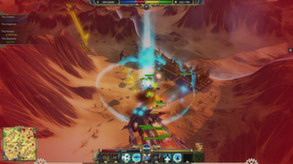
You are the Dragon Commander. Your mission it is to reunite a broken empire and become the new emperor. Success depends entirely on your ability to efficiently rule your empire, build invincible armies and lead them to victory.
Modeled estimate, not a reported figure. How we estimate →
Prices
The United States storefront in every case, so this compares stores and not countries.
Prices
Each in the currency that store quoted — not converted: the gap between two rows is the publisher's pricing, not an exchange rate.
14 of 15 markets; the rest we haven't asked for this title, not markets where it is unavailable.
Availability
We put this game to every storefront we collect. A market that answered not sold has told us something about the game; a market we never asked has not, and the two are never drawn the same.
Discounts
Every price cut of more than 20% we have observed, in each market that quoted one, with this game's chart position on either side of it. These are episodes, not a model: a sale is one event, and one event cannot tell you what the next one will do.
Reviews, worldwide (the counter carries no country): 0.11/day in the week to Aug 4 → 0.14/day in the week after.
For scale, across Steam · Top Sellers · Brazil over the last 30 days: the 26 chart moves that followed a price cut of more than 20% went a median of 7 places towards #1, and the 2,402 moves with no price cut behind them went 2 away. One store, one chart, one country — it is the only place we have enough observations to say even that.
Prices outside the United States have been collected since 6 August 2026 and chart positions since 19 July 2026, so a cut older than that has no market to compare and a market that joined later has no history yet. Nothing here is converted between currencies.
About
Genres
Sums Steam only; GOG publishes no volume signal, so the true total is higher by an unknown amount.
| Store | Price | Audience | Score | Chart | Est. revenue |
|---|---|---|---|---|---|
SteamYou are here | $39.99 | 2.5Kreviews | 74% | — | $3.1M |
| $39.99 | 316ratings | 74% | — | not modelled |
Matched by title — a reused name can pair the wrong games. * is a critic aggregate. Prices and positions are each store's United States storefront; Epic charts worldwide. Audience and Score too, except Steam's, which is worldwide.
Updates
Build ids and update times come straight from Steam's PICS — the same source SteamDB reads. Patch history grows as we record new builds.
Engagement
Reviews
Themes across 803 recent reviews and how positive each mention is. A keyword signal, not full sentiment analysis.
Reviews
Великолепная игра, захватывающий геймплей и потрясающие разработчики. Возникла ошибка дропающая игру из-за отсутствия файла "grGranite". Лазил по форумам и в единственном месте где его можно было скачать на него была недействительная ссылка. Написал разработчикам на почту о проблеме и через 2 дня они мне прислали его.
Cool concepts, awkward execution. The RTS mechanics were technically alright but engagements felt repetitive and the AI was easily overcome. The dragon, while effective, did not feel very satisfying and its progression was underwhelming. The story could have been cool but its antagonists were horribly underdeveloped, allies were goofy caricatures, the writing gave a generally un-serious impression, and decisions dwelling on identity politics were the most ridiculously overt, cringe-worthy, and out of place I've ever seen in a game. Not devoid of fun but an undercooked and forgettable mess.
Media

Related
Related
Price dynamics, follower growth, revenue and sales trajectories with interactive tooltips
This and every other Pro feature is free until October 20, 2026. A free account is all it takes.
14 on sale1 answered “not sold”0 we did not ask
The 1 “not sold” market is read from the Steam price pass of Sep 10: that day the store answered for this game elsewhere and gave no price there. The 14 priced markets are the same rows as the table above — each the latest price we hold, dated here when it is older than that pass. The 0 marked “not asked” were not put to this store at all — either it has no storefront there or we do not collect it yet, and neither is a statement about the game. A refusal is a refusal on one day; a store can list a title again tomorrow.
Stats
All-time low is the lowest price we've recorded for this game since we started tracking it.
Languages: English*, German*, French*, Russian, Polish*languages with full audio support
Hours played at review time, across 806 reviews with recorded playtime.
positive critical· bar length = how often the theme comes up
Dragons and jetpacks, Civilization and StarCraft. Mix’em all together and what do you get? Divinity: Dragon Commander. Okay, it’s a bit more complicated than that, but those are certainly the core elements at play when discussing Divinity: Dragon Commander. It’s not quite a real-time strategy game as complex as StarCraft, and it’s just shy of being as big-picture as Civilization. It does have jetpack-wearing dragons, however, which sort of puts things in perspective. I mean, what else really matters? The single-player mode in Divinity: Dragon Commander sets up a decent plot about a being who can transform into a dragon who is disputing with its other, equally crazy siblings. The story portrayed through the cutscenes is certainly well told, but serves as more or less a justification to go from one map to the next. Though the tutorials don’t do much to explain this, Divinity: Dragon Commander is a mix of board game-style territory control (a la Risk) and real-time strategy (RTS) battles. The majority of a “match” will have players moving pieces around a game board in an attempt to control and dominate as much of the map as possible. The biggest problem is that the tutorial doesn’t even attempt to explain any of this. After watching the multitude of tutorial videos, it’s easy to assume that the game is only an RTS game, as it doesn’t touch on any of the mechanics associated with the board game portions of a match. When first confronted with the board, some tooltips are displayed to help explain things, but they are incredibly insufficient. The tutorials for the RTS elements are also insufficient, as is the case with just about every non-interactive tutorial. There is a “Training Ground” that allows players to screw around as they please, but it does little in the way of actively teaching anything. The board game portions of the game take place in turns and require a “big picture” type of thinking in order to play effectively. Two types of resources are up for grabs: gold and resource points. Occupying various areas on the map will add to the amount of resources gained per turn, the exact amount being displayed on the territory itself. When a battle occurs, the player has the option to choose a specific general, each with their own playstyle, to auto-simulate the battle and play the odds, or they can control the Dragon Commander and head into battle themselves. The battles play out like many other real-time strategy games, but with one twist: the player can take control of a jetpack dragon and partake in the battle themselves. Doing so is somewhat limited; there are a couple of minutes in the beginning of the match in which the dragon cannot be spawned (it takes resources, which you don’t yet have, to spawn the dragon), and there is a brief period after death in which the dragon cannot be spawned. The dragon has specific abilities at its disposal as well, each with its own separate cooldown. As for the non-dragon RTS mechanics, battles consist of vying for resources called Recruits. Recruits are gained over time as long as the player has Recruitment Centers built on top of certain locations around the map. These locations are neutral in the beginning of the map, and need to be captured by having at least one unit nearby. The beginning of the match is incredibly important as players have limited units and must try to capture and hold as many build locations as possible, both for Recruitment Centers and unit-producing buildings. The RTS controls do feel a bit clunky when compared to the standards of the genre. Intermediate tactics like control groups can be utilized, but most units move way too slowly to micromanage effectively. The true highlight of the single-player campaign is what happens in between turns, aboard a ship called the Raven. This is where the diplomatic elements come into play, as a group of five diplomats will constantly bug the player with proposals and recommendations as to how to run a country. Each diplomat represents a specific race: Undead, Elves, Dwarves, Lizards, or Imps. Making certain decisions will alter how each race feels about the player, so balancing the favor of each race becomes quite the juggling act. The Raven is also where players will spend their research points. These points, accrued each turn, can be spent on new units and unit abilities or on new dragon abilities. Deciding where to spend research points is no easy feat, as doing so can drastically alter a playstyle. One player might want to spend heavily on their dragon, making each player-controlled battle that much easier, while someone else might want to focus on their army and let their AI generals auto-simulate the battles. A good amount of humor is peppered throughout these interactions. One turn you may be asked to legalize an Elven herb with “healing properties” for medical use and the next you may have to pick a wife in order to form a political marriage with one of the races. There are plenty of goofy situations and decisions to be made, which are only made funnier by the fact that the council is completely serious about these proposals. A lot of polish has gone into the interactions that take place aboard the Raven. Most of the dialogue is well written and can be genuinely funny instead of relying on cheap jokes for laughs. I continually found myself spending more and more time talking to the NPC characters simply because I wanted to read more of their dialogue. It is, of course, also possible to take the battles online against honest-to-goodness humans. The Raven doesn’t make an appearance in any multiplayer mode, since chances are people would spend forever in between turns, but its absence is made up by the presence of dragon-on-dragon battles. The voice work of Divinity: Dragon Commander deserves special mention. With so many different characters aboard the Raven, the voice acting was immediately a cause for concern for me. Luckily, each character performs well and it is a joy to talk to each and every one. Sure, no one character’s voice actor stands out as particularly amazing, but the sheer virtue of not having a single character grate on the nerves is not to be understated. Divinity: Dragon Commander is a prime example of a game being bigger than the sum of its parts. The RTS elements are a bit rough, but at least it’s possible to control a dragon with a freaking jetpack to blow stuff up, while the boardgame-esque territory map requires players to think of the big picture. Talking to the colorful cast of NPCs aboard the Raven in between turns in single-player was easily one of my favorite non-dragon parts of the game and really highlights the writing and wit that the Divinity series has come to be known for. The tutorial needs a lot of work and the game isn’t very friendly to colorblind players, but Divinity: Dragon Commander will certainly unleash the dragon strategist in all of us. Verdict: 7/10
This game does so much well. Story is a bit basic/predictable, but I enjoyed it a lot. Board game elements are also super nice. I don't like the RTS mechanics, nor do I like the dragon mechanics. Flying around as a dragon feels pretty bad and so does shooting... And thats like a third of the game. With that being said, consider bumping the difficulty down and just enjoying yourself. Huge reccomendation for people who want to make their own strategy/narrative/action hybrid games. So many systems, and it does so much wrong.
Even all these years after release, there are still game breaking bugs. The last straw was the one where the game does not let you recruit units, by extending the recruit bar to the right hand side of the screen and freezing progress. It's a shame. I had no idea Larian was capable of this. It seemed like it would be fun to play, but I've seen enough as to why the game isn't so positive as I might expect. It's abandonware.
The core gameplay is a ton of fun, but JFC the political portion is so hamfisted, bigoted and absurd. "should we deport the foreigners?" TO WHERE? This is supposed to be a civil war, there shouldn't be any. I mean, I'm a bi-trans woman, and even I cannot fathom why the frack we have to debate gay marriage CONSTANTLY. Why do the undead give a shart about half these things? They can't have sex, can't eat, and if their gods are so weak as to be usurped by mortals, they ain't gods. And back to the gay stuff, it's not cool to toss slurs around just to make the bigots sound bigoted. IF you play, maybe find a mod to turn off the entire chancellor system. It's barely even useful, and listening to a bunch of bigots argue why their bigotry and greed is great and then a bunch of weak liberal "but human rights" counterpoints isn't what I want from a game. There are games that have that discussion well, and then there is this garbage. Somehow it manages to present both sides in a way neither side would want to stomach.
Insane that this is the earliest game in the timeline. Fun gameplay, neat characters and the roleplay was fun as well. Wish they'd revisit this concept again sometime.
You command as a ♥♥♥♥♥♥♥ dragon what more can I say. Peak gameplay.
Divinity: Dragon Commander is a weird, ambitious genre mash-up: part grand strategy, part real-time tactics, part choose-your-own-adventure RPG. You’re an imperial leader trying to unite a fractured land, and the game constantly shifts perspective—from managing territories and armies on a campaign map, to making political decisions aboard your flagship, to personally joining battles as a dragon. It’s messy in places, but it’s also the kind of game that feels unlike anything else. On the strategic layer you conquer provinces, tax and develop regions, recruit and upgrade troops, and decide where to push next. It’s not a pure spreadsheet war simulator; it’s more about keeping your momentum, protecting borders, and building an army composition that can win the next fight. The map play can feel swingy, but it does a good job of giving you that “one more turn” drive. Battles are real-time and army-focused, with a slightly arcade feel compared to hardcore RTS games. You’re juggling infantry lines, ranged units, artillery, and special troops while trying to capture points and break enemy morale. It’s not as finely tuned as a dedicated competitive RTS, but it’s readable, fast enough to stay exciting, and varied by terrain and unit matchups. The signature hook is that you can transform into a dragon during battles and directly intervene. As the dragon you can fly, burn lines, hunt key units, and generally act like a tactical nuke with a health bar. When it works, it’s a great power fantasy: you’re not just ordering icons around, you’re literally the trump card that can turn a collapsing front into a win—if you manage your risks. Between battles, the game leans into roleplaying through “council” decisions and personal politics. Advisors argue, factions demand laws, and you make choices that affect morale, income, unit availability, and how various groups see you. A lot of these decisions are intentionally uncomfortable trade-offs, and the writing has a tongue-in-cheek edge that keeps it from feeling like dry governance. Where Dragon Commander struggles is consistency and polish in its fusion. Some systems feel deeper than others, balance can be uneven, and the difficulty can spike if you commit to the wrong upgrades or fall behind on the campaign map. The constant context-switching is also a taste thing: if you want a pure RTS or a pure grand strategy, you may find the hybrid pacing distracting rather than refreshing. Overall, Divinity: Dragon Commander is best for players who enjoy experimental strategy games, like making narrative-flavored decisions, and want battles that are more chaotic fun than perfectly tuned competition. If you can forgive rough edges, you’ll get a memorable campaign full of personality and surprising moments. If you need tight balance, clean interfaces, and one genre done “by the book,” it may feel like a fascinating prototype that never fully smooths out.
Because dragons 🐉 are cool. However, the RTS part is very quirky, especially in the late game where battles are mostly decided by numbers before a dragon can be spawned. The main strength of this game is the characters, honestly. the dragon itself. [h1] 15/10 [/h1]
Players by region
Where this game's players are, estimated from review languages.
Players also reviewed
The games this title's players most often review too — audience affinity.
Related
| Game | Estimated lifetime revenue | Reviews | Review score | Price |
|---|---|---|---|---|
| — | 316 | 74% | $39.99 | |
| $22.4M | 45.1K | 68% | $20.99 | |
| $48.5M | 33.7K | 87% | $49.99 | |
| $8.9M | 13.3K | 87% | $29.99 | |
| $2.3M | 8.1K | 86% | $9.99 | |
| $430.7K | 2.8K | 77% | $7.49 |
Related
| Game | Estimated lifetime revenue | Reviews | Review score | Price |
|---|---|---|---|---|
| $3.1M | 17.8K | 82% | $12.99 | |
| $3.1M | 7.9K | 95% | $14.99 | |
| $3.1M | 4.4K | 98% | $29.99 | |
| $3.1M | 7.9K | 88% | $14.99 | |
| $3.1M | 8.3K | 88% | $12.99 | |
| $3.1M | 15K | 97% | $10.79 |