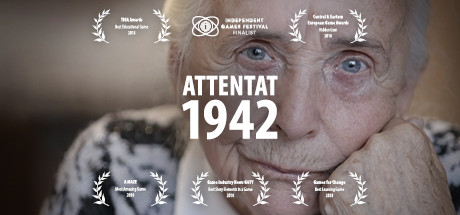
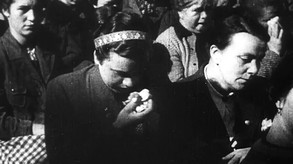
Attentat 1942, developed and published by Charles Games, is a strikingly emotional and historically rich narrative experience that uses the medium of interactive storytelling to explore the impact of Nazi occupation on the people of Czechoslovakia during World War II. Rather than relying on combat or spectacle, it immerses players in the aftermath of a pivotal historical event—the assassination of Reinhard Heydrich, one of the highest-ranking Nazi officials—and examines the personal consequences that followed. The story begins decades after the war, as a young protagonist in the early 2000s investigates why their grandfather was arrested by the Gestapo in 1942. What unfolds is less a conventional game and more an interactive documentary that combines historical authenticity, emotional storytelling, and unique presentation to bring the past to life in an intimate and reflective way.
What immediately sets Attentat 1942 apart is its fusion of narrative formats. The game seamlessly weaves live-action interviews, hand-drawn comic sequences, archival materials, and point-and-click investigation segments into one cohesive experience. You spend much of your time speaking with surviving witnesses and family members, each with their own memories and interpretations of what happened. The interviews feel genuine, both because they are performed with quiet realism and because they are based on extensive research and real historical testimonies. Through these conversations, the player gradually pieces together the truth about the grandfather’s fate and, by extension, the moral and political complexities of life under occupation. It’s a deeply human approach to storytelling, one that avoids dramatization in favor of honesty and empathy. Each interaction invites contemplation rather than judgment, revealing how ordinary people were forced to navigate extraordinary moral dilemmas.
Visually, the game alternates between different art styles to powerful effect. The live-action segments provide a documentary-like realism, grounding the story in authenticity, while the illustrated flashbacks reimagine past events with expressionist style and emotional weight. The black-and-white comic panels, often punctuated with splashes of color, evoke the uncertainty and fear of living under Nazi rule. These visual contrasts not only maintain variety but also symbolize the act of remembering—the difference between the clarity of the present and the fragmented, sometimes stylized recollections of the past. The sound design contributes to this atmosphere with restrained yet evocative audio cues: the distant echoes of machinery, faint street noises, and subdued background music that never overpowers the spoken word. Everything about the presentation is designed to make you listen, observe, and reflect.
Mechanically, Attentat 1942 is straightforward. It operates largely through dialogue trees, investigative tasks, and short puzzle-like interactions that punctuate the narrative. The puzzles themselves are simple—such as decoding a letter, examining historical artifacts, or piecing together fragments of memory—but they serve an important narrative function, helping the player engage more directly with the historical material. Rather than testing skill or reflexes, they simulate the process of research and discovery. The player isn’t a hero in the traditional sense but rather a historian, piecing together a family’s hidden story through patient questioning and analysis. The interface is clean and unobtrusive, designed to foreground the content rather than distract with unnecessary complexity. Each interview or scene feels self-contained yet connected to a larger emotional tapestry, emphasizing the cumulative nature of history—how the truth emerges not from one account but from the overlapping stories of many individuals.
The emotional power of Attentat 1942 comes from its restraint. It does not rely on shock or spectacle to convey the horrors of occupation; instead, it lets the characters speak for themselves. Their memories, filled with hesitation, guilt, and grief, reveal the profound moral ambiguity of survival in wartime. Some characters were part of the resistance, others were bystanders, and a few participated—willingly or not—in collaboration. The game never simplifies their experiences into clear categories of good and evil. Instead, it highlights the psychological toll of living under totalitarian oppression, where every decision could have fatal consequences. By focusing on ordinary people rather than soldiers or political leaders, the story captures the personal dimension of history that is often overlooked in more traditional narratives about the Second World War. It is a rare example of a video game treating history not as a backdrop for action, but as a living, human story.
Though the game is only a few hours long, its impact lingers well beyond its runtime. The brevity suits its documentary-like structure, giving the narrative focus and urgency without overstaying its welcome. That said, some players may find its simplicity limiting—there are no branching paths or significant choices that alter the outcome, and its replay value lies primarily in revisiting certain dialogues or missed details. Yet this design choice aligns with the developers’ intent: Attentat 1942 is not about manipulating the past but understanding it. It’s an experience meant to be absorbed rather than conquered, encouraging reflection rather than mastery. It also succeeds as an educational tool, having been developed in collaboration with historians from Charles University and the Czech Academy of Sciences, ensuring historical accuracy while maintaining accessibility for players unfamiliar with Czech history.
Ultimately, Attentat 1942 stands as one of the most mature and thoughtful uses of the video game medium to explore history and memory. It refuses to sensationalize tragedy, instead using interactivity to deepen empathy and understanding. It reminds us that history is not a collection of distant facts but a series of lived experiences passed down through generations. By engaging the player directly in the process of uncovering the past, it transforms remembrance into participation. Few games have the courage to be so quiet, so human, and so honest. Attentat 1942 is not merely played—it is listened to, absorbed, and remembered, a testament to how interactive storytelling can bridge the gap between education and emotion in ways no other medium can achieve.
Rating: 8/10