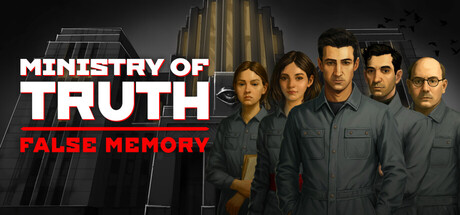
Ministry of Truth: False Memory is a story-driven simulator in a totalitarian society. Become an official, manipulate facts, rewrite history, and provide the ‘truth’ to the public. Choose: obey or fight against the regime. The Great Father is watching you!
Modeled estimate, not a reported figure. How we estimate →
About
"Suffering is a blessing. Silence is wisdom. Obedience is loyalty."
Congratulations, Comrade! You have been appointed as an official of the Ministry of Truth. This is a great opportunity to serve the Party. Your task is to rewrite history, control information, and provide the ‘truth’ dictated by the Party.
Emotions have no place here; thoughts are dangerous. Your path is your choice: obey and remain loyal to the regime, or attempt to resist the system. Remember, The Great Father is watching your every move. Every misstep will be punished, every doubt recorded.
Five Minutes Rage
Gather for the daily ritual of the Five Minutes Rage. Watch the enemies of the Party on giant screens, scream, and surrender to the crowd’s fury. Fear and hatred become loyalty.
Your Truth, Your Choice
Rewrite events, alter records, and decide what the public will believe. Every choice shapes the ‘truth’.
Keep Your Mind Pure
Suppress doubts, govern your emotions, and obey the Party. Any weakness, any rebellious thought, threatens both you and the State. Your mind is under constant scrutiny.
Genres
Stats
All-time low is the lowest price we've recorded for this game since we started tracking it.
Add-ons
Each DLC is estimated with the same model as a game, then summed — a modeled figure, not reported DLC sales.
Engagement
Reviews
Themes across 77 recent reviews and how positive each mention is. A keyword signal, not full sentiment analysis.
Reviews
Вас чекає: тест на лояльність і любов до партії, таємний роман на роботі, обрізання фоточок для газети, щоб виставити все в гарному світлі для партії, і більше того, ви навіть будете складати вірші. Хороші, бо інакше на підвал. Якщо чесно, гра мене приємно вразила - я нічого не очікувала. Думала, це ще одна Papers Please, але зовсім ні, вони різні. Гра виявилась цікавою, атмосферною, і візуальний стиль безумовно пасує до жанру. Гра від українських розробників - це ще один плюс. Рекомендую абсолютно точно. Особливо якщо давно хотіли дізнатись наскільки сильно ви любите Великого Батька
Не погана гра, мені сподобався візуал та завдання. Перше проходження - намагався бути повним мудачеллою, але в мене не вийшло. Але вийшло практично повністю по книжці Орвела, навіть закінчення. Другий раз вийшло більш ХЄ, але з нюансами. Вцілому, вважаю, що буде цікавіше тим, хто Орвела не читав. Хотілося більше варіативності й можливості впливати на щось, але з іншого боку - як ти не старайся все одно для "Партії" ти просто маленький гвинтик.
Media

Related
Related
Price dynamics, follower growth, revenue and sales trajectories with interactive tooltips
This and every other Pro feature is free until October 20, 2026. A free account is all it takes.
Languages: English*, Ukrainian*, German, French, Italian, Spanish - Spain, Danish, Simplified Chinese, Traditional Chinese, Korean, Norwegian, Dutch +10 more
Hours played at review time, across 77 reviews with recorded playtime.
positive critical· bar length = how often the theme comes up
This game is great and bad at the same time. Great - very atmospheric, with a deep story and many endings. Bad - unfortunately, it feels a little too much like something from nowadays.
I feel bad saying this, but this game is bad on basically every level. Let’s start with premise. The game is an unlicensed adaptation of the novel 1984. It was clearly intended as such from the beginning, was named as such from the beginning, and only changed because the Orwell estate threatened legal action against them (the creator is quite open about this). I don’t know at precisely what stage of writing or development this change occurred. I have to assume it was very late in the stage because the game *still* contains numerous references to verbatim concepts and words from 1984 (Oceania, Eurasia, Eastasia), alongside what are clearly hastily and obviously swapped out concepts (Big Brother -> Great Father). But even this scrubbing is incomplete. An example: the resistance movement from 1984, “the Brotherhood”, has been changed to be called in game dialogue “The Will”. But in at least one case the dialogue still says “the Brotherhood” mid conversation before going back to being called “The Will”. This is just sloppy use of ctrl+f the script to change X to Y. Setting all of that aside, we can generously say the game as it is now is *inspired* by the novel 1984. An homage if you will! That’s fine. 1984 was a seminal dystopian text. Many if not most of the dystopian fictional worlds that followed it referenced it or drew inspiration in some way. But usually the good ones do their own thing creatively. This is at best a straightforward knock off. Okay, fine. Moving past that. What is there to adapt from 1984 into a game? What are the key themes you want to present or highlight in your homage art project? How do they translate into game mechanics? The game seems primarily interested in gamifying three ideas from the novel: Doublethink/thoughtcrime: This occupies the majority of the gameplay. The player is presented with scenarios and tasked with responding on how to react properly. They are given an option of 4 emotional/affective responses, have to pick 2, and then those in combination produce a response to the scenario that impacts the players score on a series of meters (such as loyalty, empathy, etc). As a core gameplay loop this is not inherently a bad idea, and certainly the most creative one in the game. Unfortunately the meters do not really seem to do much or impact gameplay. I maxed out the loyalty/obedience to the party ones early on and still completed the resistance/escape portion of the narrative. I would honestly like to see a mechanic like this iterated on in a new unique setting. There’s a lot you could do with this sort of rorschach loyalty test thing in a dystopian world. I think there was also a lack of interrogation with the deeper concept behind Orwellian doublethink and cognitive dissonance. Which I wouldn’t care about as much mechanically if that wasn’t clearly the inspiration. The point in the novel is to hold two incongruent ideas in your head at once. That doesn’t seem to be rendered here at all. Too bad. Altering history: A few times during the game (maybe around 6?) you are given the task to rewrite old headlines to bring them into line with the party, alter a photo/drawing, etc. Fine ideas but undercooked mechanically on their own terms and also how they weave into the narrative. You get binary choices, i.e. tell the truth or lie for the party. None of them seem to have any impact on the other actions in the game. If I tell the truth will the party be weakened? Will the resistance grow stronger? None of it matters. It bears mentioning that this idea has been explored in a lot of other games in ways that are more mechanically deep and creative. Not For Broadcast comes to mind. Even on a barebones level, Lucas Pope’s The Republia Times is a game built entirely around the concept of headline manipulation in an authoritarian dystopia & takes about 10-20 minutes to play. Molleindustria’s more recent New York Times simulator also lifts this concept. Both manage it better than this game, and critically, they are *free*. The love story/resistance plot: This is the narrative core of this game. It mostly plays out like a visual novel with a few puzzle elements and a deeply unengaging stealth maze escape ending. I’m not much for visual novels, but this one does not clear the bar at all. As a plot it is stripped down of about 90 percent of the story from the original novel. You are Winston and you meet Julia (again they changed the names but this doesn’t matter) and meet once or twice and are eventually captured. There is no story here, no real stakes, no meaningful interactions or relationships, not from the novel or from an original spin. For you to care about what happens relies entirely on the idea that you read the novel previously and are seeing a sort of greatest hits clip show of some of the key moments. In one scene you meet a woman, the next scene she says she’s in the resistance, and the following scene you are captured. There is no expression of affection or romance. At the end you are asked if you would be willing to betray her. Betray her? I hardly know her! This cuts to another issue with the game: the length. It took me about 2.5 hours to complete. The last hour of which was navigating the mechanically frustrating escape sequence. This took much longer than it needed to be simply because of jank (bad controls, bad design) forcing the player to repeat the same bits over and over again. This sequence was so poorly executed that it inspired me to write this review. I was willing to overlook a lot of the game's problems until it dawned on me that nearly half the games runtime was eaten up by this “climax” seemingly designed to conveniently push the game length just past the refund window of 2 hours. To be clear: I’ve played plenty of short games for a few hours that cost 5-10 bucks that were absolutely worth it. This just feels incomplete, rushed, and poorly executed. Unfortunately that wasn’t even the worst part. Undeniably the worst part is the “torture” sequence. When you are finally captured by the Ministry of Love-ah sorry, Ministry of *Care*-you are subjected to an interrogation. You click through a series of responses to questions (again, seems irrelevant what you pick) and proceed to three rounds of a rhythm-based mind control mini game. You have to play dance dance revolution with the WASD keys so O’Brien-sorry, Agent Crow-can calibrate his mind reading device. This is so childish as to be insulting, both to the players intellect, and to victims of actual torture. What is the tone? Is it meant to be scary? Intimidating? Threatening? The keys light up in bright primary colors and make musical sounds when you successfully hit them. Great job, you’ve aligned the mind reading machine (again narratively it has no point). With all of the strange decisions in this game, this one baffles me the most. Who thought this was a good idea? Did they get to the interrogation part and think, well, it can’t just be dialogue. Then it’s not a game. How do we add a game element. Y’know. To make the torture more exciting. In the novel, the entire thematic climax of the book is the interrogation and the dialogue. A lot of other stories have similarly used the idea of a big moral/existential confrontation between interrogator and prisoner. This is the place where good writing can shine! Or go the more gameified route and come up with a mechanic to represent trying to resist interrogation. Problematic, sure, but hey. Anything would be better than Garage Band for Dissidents. I’ve spent more time writing this review than playing the game. That’s how mad it made me! A game that adapts, or better yet, is inspired by, the themes of 1984, could be great! The incongruent paradoxes of orthodoxy, the way that war fundamentally bends political orders towards authoritarianism and conformism, the erasure/manipulation of truth. All of that continues to be as relevant today as it was in 1949. What a shame.
🕴️ Ministry of Truth: False Memory Review Some games are not played. They are endured. The demo of Ministry of Truth: False Memory had already left a strong impression on me. Twenty-five minutes were enough to make me feel that I was no longer a player, but part of the system. After spending approximately 1 hour with the full version, that feeling is still there. Although, as a Ministry employee, I don't think I have the right to complain anymore. My thoughts have been properly forwarded to the appropriate departments. The full version gave me much more than what I saw in the demo and expanded on many of the things I wanted to see. Yet somehow, I found myself slightly disappointed—not because of the game, but because of my own expectations. I went into it expecting something a little more like Beholder or Papers, Please, and that wasn't quite what I found. That doesn't make Ministry of Truth: False Memory a bad game. On the contrary, it is a very interesting one. If you have read George Orwell's 1984, I believe you will understand and appreciate what this game is trying to say on a much deeper level. For me, the most successful part of the game is the relationship between Party loyalty and rewards. The more loyal you are to the Party, the greater your rewards become. Your reliability progresses in much the same way. And this is exactly where the game becomes unsettling. I knowingly made choices that were good for the Party but bad for the people—and I still made those choices with a smile. Not because I believed they were right. Because the system rewarded me for believing they were. After a while, I started questioning whether this was really a choice at all. Fortunately, Big Brother had already answered that question for me. At the beginning of the game, you are given two different paths. You can choose loyalty to the Party or a desire for freedom. This immediately gives you the feeling that your decisions matter. For a while, you genuinely think: “My choices really have consequences.” But as you progress, that thought is gradually replaced by another: “No matter what I choose, the system is going to win anyway.” And perhaps that is exactly the point. You are already a watched employee. Your choices are constantly observed, your loyalty is measured, and your obedience is rewarded. Free will is a beautiful idea. As long as the Ministry approves it. I wasn't simply making decisions. I was learning how to make the decisions the system wanted me to make. The gameplay itself is interesting, and the tasks remain engaging as you progress. However, the game is quite easy. I never felt particularly challenged by the mechanics. Even so, the psychological aspect of the choices was much more interesting to me than the difficulty of the game itself. Visually, the game maintains the minimalist and cold aesthetic I enjoyed in the demo. It successfully makes you feel like you are inside a dystopian world. The environments, interface, and overall design all support that atmosphere. However, once again, I found myself comparing it to Beholder. I think the feeling of being a cold, mechanical Party employee could have been pushed much further. Beholder manages to create a much more oppressive atmosphere through its presentation, and its music in particular feels far more disturbing. In Ministry of Truth: False Memory, the music sometimes feels more like background music than an active part of the atmosphere. If this was intentional, I can accept it. However, if the goal is to make the player increasingly uncomfortable and trapped within the Party's system, I think the music could have gone much further. The same applies to the overall atmosphere. The game succeeds in creating a cold and dystopian world, but I wanted to feel more uncomfortable inside that world. Sometimes I felt less like I was inside a dystopia and more like I was working in the Human Resources department of a dystopia. The interface and visual design are still strong, and I didn't experience any major technical problems during my playtime. I did notice a few Turkish translation errors, but they were minor and didn't prevent me from understanding the game. One thing I particularly appreciated is that the experience becomes much more meaningful if you already know 1984. Understanding Orwell's ideas makes the themes of the game easier to recognize, and some of the choices become much more meaningful because you already understand their references. If you haven't read the book, that's fine too. The Ministry will tell you what you need to remember. I haven't finished the game yet, so I don't want to comment on the ending or the story as a whole. This review is based on approximately 1 hour of gameplay and the content I have experienced so far. Conclusion Ministry of Truth: False Memory is an interesting interpretation of Orwell's themes and becomes much more meaningful if you have read 1984. The game doesn't necessarily make you feel like a villain. And that is exactly what makes it disturbing. You can knowingly make decisions that harm people, receive rewards for doing so, and eventually realize that the system has made obedience feel completely normal. The demo made me think: “I was the system.” The full version made me think something slightly different: “The system was shaping me.” I haven't finished the game yet, so my final thoughts may change depending on where the story takes me. Although, if I need to change my mind, I'm sure the Ministry will be happy to help. For now, 8/10. And to IKKOSAMA, False Memory Dept., and Two Cakes Studio: thank you for welcoming me back to the Ministry. I assure you, my loyalty has been properly recorded. All opinions expressed in this review have been examined, the appropriate ones have been corrected, and the remaining ones never existed. Big Brother is watching. Glory to the Party. 🕴️ 8/10
Such a hot topic nowadays. Media censoring, propaganda, lying politicians, fake news and fake experts. The game is a reflection of Orwell and the future we shouldn't have. Good game, it feels well - you always choose, even quite often you have no choice. I definetely want to see all the endings.
Computergame Adaptation of George Orwells '1984" , I like it and i highly recommend reading the book!
fun, many choices you have to make about weather to sow seeds of doubts into the peoples minds at the risk of your own life or to obey the great father and pump out more state issued propaganda and allow the lies to continue. pretty fun and is well made, there does not seem to be any bugs or issues. plus its priced fairly unlike a lot of the overpriced games now adays that cost like 25-50$ for a half baked game, as i said before its a well made game and worth the money and the topics the game has are relevant more then ever. very solid game.
总体上游戏还是挺有1984的感觉的,配音也比较到位。就是做了那么多数值和小道具结果都没用上就结局了?实际上剧情的选择好像影响也不大,是还有游戏内容没放出来吗?如果这就是完整版的话那就比较失望了。
lan bura bizim memleket
Selling now
See how fast this game is selling right now — estimated copies and revenue per day from recent review growth.
Players by region
Where this game's players are, estimated from review languages.
Players also reviewed
The games this title's players most often review too — audience affinity.
Related
| Game | Estimated lifetime revenue | Reviews | Review score | Price |
|---|---|---|---|---|
| $607.5K | 1.9K | 76% | $9.99 | |
| $305.7K | 817 | 73% | $16.99 | |
| $24.2K | 41 | 78% | $14.99 | |
| $6.1K | 67 | 76% | $4.99 | |
| — | 0 | — | — | |
| — | 0 | — | — |
Related
| Game | Estimated lifetime revenue | Reviews | Review score | Price |
|---|---|---|---|---|
| $20.5K | 114 | 98% | $6.99 | |
| $20.5K | 87 | 91% | $19.99 | |
| $20.5K | 118 | 97% | $7.99 | |
| $20.5K | 58 | 79% | $12.99 | |
| $20.5K | 132 | 69% | $9.99 | |
| $20.5K | 108 | 81% | $7.99 |