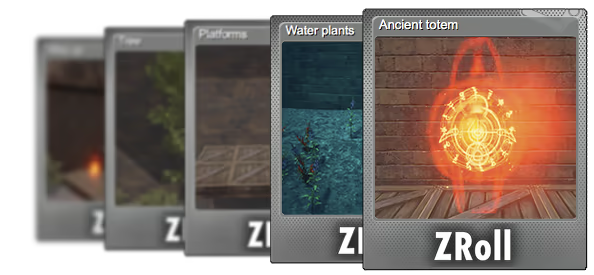
ZRoll is a minimalist yet demanding indie platformer developed by KxONE, Andrew Drumov, and starmops, and published by Bitlock Studio. It takes a traditional approach to precision platforming, offering a straightforward test of timing, reflexes, and patience. The concept is simple: move through a series of compact stages, avoid traps, manipulate mechanisms, and collect totems scattered across increasingly treacherous environments. There is no elaborate backstory or narrative structure; the game’s focus is purely mechanical. Every stage is built to challenge precision and consistency, drawing inspiration from classic skill-based platformers while keeping its presentation clean and uncluttered. This simplicity is both the foundation of its charm and the source of its limitations.
At its best, ZRoll succeeds in distilling platforming down to its purest form. The levels are tightly constructed, rarely wasting space, and each obstacle serves a clear purpose. Jumps must be timed to perfection, switches must be activated under pressure, and hazards often leave no room for hesitation. The game operates with an almost rhythmic quality—the player learns to move in patterns, to anticipate, and to react instinctively. Each stage offers a self-contained puzzle of movement, often forcing you to experiment with speed and trajectory before you find the perfect path forward. The inclusion of collectible totems adds a layer of optional challenge for completionists, rewarding those willing to explore every corner and master the nuances of the game’s physics. The design is unforgiving but fair, and while death comes frequently, the restart is immediate, keeping frustration at bay and encouraging quick retries.
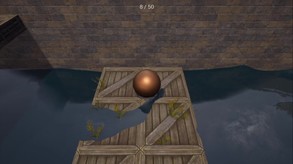
The game’s simplicity in presentation serves its gameplay well. Visually, ZRoll avoids unnecessary detail, opting instead for clarity and contrast. Backgrounds are muted, emphasizing platforms, traps, and interactive elements. The color palette shifts subtly from level to level, giving each stage a distinct tone without overwhelming the senses. This minimalist art direction allows the player to focus entirely on movement and timing. The occasional environmental effect or lighting variation gives the sense of progression, but the game never relies on spectacle. Its audio design mirrors this restraint—sound effects are minimal and functional, marking jumps, collisions, and successful interactions without drawing attention to themselves. The soundtrack, though sparse, maintains a steady energy that complements the rhythm of repeated attempts and incremental improvement.
As the game progresses, it introduces new mechanics that change how players think about movement. Moving platforms, switches, and timing-based hazards force constant adaptation. Some levels require manipulating the environment to open new paths or deactivate traps, adding a mild puzzle element to the otherwise linear structure. The difficulty curve ramps up sharply, but in a way that feels earned. Each stage builds on lessons learned in the previous one, creating a satisfying sense of growth through skill rather than upgrades or power-ups. The developers’ choice to keep controls simple—focusing on precision and physics rather than gimmicks—gives the gameplay a consistent, honest challenge. For those who enjoy the satisfaction of mastery and repetition, ZRoll can become strangely addictive, rewarding patience and persistence over brute force.
Despite its strengths in design clarity, ZRoll is not without its shortcomings. The biggest issue lies in its repetition. While the early stages introduce mechanics at a brisk pace, later sections start to feel familiar, with variations on obstacles that players have already conquered. The limited variety in visual themes and hazards can make extended sessions feel monotonous, and without a narrative or evolving goal structure to tie the experience together, the motivation to keep pushing forward can wane. The precision required for later levels can also alienate more casual players, as mistakes tend to be punished harshly. For some, this high difficulty will be the main appeal; for others, it may quickly become discouraging. Additionally, because the game lacks deep customization or alternative gameplay modes, it relies heavily on its core mechanics to maintain engagement.
Technically, ZRoll runs smoothly and efficiently, with fast loading times and stable performance even on modest systems. Its Unreal Engine base allows for sharp presentation and fluid animation, though its visual ambition remains modest. The physics engine feels responsive, and the character’s weight and momentum are consistent across all stages, making it easy to develop muscle memory for jumps and landings. However, there are moments where collision detection feels slightly unforgiving, especially when landing near edges or trying to execute tight maneuvers. These small imperfections don’t break the game, but they add a layer of tension that can occasionally feel unintended. Still, for a small-scale indie project, ZRoll’s polish is commendable, and the minimalist design helps avoid many of the pitfalls that plague more complex platformers.
What sets ZRoll apart from many of its peers is its purity of intent. It is not trying to reinvent the platforming genre or impress with cinematic flair—it simply aims to offer finely tuned levels that test your precision and patience. Its stripped-down presentation reinforces that focus, making it easy to pick up and play in short bursts. The inclusion of hundreds of achievements gives an extra incentive for perfectionists to replay stages, chase better times, or complete every optional objective. For players who thrive on mechanical challenge and don’t mind the absence of story or spectacle, ZRoll provides a satisfying loop of failure and improvement. Each completed level feels like a small personal victory, earned through repetition and skill rather than luck.
Ultimately, ZRoll is a game built for a very specific kind of player—someone who appreciates discipline, timing, and minimalist design. It offers no distractions, no artificial padding, and no pretense. Its simplicity may limit its appeal, but within that narrow focus lies its greatest strength. It is a platformer that demands attention, rewards mastery, and punishes carelessness, yet it always encourages another attempt. For a small, inexpensive title, it delivers a surprisingly cohesive and well-balanced experience. Though it may not leave a lasting impression on those seeking narrative or variety, ZRoll achieves exactly what it sets out to do: provide a compact, skill-driven platforming challenge that values precision and perseverance above all else.
Rating: 6/10