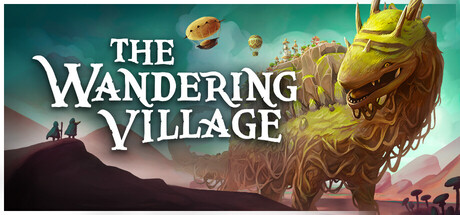
The Wandering Village is a city-building simulation game on the back of a giant, wandering creature. Build your settlement and form a symbiotic relationship with the colossus. Will you survive together in this hostile, yet beautiful post-apocalyptic world, contaminated by poisonous plants?
Modeled estimate, not a reported figure. How we estimate →
Each in the currency that store quoted — not converted: the gap between two rows is the publisher's pricing, not an exchange rate.
Every market we collect.
Discounts
Every price cut of more than 20% we have observed, in each market that quoted one, with this game's chart position on either side of it. These are episodes, not a model: a sale is one event, and one event cannot tell you what the next one will do.
Reviews, worldwide (the counter carries no country): 2.29/day in the week to Aug 28 → 4.14/day in the week after.
About
In a world where mysterious plants are spreading all over the earth, emitting toxic spores as they grow, a small group of survivors seeks shelter on the back of a giant, wandering creature they call 'Onbu'.
Become their leader, build their settlement and form a symbiotic relationship with Onbu to survive together in this hostile, yet beautiful post-apocalyptic world.
A functioning village is the basis of your survival. Build your settlement and expand it over Onbu’s back. Plan production chains and optimise them to utilise the limited space as efficiently as possible. Create a society that can overcome any challenge.
Living on the back of another organism comes with its own set of challenges. Will you live in symbiosis, bond with Onbu and survive on mutual trust? Or will you become a parasite, only aiming to ensure a better life for your villagers? The choice is yours.
Continuously adapt your village as you travel through a multitude of different biomes, each with its unique climate zones, opportunities and threats. Scout your environments and send out foraging missions to gather rare resources and ancient artefacts.
Remnants of the old world hold knowledge that has long been forgotten, but can be unearthed by your villagers. Find and research these technologies, but use them wisely, as progress can be a double-edged sword.
Ensure the survival of both your villagers and your Onbu, even though poisonous spores, merciless weather, bloodsucking parasites and many more challenges mean that the odds are often stacked against you.
Genres
Add-ons
Each DLC is estimated with the same model as a game, then summed — a modeled figure, not reported DLC sales.
Sums Steam only; Xbox, Nintendo publish no volume signal, so the true total is higher by an unknown amount.
Updates
Build ids and update times come straight from Steam's PICS — the same source SteamDB reads. Patch history grows as we record new builds.
Engagement
Reviews
Themes across 898 recent reviews and how positive each mention is. A keyword signal, not full sentiment analysis.
Reviews
CONTAINS VERY MINOR SPOILERS I love this game. If you like Nausicaä of the Valley of the Wind (1984), this is very close to that. Opening animation is a clear clue of the inspiration. Instead of Ombus (giant insects) you have an Onbu, a dinosaur like slow moving cute creature! Basically you have a mobile city with somewhat limited resources, and you have to keep the city and people running. What I like is that the pace at which new tech is researched and resources accumulate. Just enough to make you feel the progress, but not so fast that you end up with ridiculous amounts of stuff that you can trade easily. Once I ended up with tons of water, which turned out to be disadvantage because I needed saltwater to get salt and all the storage space was used! Allocating work force is damn near perfect mechanics wise. If you do not need fisheries, just click lock symbol and the facility closes and workers are sent elsewhere. If you need to open up, just unlock and you get the place working very quickly. If you need more workers somewhere else, just adjust the amount of workers in one work place from 4 to 1 or so on. Also, already when you're building new work place you can already click that once it's ready, new workforce will start working there. Real salt here is that environment changes. When Onbu moves, there are two paths every now and then and you can choose one (in the beginning Onbu doesn't trust you and doesn't do what you tell it to do). Different areas have different kind of resources, humidity, temperature and environmental risks, and you have to adjust things like water collecting and plants to farm for those changes. You can't solve by relying on just one source, but if you look what's ahead you can actually plan your next moves. This is really fun, and if you fail to react it doesn't feel like the game is against you, it's just that you didn't plan ahead despite all the information available. Worker allocation is perfect for this: Close air wells, open saltwater collectors once you move to sea area. The explore-element is nice, you can send exploration teams to search for resources from abandoned mines, laboratories, villages, oases etc. and sometimes you get a random event with three choices: risky, less risky or no risk. Result is somewhat random, and I like it because once the less-risky was actually the risky one. You don't know what happens next, which gives this game more story like feeling. Game is kind a like Last Train Home but without battle element. Story of The Wandering Village is a bit bittersweet, and somewhat deep with humanity destroying the nature in their greed, but now having one last change to make things right. This brings another element to the game: moral choices. The player can exploit the Onbu, but doing so hurts the animal and it's trust in you. This makes game easier, since some resources become more abundant. There are some game scenes where for a reward you can do this, like actually causing pain to the Onbu to impress a poet in need of inspiration. Luckily narration made it clear that I do not have to do this to advance the game, so whatever to see the Onbu as beloved animal or as a source of resources is up to you. Some small cons: Only bigger minus thing is the rather odd mechanics of village happiness, but after you get better apartments, bakery to make enough bread and decorations around houses this is no longer a problem. I get it that villagers are unhappy and might rebel and leave the city when there is no food, but sometimes everything seems to be OK and they still complain. Usually a nice festival solves that (temporary boost to happiness), which makes sense in "bread and circuses" way of ruling. Another thing are the herbs: they are very important, but for some reason you can only cultivate like 20, no matter how many plots a herbalist has. I even build two herbalists, and still the amount was limited though I had every resource needed to cultivate them. Also, I miss "produce until you have X amount" mechanic for work places. The disabling of workplaces does the trick, but this would make the game easier to manage.
Media

Related
Related
Price dynamics, follower growth, revenue and sales trajectories with interactive tooltips
This and every other Pro feature is free until October 20, 2026. A free account is all it takes.
Related
| Game | Estimated lifetime revenue | Reviews | Review score | Price |
|---|---|---|---|---|
| $9.6M | 14.4K | 79% | $19.99 | |
| $9.6M | 27.2K | 95% | $9.89 | |
| $9.6M | 9.3K | 88% | $34.99 | |
| $9.6M | 26.3K | 92% | $19.96 | |
| $9.7M | 13.9K | 97% | $24.99 | |
| $9.6M | 125.4K | 93% | $4.99 |
Related
| Game | Estimated lifetime revenue | Reviews | Review score | Price |
|---|---|---|---|---|
| — | 0 | — | — | |
| $4.3M | 4.2K | 76% | $20.79 | |
| $4.1M | 4.6K | 81% | $24.99 | |
| $24.7K | 35 | 94% | $15.99 | |
| $56.9M | 41.8K | 96% | $34.99 | |
| $702.7K | 2.3K | 94% | $9.99 |
Reviews, worldwide (the counter carries no country): 149.2/day in the week to Jul 16 → 3/day in the week after.
For scale, across Steam · Top Sellers · Poland over the last 30 days: the 21 chart moves that followed a price cut of more than 20% went a median of 12 places towards #1, and the 2,501 moves with no price cut behind them went 1 away. One store, one chart, one country — it is the only place we have enough observations to say even that.
Prices outside the United States have been collected since 6 August 2026 and chart positions since 19 July 2026, so a cut older than that has no market to compare and a market that joined later has no history yet. Nothing here is converted between currencies.
Stats
All-time low is the lowest price we've recorded for this game since we started tracking it.
Languages: English*, French, German, Spanish - Spain, Japanese, Korean, Polish, Portuguese - Brazil, Russian, Simplified Chinese, Traditional Chinese, Arabic +2 more
| $29.99 |
| — |
| — |
| — |
| not modelled |
Matched by title — a reused name can pair the wrong games. * is a critic aggregate. Prices and positions are each store's United States storefront; Epic charts worldwide. Audience and Score too, except Steam's, which is worldwide.
Hours played at review time, across 906 reviews with recorded playtime.
positive critical· bar length = how often the theme comes up
Неплохой простенький ситибилдер на недельку - две Вернусь как только выйдет длс, если конечно отличия будут явными, а не просто скином
Fantastic little city builder!
I mean, it's a nice game, but after the first playthrough I probably won't open it again, there's not much you can do...
Early Access Review: A game about building a small wandering civilization on a giant creature's back and aesthetic is very Ghibli movies inspired, particularly Naussica of the Valley of the Wind with some notes from others as well. Certainly fun for what it is, with the usual tech tree and resource management stuff, but has the additional angle of building a relationship between your community and your massive dino-taxi that the whole settlement rides around on. I'm only a few hours in, and I can say the pace is rarely fast, so this is a more relaxed civ-builder it seems.
Une centaine d'heures via le Game Pass à l'époque de la bêta sont à ajouter à mes 13h Steam. Le jeu offre une expérience unique, non seulement car la gestion de ville passe par la gestion toute ou partielle de votre Onbu et à quel point vous arrivez à tisser un lien symbiotique, mais aussi parce que l'on ressent un attachement personnel. Quand on blesse la créature, ou quand elle meure, c'est uniquement notre faute. Si notre partie de 250 ou 400 jours vient à prendre fin, c'est parce que nous avons mal fait quelque chose. Et le jeu est très punitif, un état de ville trop faible trop longtemps baisse rapidement la population, et qui dit moins de population, dit moins de ressources, et donc moins de manières de s'en sortir. L'équilibre est parfait, il s'agit sûrement de mon jeu de gestion préféré. Je n'ai pas non plus assez parlé des visuels du jeu, qui contribuent à l'atmosphère unique, tout qui est dessiné à la main puis implémenté rajoute un quelque chose de spécial, on pourrait presque se croire dans un film Ghibli parfois :') Les petits plus sont le lien avec Twitch (si vous streamez, le chat peut décider certaines actions pour ou contre vous), et les villageois peuvent également prendre le nom des spectateurs. La personnalisation du Onbu, bien que limité par des skins via un pack payant, reste satisfaisante dans le jeu de base, qui possède me semble-t-il minimum 3 skins gratuits différents. Hâte de voir la suite sortir avec le DLC "Last Leviathan", qui pour moi vaudra le coup !
Fun and cozy city builder, feels like it's a little lacking in some options and very auto-pilot-y, but still a good time
if my bed got bigger i whould have more bedroom but there is not more of my bedroom
This game goes so ♥♥♥♥♥♥♥ hard and it did that for us, if you like city builders and big friendly monsters this game is the goat.
absolute game of the year. i played it in in early access on Xbox and loved it i just finished the story and loved every second of it. R.I.P Nona & Waltraud
Active players
Estimated daily and monthly active players (DAU/MAU) modeled from peak concurrency.
Players by region
Where this game's players are, estimated from review languages.
Players also reviewed
The games this title's players most often review too — audience affinity.