Lead empires that evolve or endure through the Ages. Build something you believe in with Sid Meier's Civilization® VII.
Modeled estimate, not a reported figure. How we estimate →
Prices
Each in the currency that store quoted — not converted: the gap between two rows is the publisher's pricing, not an exchange rate.
14 of 15 markets; the rest we haven't asked for this title, not markets where it is unavailable.
Availability
We put this game to every storefront we collect. A market that answered not sold has told us something about the game; a market we never asked has not, and the two are never drawn the same.
Charts
Each storefront's own chart, in its own country — the closest public signal to sales where none is published. A country missing from a list is one we don't collect there, not one where the game doesn't chart.
Discounts
Every price cut of more than 20% we have observed, in each market that quoted one, with this game's chart position on either side of it. These are episodes, not a model: a sale is one event, and one event cannot tell you what the next one will do.
About

Will your civilization evolve with the Ages or stand the Test of Time?
In Sid Meier's Civilization® VII, every strategic decision shapes your empire's unique lineage. Rule as legendary leaders from throughout history and strive for unique victories by choosing how your civilization changes or persists across each Age of human advancement.
Grow your territory with new Settlements and architectural Wonders, spur advancement with technological breakthroughs, and conquer or cooperate with your competition as you explore and expand into the world's far, unknown reaches. Pursue prosperity in an immersive solo experience or play with others in online multiplayer.*
Whether you follow a path rooted in history or chart your own way forward, build something you believe in with Civilization VII.
EVOLVE WITH EACH AGE OR STAND THE TEST OF TIME
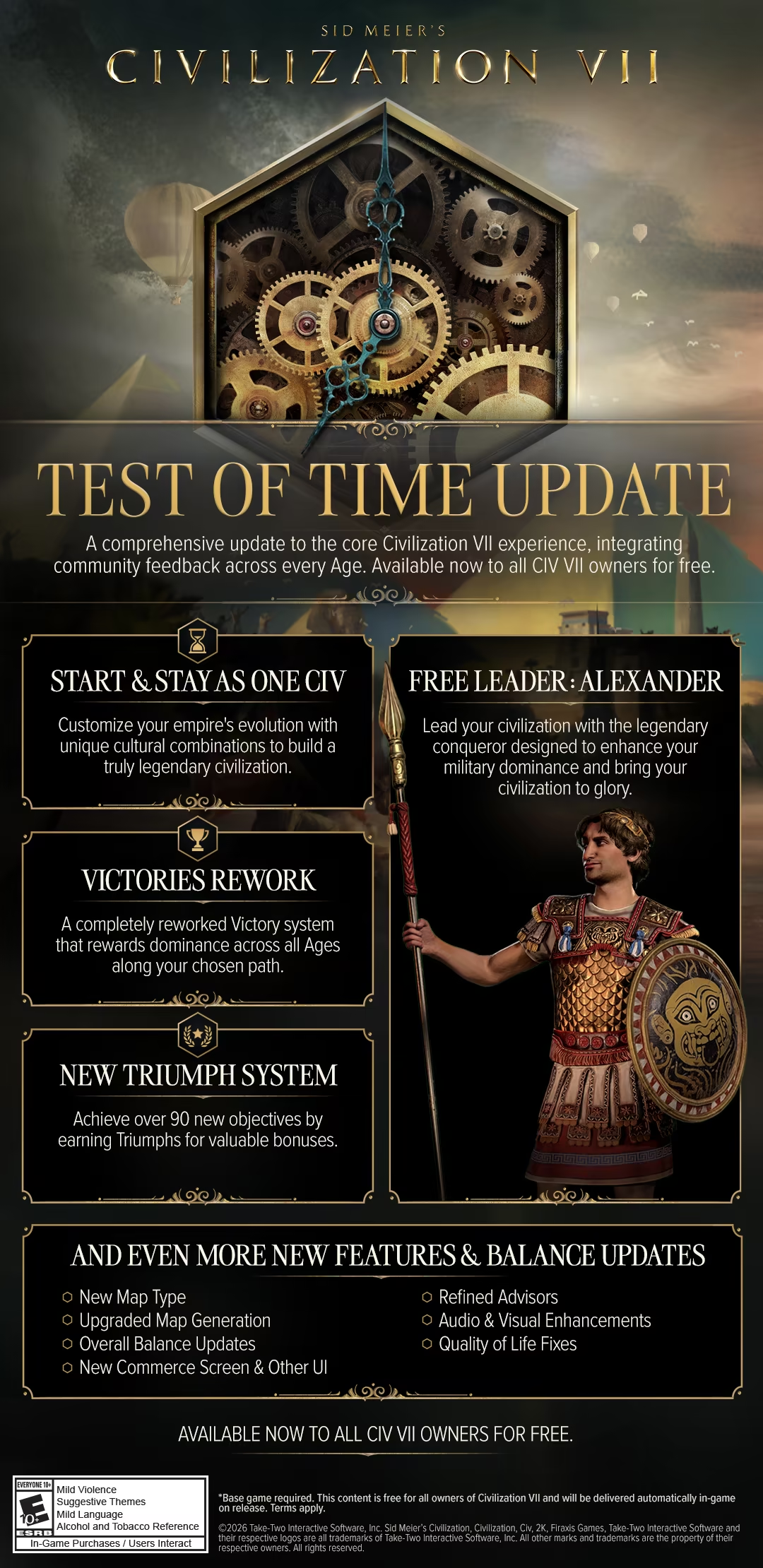
Lead your empire through distinct Ages of human history. Across the Antiquity, Exploration, and Modern Ages, choose whether to lead one Time-Tested civilization from start to finish, have it strategically evolve to flourish with a new identity in the next Age, or split the difference through hybridization. As accomplishing scientific, cultural, militaristic, and economic milestones within each Age unlocks advantages in the next, you'll decide how and when your empire's identity and strategy develop.
CHART YOUR OWN PATH TO VICTORY
Shape your empire's unique story by pursuing a wide range of distinct Triumphs, attribute-based objectives that offer a player-driven experience. As each new Age expands the game's scope, it also brings opportunities to borrow elements from other civs, unlock new bonuses, and achieve Victory in myriad new and exciting ways. Order Commanders to move armies as one, engage enemies with revamped combat mechanics, equip swappable leader bonuses across campaigns with Mementos, and much more.
PLAY AS VISIONARY LEADERS OF PROGRESS
Embody illustrious leaders with one of Civilization's most diverse rosters yet, from traditional heads of state known for militaristic might or political prowess to visionaries who made lasting impacts on philosophy, science, human rights, and more. Your chosen leader will endure across the Ages, with a unique ability that can help reinforce or pivot your strategy from one Age into the next. For the first time in franchise history, leader selection is separate from your civilization, giving you the freedom to create all-new strategies by mixing and matching gameplay bonuses.
EXPLORE A WORLD VIVIDLY BROUGHT TO LIFE
Make your mark on a gorgeously detailed world! Your empire comes to life with a diverse range of cultural styles, represented across building architecture and Unit design. Traverse navigable rivers, explore the map's undiscovered reaches, and extend your borders with new Cities or specialized Towns. As your lavishly rendered territory expands, all of your scenic vistas, vibrant metropolises, and fledgling frontier territories will connect seamlessly across the ever-changing landscape.
TEST YOUR STRATEGIC METTLE IN MULTIPLAYER
Compete against other players online and prove your prowess as a great leader.* Multiplayer matches can be epic multi-Age campaigns or take place in a single Age, and cross-play is supported between PC and consoles, so you can play together with friends wherever they are.
*Online play and features (including progression bonuses) require an Internet connection and 2K Account (minimum age varies). Up to five players supported in the Antiquity & Exploration Ages. Up to eight players supported in the Modern Age. Map size restrictions may apply to certain cross-play multiplayer games. Terms apply.

Add-ons
Each DLC is estimated with the same model as a game, then summed — a modeled figure, not reported DLC sales.
Updates
Build ids and update times come straight from Steam's PICS — the same source SteamDB reads. Patch history grows as we record new builds.
Engagement
Reviews
Themes across 2483 recent reviews and how positive each mention is. A keyword signal, not full sentiment analysis.
Reviews
Also a long time Civ Player here. This game is a waste of time. Its just boring. I dont even want to spend the time on proper feedback. See for your self.
Przeczytałem trochę negatywnych recenzji tej gry i z niektórymi się zgadzam, ale ciągłe porównywanie CIV VII do CIV VI nie pomoże. Gra różni się od CIV VI, ale trzeba się tylko przyzwyczaić. Bez żadnych DLC jest mało cywilizacji i przywódców, ale odkąd można grać jedną cywilizacją od pierwszej ery do ostatniej, to trochę się poprawiło. Grafika i muzyka są super. Niektórzy uważają, że wprowadzenie er było błędem, lecz nie zgadzam z tym stwierdzeniem. Oto powody. Można wybrać jakiegokolwiek przywódcę i jakąkolwiek (nawet niepowiązaną z nim) cywilizację, co uważam, że jest super. Jeżeli uważasz, że cywilizacja, którą masz świetnie pasuje do przywódcy, którego wybrałeś możesz ją zachować do ostatniej ery ( nie jak wcześniej). Serie CIV nawiązują do historii jaką znamy, a gracze chcą żeby były one realistyczne (przynajmniej tak uważam). Ery idealnie pasują do tego. Cywilizacje w historii zmieniały się wraz z czasem (np. Cesarstwo rzymskie, a dzisiejsze Włochy) tak samo jest w CIV VII. Relacje z przywódcami które wcześniej były okropne, później mogą być przyjazne (po zmianie er) Inne cywilizacje prowadzą w antyku, a inne w epoce odkryć czy nowożytnej. Jak już o erach, to chciałbym powiedzieć, że każda z nich ma swój urok. W epoce antyku odkrywasz i zaludniasz swój kontynent. W epoce odkryć zaludniasz i okrywasz drugi kontynent.(co pasuje do kolonizacji jaka się kiedyś działa) Natomiast w epoce nowożytnej odkrywasz artefakty co pokazuje ci, że to co ty dokładnie pamiętasz, czyli epoka odkryć i antyku, jest już historią świata, na którym grasz. Co też oznacza, że twoja przygoda z tym światem dobiega już końca. To był tylko ogólny zarys tego co się dzieje w trzech epokach. Chciałbym jeszcze dodać, że nowo dodani dowódcy są fantastyczni. Obchody też są fajne Jednak pomimo tych rzeczy gra ma też swoje negatywne strony. Nie ma rożnych sojuszy (np. naukowy) jak dawniej. Jednostki nie mogą już zdobywać doświadczenia (za to są dowódcy) jak dawniej. Relacje z przywódcami w epoce nowożytnej mogą się drastycznie zmienić przez różne poglądy (demokracja, faszyzm i komunizm) Nie ma realistycznych map jak wcześniej np. świat czy Europa Jednak tak jak napisałem na początku trzeba się skupić na tym co jest a nie na tym co było. Przez pierwsze 100 godzin gra średnio mi się podobała, ale wiedziałem, że to tylko kwestia przyzwyczajenia i ciągłego porównywania do CIV VI. Zobaczyłem też negatywną recenzję od kogoś kto grał pół godziny. Uważam, że trzeba najpierw poświęcić więcej czasu zanim napiszę się recenzję. Polecam kupić pomimo, że drogie, uważam, że się opłaca.
Media

Related
Related
Price dynamics, follower growth, revenue and sales trajectories with interactive tooltips
This and every other Pro feature is free until October 20, 2026. A free account is all it takes.
Related
| Game | Estimated lifetime revenue | Reviews | Review score | Price |
|---|---|---|---|---|
| $133.6M | 429.3K | 81% | $19.99 | |
| $133.3M | 262.7K | 92% | $39.99 | |
| $135.5M | 184.9K | 96% | $49.99 | |
| $130.2M | 180.5K | 83% | $39.99 | |
| $138.8M | 143.8K | 96% | $59.99 | |
| $129M | 1.1M | 98% | $9.99 |
Related
| Game | Estimated lifetime revenue | Reviews | Review score | Price |
|---|---|---|---|---|
| $4.8M | 3.8K | 67% | $39.99 | |
| $198K | 1.7K | 88% | $4.49 | |
| — | 0 | — | — | |
| $7.4M | 6.9K | 83% | $39.99 | |
| $156.9K | 368 | 80% | $7.99 | |
| $81K | 1.7K | 82% | $1.99 |
14 on sale1 answered “not sold”0 we did not ask
The 1 “not sold” market is read from the Steam price pass of Sep 21: that day the store answered for this game elsewhere and gave no price there. The 14 priced markets are the same rows as the table above — each the latest price we hold, dated here when it is older than that pass. The 0 marked “not asked” were not put to this store at all — either it has no storefront there or we do not collect it yet, and neither is a statement about the game. A refusal is a refusal on one day; a store can list a title again tomorrow.
Latest in each market: best PL #49, worst AU #96 · 13 markets collected
US · last 30 days
Reviews, worldwide (the counter carries no country): 52.86/day in the week to Sep 4 → 369.86/day in the week after.
Of the 6 markets with a position on both sides, 4 climbed and 2 fell. The same sale, the same day, opposite directions — which is why nothing here is averaged into a single arrow, and why one sale is not a trend.
Reviews, worldwide (the counter carries no country): 25.43/day in the week to Sep 3 → 360.29/day in the week after.
Reviews, worldwide (the counter carries no country): 20/day in the week to Aug 28 → 52.86/day in the week after.
Of the 2 markets with a position on both sides, 2 climbed and 0 fell. The same sale, the same day, opposite directions — which is why nothing here is averaged into a single arrow, and why one sale is not a trend.
Reviews, worldwide (the counter carries no country): 25/day in the week to Jul 22 → 37.5/day in the week after.
For scale, across Steam · Top Sellers · Brazil over the last 30 days: the 23 chart moves that followed a price cut of more than 20% went a median of 14 places towards #1, and the 2,515 moves with no price cut behind them went 2 away. One store, one chart, one country — it is the only place we have enough observations to say even that.
Prices outside the United States have been collected since 6 August 2026 and chart positions since 19 July 2026, so a cut older than that has no market to compare and a market that joined later has no history yet. Nothing here is converted between currencies.
Genres
Stats
All-time low is the lowest price we've recorded for this game since we started tracking it.
Languages: English*, French*, Italian*, German*, Spanish - Spain*, Japanese*, Korean*, Polish*, Portuguese - Brazil, Russian*, Simplified Chinese*, Traditional Chinese**languages with full audio support
Hours played at review time, across 2.5K reviews with recorded playtime.
positive critical· bar length = how often the theme comes up
Even with the update, still 6 > 7.
Meta progression? Absolutely horrible boxy, bland, brown UI? Confusing changes to gameplay, especially to city building - needing to drop gold on new settlements to turn them into cities else they can't use production? No British civs or leaders? I got as far as needing to assign resources to settlements for bonuses before giving up..
Imagine playing Civ V or VI and restarting every time you go into a new era. This game is just confusing and disorientating, and the UI is not helping.
Feel a bit scammed, was charged full price for an incomplete game... no modern military, oversimplified politics and game play. Should have just remastered Civ Vi.
The AI in this game is so bad, the game is not worth playing.
it is inferior to civ 6 in every aspect except the graphics
[h3]VII[/h3] [i]”My topic is the shift from 'architect' to 'gardener', where 'architect' stands for 'someone who carries a full picture of the work before it is made', to 'gardener' standing for 'someone who plants seeds and waits to see exactly what will come up’.”[/i] - Brian Eno, 2011 French theorists Gilles Deleuze and Felix Guattari reject the hierarchical nature of “arborescent” structures in favor of what they call “rhizomatic” structures, that of networks that can be connected to and from any point. Game designer and researcher Jesper Juul distinguishes “games of progression” from “games of emergence” in his essay “The Open and the Closed.” The original Civilization games had the courage to be games of emergence. Simple rules were created, and the consequences of those rules were allowed to run wild. They were cellular automata, complexity springing from simple conjecture. Thus, the games felt gigantic. The possibilities were manifold and endless. You could end up in a timeline where the Aztecs showed up off your coast with an aircraft carrier in the 17th century. Or, like the famous Civ II save game “Eternal War”, played thousands of turns over a decade, far past the typical end date, a world rendered a complete dystopia reminiscent of Orwell’s 1984, where three super nations contest a battleground where "ice caps melted 20 times.” The paths were vast and serpentine, each game truly the creation of a world, a universe, a timeline. Alas, Civilization VII feels small. Miniature. There is claustrophobia where there should be awe. The vast expanse of space and time both reduced to cramped room. This shrinking process was accidentally started by Civ V, where the (absolutely novel at the time) decision to switch to hexagons from squares and force units to spread out altered the scale of the map. Civ VI accelerated this, cramming a city-building game into a strategy game, giving value to land, making wonder-chasing a trap, and leaning into the cartoonish elements of the design (which, admittedly, on launch, I despised). But none of these approach the extent to which Civ VII diminishes itself. Turns take too long while the overall pace is compressed. The (too) many mechanics have almost no interaction with one another. Sure, the series and its conceptual underpinnings are under pressure, threatened by both the sophistication and (attempt at engagement with) pseudo-historical realism the Paradox school of grand strategy games contain, and the sheer Genesiacal inventiveness present in many indie colony simulators and roguelikes. Unfortunately, Civ VII attempts to compensate for the obvious anachronisms of large scale national-ish organizations existing when they could not, and persisting indefinitely across millennia, by garishly grafting artificial constraints onto the fabric of the game systems, without a thought for the notion that a world should feel like an ecosystem evolving by its own nascent accord. The emergent is destroyed in favor of the embedded. The lion is caged. The Ferrari is placed on a go-kart track. The “eras mechanic” is absurd, an arbitrary constraint that has no basis in human history. Eras, to the extent they exist at all, are not static deadlines, but results and symptoms caused by the collective actions of societies in staggeringly complex dynamic systems. Crises are not on rails, but emergent events. After vicious backlash, the updating of the game to allow game-spanning civilizations does nothing to remedy the flooded crumbling foundations upon which the structure is built. The world does not suddenly take intermission and awake to a new era. Literal billions of independent actors and cascading systems collide and forge a future. What’s particularly troubling about this is many of the game’s creators view themselves as sophisticated intellectuals resisting the consumerist philistine mob, when in fact they are agents of a publicly-traded, shareholder-return-maximizing behemoth, refusing to actually create generative systems whose processes might output their goals, pawns in their bosses’ publicly stated goal to cater to the lowest common denominator. If you want to make it harder for a single player to span 6000 years, then actually make it more difficult within the generative system. It’s always been entirely possible to change the basis on which Civ has been built, to move away from the Jared Diamond-esque geographic determinism and create a system for modeling human civilization built on Graeber/Wengrow (“rather than asking 'Why did inequality arise?', the most interesting question to pose about human history becomes ‘Why did we get stuck with it?’”) or Weber (“but fate decreed that the cloak should become an iron cage”) or Gibbon (“I have described the triumph of barbarism and religion”) or Spengler ("For every Culture has its own Civilization”) or Tainter (“in the evolution of a society, continued investment in complexity as a problem-solving strategy yields a declining marginal return”) or Khaldun ("dynasties have a natural life span like individuals”) or Braudel (“Events are the ephemera of history; they pass across its stage like fireflies, hardly glimpsed before they settle back into darkness”). But no, instead, we abandon the courage of generative systems for repetitive drudgery of branching narrative. The eras mechanic, the crisis mechanic, the time constraints, all of these decisions are, at their heart, acts of defensiveness. We might call them “verisimilitude theater,” “performative realism,” “ostensive realism,” or “corrective artifice.” If there is such a thing as an “overcorrection fallacy,” this is a showcase for it. Fixes that each trade one unrealism for another, much worse one. This is all especially depressing because certain specific elements of the game might be heart-wrenching instances of brilliance in another context. The craftsmanship and beauty present in some of the terrain tile design, almost Hudson River School-esque in their romantic evocation of landscape, would be an astonishing achievement if only the rules of the world around them were competent. These are hurt even more by the interface design existing as an abomination of disastrous proportions, a set of aesthetic crimes against taste and function that would force the average RISD professor to suffer a catastrophic mental break. Civ VI, of course, was a mess on launch, and an utter disappointment to many of the longterm players of the series, only to later find itself and undergo a reappraisal with many (myself included, though this reappraisal happened only after a complete inability to reckon with VII). Perhaps VII will follow a similar path, though if it does, I suspect it will be the players and modders who get it there, who play an emergent game unto itself, a sort of metacommentary on how you might fashion functioning civilization onto an unjust and uncaring world. What might it mean to fix a game that fails in its attempt at navigating the feeling of belonging to a living environment? French philosopher Jean Baudrillard might have said it best when describing his notion of the “hyperreal”, in reference to the map in Jorge Luis Borges's story "On Exactitude in Science" — [i]“Today abstraction is no longer that of the map, the double, the mirror, or the concept. Simulation is no longer that of a territory, a referential being, or a substance. It is the generation by models of a real without origin or reality: a hyperreal. The territory no longer precedes the map, nor does it survive it. It is nevertheless the map that precedes the territory—precession of simulacra—that engenders the territory, and if one must return to the fable, today it is the territory whose shreds slowly rot across the extent of the map. It is the real, and not the map, whose vestiges persist here and there in the deserts that are no longer those of the Empire, but ours. The desert of the real itself.”[/i]
I think this game is meant to close the franchise. the devs decided to drop a cheap, crappy game to rake in the $$ and call it quits. that is the only thing i can come up with of why this is a less than half measure of all the previous games. i bought it, i will play it. but this hurts my soul.
Active players
Estimated daily and monthly active players (DAU/MAU) modeled from peak concurrency.
Players by region
Where this game's players are, estimated from review languages.
Players also reviewed
The games this title's players most often review too — audience affinity.