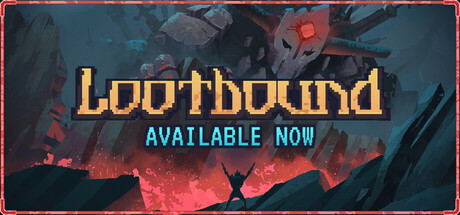
Lootbound is a tactical roguelite with turn-based combat, loot management and D&D elements set in a dark fantasy world. Fight dangerous enemies, collect epic loot, recruit allies and lead them on a path of adventure.
Modeled estimate, not a reported figure. How we estimate →
Prices
The United States storefront in every case, so this compares stores and not countries.
Prices
Each in the currency that store quoted — not converted: the gap between two rows is the publisher's pricing, not an exchange rate.
Every market we collect.
About
Every run starts with you alone.
As you move across the map, choose a route that leads to valuable loot. Along the way, you will meet companions who will help you fight this difficult battle!
You need to collect a separate set of equipment for the hero and each companion.
Items do not have fixed slots. You can rotate them and place them in the inventory as long as there is free space.
Items become truly powerful when they start affecting one another. Some items have auras that strengthen weapons or armor in adjacent cells.
Sometimes moving an item by a single cell is enough to change the entire build.
In combat, you control only the main hero.
Companions act on their own. They already know what to do...
At the end of each biome, you choose one of two boss parts.
Each part changes the Guardian's appearance and power. After completing all biomes, you will have to face the final boss.
Some rewards in Lootbound cannot be obtained just like that.
In special rooms, you are offered several options with different difficulty levels. The more valuable the reward, the harder it is to obtain with a dice roll.
Genres
Sums Steam only; Xbox publishes no volume signal, so the true total is higher by an unknown amount.
| Store | Price | Audience | Score | Chart | Est. revenue |
|---|---|---|---|---|---|
SteamYou are here | $14.99 | 1.3Kreviews | 77% | — | $713.5K |
| $14.99 | 41ratings | 90% | — | not modelled |
Matched by title — a reused name can pair the wrong games. * is a critic aggregate. Prices and positions are each store's United States storefront; Epic charts worldwide. Audience and Score too, except Steam's, which is worldwide.
Engagement
Reviews
Themes across 743 recent reviews and how positive each mention is. A keyword signal, not full sentiment analysis.
Reviews
喜欢玩杀戮尖塔的可以试试
Been having a blast playing the game. Started before the balance patch and boy did it help. Shout out to the developers for listening and not going overboard trying to adjust. Oh and Developers, you should give us a toggle for the turnaround poses. Because... Yeah. Who doesn't like a little cake.
Media

Related
Related
Price dynamics, follower growth, revenue and sales trajectories with interactive tooltips
This and every other Pro feature is free until October 20, 2026. A free account is all it takes.
Stats
All-time low is the lowest price we've recorded for this game since we started tracking it.
Languages: English, Russian, French, Italian, German, Hungarian, Indonesian, Spanish - Latin America, Simplified Chinese, Korean, Malay, Polish +8 more
Hours played at review time, across 745 reviews with recorded playtime.
positive critical· bar length = how often the theme comes up
バフ、デバフをうまくつかえば、けっこー楽に勝てます。一撃3万ダメージとか出ます。なので、おすすすめしない人のレビューはたぶん、まだ仕様をよくわかってないと思う。あとマナは余裕で余りますw。
This is a very innovative mix of genres, the first 10 hours were super fun, highly recommend buying it! It was very fun to wrap my head around the math of how the stats multiply off of each other and it definitely helped me make strong builds. Game runs very smooth, very nice graphics, good UI, nice tooltips, easy tutorial. With that being said, most of this review will be focusing on what can be improved, because I think the game has a lot of unrealized potential. For some background, I think I'm pretty decent at these types of games, and I beat difficulty 3 on the Witch without buying any long-term progression stuff to see if I could. (felt too easy) (Note: had to enable Proton experimental to get it to run on Linux, otherwise no issues) Here are my points of feedback, ordered based on how strongly I feel about them: - inventory management is tedious - problem 1: too many permutations to find min max solution - problem 2: sometimes optimal to transfer vampirism across characters to heal them, but doing it is annoying - solution: more rectangular items, fewer complex shapes. - solution: Remove ability to rotate. Forces player to make tough decisions, retains the feel of piecing together your inventory. (and for the love of god, please remove the "automatically rotates after combat" items, SO tedious) - solution: inventory profiles? ability to save a given setup and go back to it? Might be hard and/or clunky to implement. - runs feel samey, you can force builds, after you wrap your head around how to mult your damage, the game feels pretty solved - solutions: - adding A BUNCH of new items, e.g. - "+10 order for each item in your backpack" - "+10 chaos for each destroyed item this game" - "+1% crit chance for each enemy slain this game" - more characters - more mechanics - more nodes on the map - in-combat optimizations are annoying (restoring mana, restoring health) - solution: make it so that you're always rewarded most for finishing battles quickly - mana feels like a useless resource, deity events are no brainers to mana sac - solution 1: make default ability cost mana / make mana more scarce - solution 2: re-work mana so that it's also a multiplier on spells' base numbers (e.g. take a spell that deals 200 dmg and costs 0 mana; if you have 35 mana, then multiply dmg by 1.35, if you have 0 mana then just deals 200 dmg) - solution 3: make deity events so that you can't enter unless you have X mana - difficulty 3 is too easy - solution: add more difficulties after 3 or make current ones harder - feels like not much to do after a certain point - solution: implement global leaderboards? - combat speed too slow - sometimes I know exactly what I want to do each turn but have to wait 5 secs between enemy actions - solution: animation speed settings
I really like it <3
Lootbound is a tactical roguelite that makes the contents of your backpack almost as important as what happens on the battlefield. Developed by ArtDock and published by Dreland Enterprises, it combines turn-based encounters, grid-based inventory management, party building, randomized progression, and light tabletop-inspired elements within a dark fantasy setting. Instead of treating loot as a simple sequence of statistical upgrades, the game builds much of its strategy around deciding what to carry, where to position it, and which combinations can transform an ordinary collection of equipment into an effective build. A run begins with a lone adventurer, but that isolation does not last. Companions can be recruited while progressing through the adventure, gradually expanding the player's options and creating a party whose effectiveness depends heavily on preparation. Routes also present different dangers and potential rewards, so progression involves deciding how much risk is worth accepting. This gives each run a strong improvisational quality. The ideal item, companion, or opportunity will not necessarily appear when expected, forcing players to construct strategies from what they actually receive rather than endlessly pursuing a predetermined build. The inventory system is where Lootbound establishes its strongest identity. Equipment occupies physical spaces on a grid and can be rearranged to make efficient use of limited room. Items are therefore valuable not only because of their individual properties but because of how conveniently they fit alongside everything else. Finding powerful equipment can create an unexpected dilemma if accommodating it requires dismantling an arrangement that is already producing useful bonuses. Inventory management consequently becomes a genuine puzzle rather than a menu visited briefly between battles. This concept becomes more interesting through equipment auras and positional synergies. Certain objects can influence neighboring equipment, rewarding careful placement and experimentation. Moving an item can potentially strengthen one part of the build while disrupting another, making seemingly minor organizational choices strategically meaningful. Lootbound is at its best when the player discovers an interaction that allows several unremarkable pieces of equipment to become far more effective together. The pleasure comes from assembling a functioning system rather than simply watching individual statistics increase. Turn-based combat gives players enough breathing room to consider these preparations, although party control works differently from a traditional tactical RPG. The primary hero receives direct attention while companions operate with greater automation, shifting much of the player's influence toward how those allies are equipped and incorporated into the overall build. Different approaches to damage and defense encourage specialization, and character development adds further consequences to decisions made during a run. This design makes preparation inseparable from combat effectiveness. A clever inventory can make encounters feel manageable, while poorly coordinated equipment can expose weaknesses very quickly. Randomized events and dice-oriented decisions add another layer of uncertainty. Better potential rewards may demand accepting greater risks, creating choices that resemble the tension of tabletop adventuring. These situations complement the roguelite structure because the correct decision changes according to the condition of the current party. A powerful group may be able to gamble aggressively, while a weakened party might benefit from choosing safer alternatives. Randomness remains important, but players are repeatedly asked to decide how much randomness they are willing to confront. One of Lootbound's more inventive concepts involves the Guardian awaiting the player later in the adventure. Choices made across different areas contribute to the characteristics of this eventual opponent. This means progression is not exclusively about making the player's party stronger. Decisions can also influence what the final challenge becomes. It creates an appealing sense of consequence because an option that looks harmless or beneficial earlier can help shape a confrontation that may interact differently with the player's completed build. The pixel-art presentation suits the game's mixture of classic fantasy and modern roguelite systems. Visual information needs to remain understandable because players spend considerable time examining equipment, comparing effects, reorganizing inventories, and planning combinations. The colorful pixel aesthetic gives enemies, heroes, and environments personality without distracting from the mechanical information that drives most decisions. The overall presentation feels designed around repeated runs where clarity is more valuable than excessive visual spectacle. Steam Deck compatibility is another positive aspect. Lootbound includes full controller support, and the developers have specifically discussed optimizing controller navigation, interface scaling, and fonts for the Steam Deck's display. They have also reported targeting smooth performance with relatively low power consumption. This makes the underlying gameplay particularly appropriate for handheld sessions, since turn-based encounters and inventory experimentation naturally suit portable play. There has been at least some player feedback that certain interface text can still feel small, however, so readability may vary depending on the player. It is therefore better to describe Lootbound as deliberately Steam Deck-friendly rather than assuming every aspect of the interface will be equally comfortable for everyone. The game's potential drawbacks largely come from the same mechanics that make it distinctive. Players who dislike reorganizing inventories may find the constant optimization tedious, while those who prefer complete control of every party member could be frustrated by the more automated behavior of companions. Roguelite randomness also means that some attempts will naturally produce more satisfying equipment combinations than others. Yet these characteristics are fundamental to the experience. Lootbound expects players to adapt, experiment, fail, and discover new interactions rather than follow one universally reliable solution. Overall, Lootbound succeeds most strongly as a game about building efficiency from uncertainty. Its combat, companions, equipment placement, item synergies, route decisions, risk-and-reward events, and evolving final challenge all contribute to the same central idea: every choice should influence the shape of the current run. Players who enjoy tactical roguelites, inventory puzzles, build crafting, and methodical experimentation should find plenty to appreciate. It takes recognizable genre ingredients and connects them through a surprisingly thoughtful equipment system, resulting in an adventure where organizing a backpack can be every bit as satisfying as defeating the creatures standing in the way. Rating: 8/10
Gdyby Slay the Spire i Backpack Battles miało dziecko to byłoby tą grą. Bardzo fajnie wykorzystane mechaniki znane z innych tytułów. Lootbound jest tym czego szukałem od dłuższego czasu. Największym plusem jest, że na trasie zdobywamy towarzyszy i zarządzamy ich ekwipunkiem, ale nie trzeba nimi sterować, bo walczą automatycznie.
A型の人には辛いかもしれない。 鞄拡張がないし装備の枠がごちゃごちゃでストレスになってくるし、真剣にやろうと思えなくなってくる
quite enjoyable gameplay with a stellar soundtrack. the dice rolling mechanics are fun and the interactions between the heroes makes the story even more cool.
*Playing on Asus Rog Ally Z1 Extreme* I've been loving this game so far, and I think it will be my go-to handheld game for the foreseeable future. It is polished and runs extremely efficiently for maintaining battery life. Overall, I'm loving the gameplay. More than enough variety in the first few runs so far. I like the dice roll factor on some decisions as it forces you to decide the risk/reward factor for the overall run. Only couple downsides right now is that it feels slightly content light to the point where I expect there won't be a ton of replay value once I clear everything, and there isn't enough variety in the enemies or their attack patterns. Generally, loving the experience and interested to see where they take it from this solid foundation.
Selling now
See how fast this game is selling right now — estimated copies and revenue per day from recent review growth.
Active players
Estimated daily and monthly active players (DAU/MAU) modeled from peak concurrency.
Players by region
Where this game's players are, estimated from review languages.
Players also reviewed
The games this title's players most often review too — audience affinity.
Related
| Game | Estimated lifetime revenue | Reviews | Review score | Price |
|---|---|---|---|---|
| $1.1M | 4K | 72% | $4.99 | |
| $428K | 1.8K | 79% | $9.99 | |
| $15.3K | 32 | 94% | $12.99 | |
| $1.2M | 2.7K | 82% | $9.74 | |
| $606K | 925 | 77% | $12.49 | |
| $239.5K | 747 | 93% | $9.99 |
Related
| Game | Estimated lifetime revenue | Reviews | Review score | Price |
|---|---|---|---|---|
| $713.6K | 3.6K | 91% | $9.99 | |
| $713.4K | 8.2K | 79% | $5.99 | |
| $713.8K | 1.7K | 92% | $19.99 | |
| $714.1K | 3.8K | 67% | $7.99 | |
| $714.2K | 952 | 96% | $29.99 | |
| $712.4K | 1K | 91% | $29.99 |