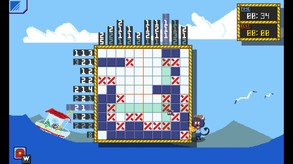
She's back just in time to do all the puzzles in your Sunday paper! It's a Khimera Nonogram adventure!
Modeled estimate, not a reported figure. How we estimate →
About
Genres
Stats
All-time low is the lowest price we've recorded for this game since we started tracking it.
Languages: English*, Japanese**languages with full audio support
Engagement
Reviews
Themes across 46 recent reviews and how positive each mention is. A keyword signal, not full sentiment analysis.
Reviews
[h1]Short Review[/h1] Khimera: Puzzle Island is a genuinely great nonogram game with a surprising amount of charm packed into it. The pixel art is excellent, the music is legitimately good, the story is more engaging than you'd expect from a puzzle game, and the puzzles themselves are polished and fair. The lack of an undo button is a frustrating oversight on the larger puzzles, and there's a minor gripe about the game sometimes giving away information too early, but those are small marks against what is otherwise a very well-made game. Recommended. [h1]Full Review[/h1] I'll be honest: I don't normally expect much from puzzle games when it comes to presentation. A lot of them treat art, music, and story as afterthoughts, focusing entirely on the puzzle design and calling it a day. Khimera: Puzzle Island doesn't do that. It commits to the whole package, and the result is a game that's more enjoyable to spend time in than most puzzle games have any right to be. [b]The art.[/b] The pixel art is excellent across the board. Landscapes, characters, the UI, all of it looks great and has a consistent visual identity that gives the game a lot of personality. The character designs in particular are charming and distinctive, which matters a lot when you're spending a good chunk of time with them. My only visual complaint is that the smaller puzzles can be hard to read once solved. It's not always clear what the completed image is supposed to be just from looking at the pixel art in those cases, which takes a little away from that satisfying reveal moment. [b]The music.[/b] The soundtrack is genuinely good. Not "acceptable background noise" good, but actually good. I found myself noticing and enjoying the music throughout, which is more than I can say for most puzzle games I've played. [b]The story and characters.[/b] For a nonogram game, the story is surprisingly solid. The cutscenes are well done, and the banter between the characters is legitimately funny and enjoyable. Everyone has a charm to them that makes the downtime between puzzles feel like a reward rather than a pause. It's the kind of writing that makes you actually care about finishing the game, not just completing the puzzles. [b]The puzzles.[/b] This is obviously the core of the game, and the design is polished. There are a lot of puzzles to work through across a good difficulty range, and crucially, the game is designed so that you should never need to guess. I played through the main story without hitting a single point where guessing felt necessary, which speaks to real care in how the puzzles were built. The hint items the game gives you are entirely optional and skippable for players comfortable with nonograms, but they're a genuinely useful accessibility option for newer players or harder puzzles. The gold time ratings are also fair and don't feel like they require perfection to achieve. One thing I did notice is that the game will occasionally gray out a number in a row or column before you could logically deduce it yourself. For instance, if you have a complex row, the game might confirm the position of one value before the logic actually supports that conclusion yet. It seems designed to prevent guessing, and I understand that, but it does feel like the game occasionally solves itself in small ways, which is a little iffy even when it helps you. The bigger issue for me is the complete absence of an undo function. On the larger puzzles, you can make a big move, realize you've made a mistake, and have no way to back out of it cleanly. That leads to a lot of frustration on the harder grids and is a notable missing feature for a puzzle game of this scope. [b]Overall.[/b] Khimera: Puzzle Island is a great time. The puzzles are well-designed, the presentation is way above average for the genre, the characters and story are genuinely enjoyable, and the music is a real highlight. The missing undo button is a genuine pain point that I hope gets addressed, and the occasional premature grayout is a minor design quirk worth noting. But neither of those things change the fact that this is one of the best nonogram games I've played, and I'd recommend it without hesitation to anyone who likes the genre or wants to try it for the first time. [code]If you liked this review, then feel free to check out my [url=https://www.youtube.com/@VinroyIsViral]YouTube Channel[/url] for more reviews. I also have a curator group called [url=https://store.steampowered.com/curator/43774503-The-Completionist-Crusaders/]"The Completionist Crusaders"[/url] that focuses more toward completionists. Thank you, and happy gaming![/code]
Media

Related
Related
Price dynamics, follower growth, revenue and sales trajectories with interactive tooltips
This and every other Pro feature is free until October 20, 2026. A free account is all it takes.
Hours played at review time, across 46 reviews with recorded playtime.
positive critical· bar length = how often the theme comes up
This is a REALLY good Nonogram game that's also got a bit of a sense of humor to it. Other than some weird controller input issues and bugs with the hint system it's pretty good, but the difficulty spikes up quite a bit pretty early on in the game. But I have two problems: The first is that it feels like the puzzles in the game were designed to use the hints on purpose. For example, if you have a line where surrounding a couple of blocks with "X"s has a chance of actually being correct, you do it, and it'll fill out the hint on the top or left of the screen. And that'll give you more info on what to do next. The second is that the hint system sometimes freaks out and clears out numbers that were already automarked as completed because you added or removed something in the line. It's irritating and it means you have to pay attention so you don't make a mistake because of that. This is still a very solid game, despite that. And not only is there a campaign but there's four more multiple-segment puzzles to complete. As of this writing, it's taken me 17.5 hours to get all the story mode cleared up and have only done two of the giant mosaics. I'd say I have at least two, maybe three more hours to go before I clear the other two. Not bad for such a cheap game.
100 nonogram puzzles tied together with a simple narrative (plus a mosaic mode). Puzzles range from 5x5 to 20x15. Difficulty ramps up nicely. I found the last set of puzzles to be quite challenging. There is an "auto clues" setting to make things easier, plus you find items you can use to help you. I enjoyed it.
[i]Extremely[/i] charming picross. Simple as. Great jams, lovely set of characters, HIGHLY enjoyable art style and overall presentation. My nitpicks are pretty minimal; 1. the lack of a ruler/'automatic counter' as seen in some of Jupiter Corp's later entries made the 20x15s a bit iffy for me early on, and 2. I felt as though the mosaics were a tad [i]too[/i] large... but saying this is tantamount to saying "there's too much picross in my picross game," so. Y'know. Strong 10. If nonograms are at all your thing, get this one. Preferably [b]off[/b]-sale because five bucks for a game of this size and with this level of pizzazz is a damned steal as-is.
I enjoy it. It is entirely a picross game. If you were hoping for other kinds of puzzles, this is not the game for you.
Khimera: Puzzle Island, developed and published by Suits & Sandals, is a logic-driven puzzle game that builds its entire experience around nonograms while layering in a light narrative and a distinct sense of personality. Rather than attempting to expand beyond its core mechanic, it focuses on refining and presenting that mechanic in a way that feels cohesive, approachable, and consistently engaging. The result is a game that leans into familiarity but elevates it through presentation and pacing. The foundation of the gameplay lies in classic nonogram puzzles, where players interpret numerical clues to determine which squares in a grid should be filled in to form an image. The rules are simple to grasp, but the challenge emerges from the increasing complexity of the grids. Early puzzles serve as a gentle introduction, guiding players through the logic step by step, while later stages demand greater attention and careful deduction. The difficulty curve is well managed, allowing players to build confidence before encountering more demanding scenarios. This gradual progression makes the game accessible to newcomers while still offering enough depth to satisfy experienced players. A notable strength of the game is the sheer volume of content. With hundreds of puzzles of varying sizes, it provides a steady stream of challenges that range from quick, satisfying solutions to more time-intensive grids that require patience and focus. This variety helps maintain engagement, as players can choose between shorter sessions or more involved problem-solving depending on their mood. The inclusion of additional modes beyond the main progression further extends the experience, offering alternative ways to interact with the puzzles and reinforcing the game’s replayability. What sets Khimera: Puzzle Island apart from many other nonogram titles is its narrative framework. The puzzles are tied together by a story that follows a group of characters exploring a mysterious island, with each completed puzzle contributing to their journey. While the narrative is not particularly complex, it adds context and continuity, giving players a sense of progression beyond simply solving grids. The dialogue is light and often humorous, providing moments of personality that break up the gameplay without becoming intrusive. This integration of story and puzzles creates a more cohesive experience than a purely abstract puzzle collection. The visual presentation enhances this sense of cohesion. The pixel-art style is colorful and expressive, with completed puzzles revealing detailed images that serve as both rewards and narrative elements. Character designs are distinctive, and the environments, though simple, contribute to the overall atmosphere. The clarity of the visuals ensures that the puzzles remain easy to read, which is essential for a game built around careful observation and logical reasoning. The aesthetic strikes a balance between charm and functionality, supporting the gameplay without overshadowing it. The pacing of the game is deliberately relaxed, allowing players to approach each puzzle without pressure. The absence of time limits or penalties encourages a thoughtful, methodical approach, making the experience feel calm and almost meditative. This design choice aligns well with the nature of nonograms, where the satisfaction comes from gradually uncovering the solution rather than racing to complete it. At the same time, the increasing complexity of later puzzles ensures that the game remains mentally engaging, providing a steady sense of challenge. However, the reliance on a single core mechanic also introduces limitations. While the puzzles are well-designed, they do not fundamentally change over time, which can lead to a sense of repetition during extended play sessions. The narrative, while enjoyable, is relatively light and may not provide enough depth to sustain interest for players who are not already invested in the puzzle-solving aspect. As a result, the game’s appeal is closely tied to the player’s enjoyment of nonograms themselves. Despite this, Khimera: Puzzle Island succeeds in delivering a focused and polished experience. It understands its strengths and builds around them, offering a large collection of puzzles supported by a charming presentation and a steady progression. The combination of accessibility, variety within its scope, and a light narrative framework makes it a satisfying experience for its intended audience. In the end, Khimera: Puzzle Island stands as a strong example of how a familiar puzzle format can be elevated through thoughtful design and presentation. It may not offer innovation in its mechanics, but it provides a consistent and enjoyable experience that is easy to engage with and difficult to put down in short bursts. Rating: 8/10
Adorable game. I've played a lot of picross in the past so it wasn't terribly difficult to me, but this isn't a bad thing. I'd say it's an excellent game for people wanting to get into this kind of puzzle. It has a lot of items to use to help you out and customizability otherwise. I'd never heard of the prior game before but this didn't hinder my experience. It's just fun easy going puzzles with the frame of cute girls getting into shenanigans.
Only real gamers play the puzzle game spin-off for 20 hours before playing the original
This is probably my favorite picross/nonogram game I've played! The puzzles themselves are super fun to play, the art is incredibly charming and well made (I love how cute these characters are), the music is always jamming, and there's quite a bit of content to get through! Would absolutely love if these devs decided to revisit a puzzle game like this again cause I haven't found a game that hits the sweet spot as good as this one-
It's fun to mull over how this game asks for even a dollar over the game that it's spun off from (which sits at a steep price tag of "nothing") but in terms of polish, content, and overall feel of quality, this would be a steal at 2x $5... for picross addicts, so be apprised of any extant biases. I have what that the layman would refer to as a "metric ♥♥♥♥ ton" of picross games between like 10 platforms, just so you're aware of the addictive proclivities of the ♥♥♥♥♥♥♥ writing this review. Like, there is a ridiculous amount of puzzling action here and going thru the first few steps of revisiting it, I feel like the only way I was able to finish the campaign the first time around was because I was locked in a 15 x 12ft Airbnb in the Upper West Side for my job for over a month in 2021. The campaign grids rank you on time and usage of power-ups or aids, so even completion gives way for repeat playthroughs for them cookies (tho this usually culminates in shallow contests of rote recall.) There's a lot... A LOT. And that's in addition to a [i]bulk[/i] of post-campaign mosiac puzzling to do, but I'd only gotten about 1/5 (probably) the way thru those. Or, at least I would have, if this game were polite enough to Cloud Sync, but Khimera's rudeness exceeds her penchant for [strike]punching[/strike] puzzling, it seems. My beautiful save file... Plays well on my laptop - even the potatotop I was using years back; not so great on touch UX/stylus, but it does offer remappable controls for those D-Pad ride-or-dies.
Selling now
See how fast this game is selling right now — estimated copies and revenue per day from recent review growth.
Players by region
Where this game's players are, estimated from review languages.
Related
| Game | Estimated lifetime revenue | Reviews | Review score | Price |
|---|---|---|---|---|
| $1.3M | 4.1K | 95% | $14.99 | |
| $112.2K | 2.1K | 88% | $6.99 | |
| $19.6M | 86.5K | 96% | $9.99 | |
| $5.4M | 59.2K | 98% | $5.99 | |
| $4.6M | 10.8K | 95% | $17.99 | |
| $4.1M | 14.2K | 92% | $19.99 |
Related
| Game | Estimated lifetime revenue | Reviews | Review score | Price |
|---|---|---|---|---|
| $23.2K | 148 | 74% | $6.99 | |
| $23.2K | 124 | 98% | $4.89 | |
| $23.2K | 435 | 84% | $2.49 | |
| $23.2K | 218 | 79% | $5.49 | |
| $23.2K | 93 | 48% | $6.99 | |
| $23.2K | 186 | 92% | $6.99 |