SCORE: ★★★★
★ =Hated It | ★★ = Disliked It | ★★ = Liked It | ★★★★ = Loved It | ★★★★★ = All-Time Favorite
THE BREAKDOWN
+A fantastic twist on the Darkest Dungeon formula that flips the entire structure on its head
+A wide variety of powerful and interesting units
+Enjoyably melodramatic protagonist that's a level of evil gamers rarely get to play
-There's not much meat to the writing and the worldbuilding's a bit dry
-Lategame progression gets a bit bogged down in an increasingly unwieldy interface
In 2016, Darkest Dungeon broke ground on a form of roguelite that wound up resonating with a massive audience, selling millions despite its difficulty due to the powerful combination of a loquacious narrator, exciting combat, and distinct heroes. I remember at the time being confident that this would be the birth of a new subgenre of 'Dungeon-likes' that took advantage of this combination of procedural generation, party dynamics, and the opportunity for uncovering mysteries through gradually revealed lore. Unfortunately, my dream of this new world - this rogue state, if you will - didn't quite come to pass, but gems like Iratus: Lord of the Dead remind me that there's still studios out there innovating on the concept.
In an inversion of Darkest Dungeon's tale of adventurers gradually delving deeper and deeper into the earth, Iratus starts the player at the bottom - literally. Iratus (the man, not the game) is a powerful necromancer who was defeated ages ago by a party of noble heroes; unable to kill him for good, they chained him miles beneath the earth in a hidden tomb. Unfortunately for them, in the eras that have passed since, humanity has grown corrupt and decadent, and they inadvertently free him from his slumber when slave miners crack open his coffin. His rage at his defeat still very much fresh, Iratus kills his accidental rescuers and sets out to take revenge on the world of the living.
It's a delightful premise, even if the story doesn't do much more than set up the gameplay and get out of the way outside of a couple of cutscenes near the end. Iratus, however, is one chatty lord of the dead. Set up deep in the bowels of his former prison, he has plenty of dialogue and musings as he starts summoning the undead and putting them to work slaying his enemies and excavating the surrounding ruins to fortify his position. It leaves him in a similar role to Darkest Dungeon's infamous narrator, and while I can't say he's quite as memorable, I did enjoy just how gleefully evil the man is and how he has commentary about every unit the player can summon.
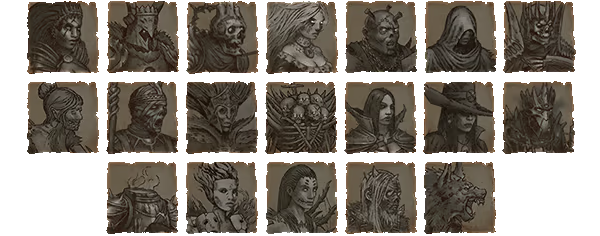
There's no lack of choice, either. As the game progresses, Iratus gains access to twenty different units, each with six possible abilities to use. Some, like the humble skeleton, are provided from the start. Others, like the fallen dhampir or the ice-wielding Unfrozen, have specific unlocking requirements. Some of these require beating the game on a certain difficulty, meaning multiple runs are required to explore every potential loadout, but others can be gotten by performing specific requirements, and this is where the system shines.
For those not familiar with Darkest Dungeon's Stress system, the horrors that the player's adventurers faced would build a meter that at the 50% point would cause them to potentially go insane and develop a crippling defect, with a small chance at shrugging it off and bolstering their team with their own virtue. At 100%, it could give the character a heart attack, killing them instantly, making managing Stress one of the game's primary mechanics. Continuing the theme of inversion, Iratus, being the villain of this particular story, is the one inflicting terror with an equivalent mechanic called Sanity. That fallen dhampir I mentioned? It's unlocked by killing enemy dhampirs' squads and leaving them as the sole survivor, then driving them insane with terror until they break and join your team. It's a delightful bit of role-playing, and serves the function of encouraging developing multiple teams in an organic way. Some enemy squads are tanky, but have shaky sanity due to their own problems. Instead of trying to tear down their defenses, I'd deploy my squad of horrifying spectres and turn them into gibbering lunatics.
Iratus is also pretty hands-on; though he isn't playable himself, the necromancer is all too eager to employ his alchemic know-how and mastery of sorcery to lend his minions aid or destroy his enemies. As the game progresses, the player unlocks a wide variety of spells that can reposition units, deal damage, buff and debuff, and more. There's also another degree of synergy here; some of the unit skills might be weak when it comes to hurting opponents, for example, but they generate more resources for Iratus to cast directly with. Once again, it's an impressive level of customization to one's playstyle, though I did find that by the time I was late in the game, the sheer number of buttons on my interface was getting a little bit out of hand. Unit stats and abilities, mana and rage resources, two pages of spells, another page of potions, turn order - it's not that it's necessarily too much on its own, but I found that the interface - while thematically gothic and brooding - didn't help much in terms of clarity.
There's a lot going on outside of combat, too, and thankfully I didn't have any problems with the interface there. Looting enemies for their remains lets you build and upgrade units with better-quality parts, and Iratus' base of operations expands through an enormous underground cavern that unlocks benefits by assigning or sacrificing minions to different locations. The sanity mechanic only affects enemies, too, which is both convenient and makes sense; I don't think my cannon-wielding zombie is really prone to trauma. As a result, there's little need to provide succor to your squad after a mission and the focus is on upgrading or replacing them with stronger options.
I just wish that I cared more about what was going on. Despite not being a particularly story-driven game, Darkest Dungeon got a lot of mileage out of its rich lore and narration. While Iratus' musings on how much he hates the living were often entertaining, there's only the barest skeleton (heh) of an actual plot here, mostly revolving around the balance of good and evil and the necessity of the death. I think what bothered me is that what's there isn't actually bad; the writing is enjoyable, and I was curious about the world I was slowly razing my way to the surface of, which made me a little frustrated that I didn't get more of it.
Still, I can't recommend the game enough. The combat feels well-balanced despite the large number of playable units, and while there's still some roguelite foundations, I found that permanently losing a run was nearly impossible as I always had enough parts to build a new team and implant them with brains that helped them start at a higher level. If you're craving a Darkest Dungeon-inspired experience that has its own twists or you just like those all-too-rare opportunities to be a gleefully villainous protagonist, Iratus: Lord of the Dead is a gloriously, goriously ghoulish time.