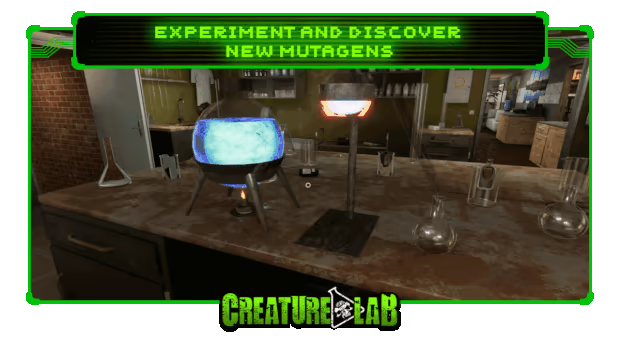
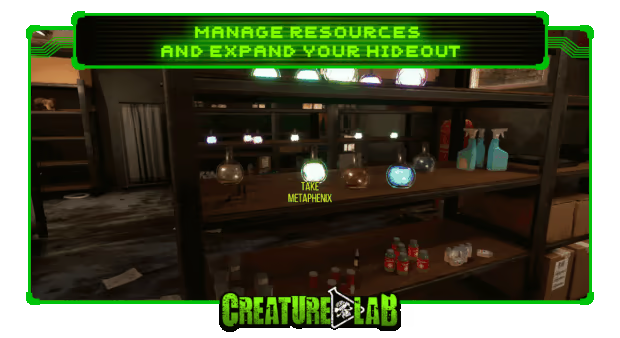
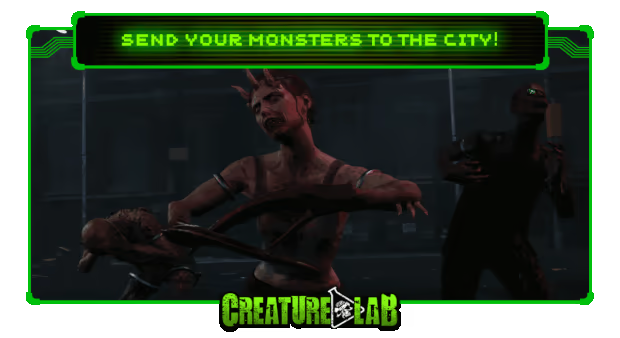
Become a mad scientist! Conduct crazy experiments, mix mutagens, breed abominable creatures, and attach monstrous body parts to them. Manage your inventory, expand your lab, and make sure your hideout is safe. Send your creations into the city to obtain salvage and test subjects!
Modeled estimate, not a reported figure. How we estimate →
Prices
The United States storefront in every case, so this compares stores and not countries.
Discounts
Every price cut of more than 20% we have observed, in each market that quoted one, with this game's chart position on either side of it. These are episodes, not a model: a sale is one event, and one event cannot tell you what the next one will do.
Reviews, worldwide (the counter carries no country): 0/day in the week to Aug 14 → 1/day in the week after.
For scale, across Steam · Top Sellers · Brazil over the last 30 days: the 25 chart moves that followed a price cut of more than 20% went a median of 10 places towards #1, and the 2,413 moves with no price cut behind them went 2 away. One store, one chart, one country — it is the only place we have enough observations to say even that.
Prices outside the United States have been collected since 6 August 2026 and chart positions since 19 July 2026, so a cut older than that has no market to compare and a market that joined later has no history yet. Nothing here is converted between currencies.
About


Add-ons
Each DLC is estimated with the same model as a game, then summed — a modeled figure, not reported DLC sales.
Sums Steam only; PlayStation publishes no volume signal, so the true total is higher by an unknown amount.
| Store | Price | Audience | Score | Chart | Est. revenue |
|---|---|---|---|---|---|
SteamYou are here | $19.99 | 410reviews | 54% | — | $250.9K |
| $19.99 | 155ratings | 61% | — | not modelled |
Matched by title — a reused name can pair the wrong games. * is a critic aggregate. Prices and positions are each store's United States storefront; Epic charts worldwide. Audience and Score too, except Steam's, which is worldwide.
Engagement
Reviews
Themes across 51 recent reviews and how positive each mention is. A keyword signal, not full sentiment analysis.
Reviews
Interesting at first. But soon the cracks show. researching things over and over: I placed A and B in a vial, So the new vial is A B, I don't need to research that. I get new ingredients, But every single time when you just simply combine.. Storage: I hate it. I like my things in order, Same vials if possible. Not stored all over the place. Not having an assistant: I can make monsters to gather but can't make myself an "Igor" ? :( Visuals: Gods they are ugly. Horns make no sense, I'm making mutants, Not demons from hell. Idea is great, the result.. less so.
too complicated for it to be fun, you dont control the creatures or watch them fight. just run around a lab
Media

Related
Related
Price dynamics, follower growth, revenue and sales trajectories with interactive tooltips
This and every other Pro feature is free until October 20, 2026. A free account is all it takes.
Genres
Stats
All-time low is the lowest price we've recorded for this game since we started tracking it.
Languages: English, French, German, Spanish - Spain, Japanese, Simplified Chinese, Polish
Hours played at review time, across 51 reviews with recorded playtime.
positive critical· bar length = how often the theme comes up
Unnecessarily complicated, half the time I don't know what potions to mix... If you love creating spreadsheets, you'll enjoy it, otherwise you won't.
This game is overly complicated for no reason, I just wanted to mix and match parts and make my monster attack things, a bit disappointed.
10/10 game idea BUT its honestly awful. Its incredible complicated most of the time you run around looking for what you need just to realize you dont have what you need so you send you monsters and get stuck on the hidden computer. I played that 4h and didn’t even get past the tutorial because i keep getting stuck and don’t get me started on the bugs. I had to close and reopen this game like 50 times. It keeps shutting down randomly aswell. If this game get a nice update, fixes all the bugs and updates the gameplay i‘m 100% in to play again but the way it is right now I can’t recommend buying or playing this game. Huge disappointment
Immediately exited the game after finding out that you can't even watch the mutants fight
Despite a complex tutorial that makes Creature Lab look like a deep science-puzzle game, the complexity ultimately feels completely meaningless. You can beat the entire campaign by mixing practically anything at random, proving that the intricate systems lack any real depth and just mask a long chain of chores. To make matters worse, mutant combat isn't even real gameplay—it's just text and numbers ticking on a screen, making the entire experience a major letdown.
Пичально что русификатора нету
Creature Lab is an ambitious first-person simulation that leans hard into the fantasy of being an outlaw genius conducting forbidden experiments at the edge of science and morality. Developed by Image Power S.A. and published by Image Power S.A. alongside HeartBeat Games and PlayWay S.A., the game sets out to merge laboratory micromanagement, experimental crafting, and high-level strategic decision-making into a single experience. Its premise is immediately striking: rather than managing a clean, orderly research facility, you inhabit a grimy hideout where unstable chemicals, stolen equipment, and half-finished experiments define your daily routine. The core of the experience takes place inside your laboratory, where experimentation is both the primary mechanic and the main source of tension. Players gather chemical compounds, analyze mutagens, and combine ingredients to produce unpredictable biological effects. Mixing substances is intentionally opaque at first, encouraging trial and error and reinforcing the fantasy of reckless scientific discovery. Success yields new creature traits, abilities, and behavioral modifiers, while failure can result in wasted resources or unstable outcomes. This process is tactile and deliberate, requiring attention to symbols, reactions, and experimental results rather than simply following predefined recipes. Creature creation is where the game’s identity truly comes into focus. Rather than producing standardized units, players assemble grotesque beings from modular parts and mutagen effects, shaping how they perform in the wider game systems. Each creature functions as both a product of your research and a strategic asset, with traits influencing their effectiveness in missions, survivability, and overall utility. The sheer number of possible combinations gives the impression of deep creative freedom, even if many outcomes eventually begin to blur together mechanically. Beyond the lab, the game expands into a broader strategic layer that represents the outside world. Creatures can be deployed into the city to collect resources, distract authorities, or escalate conflict when pressure mounts. These operations are handled through abstracted mission interfaces rather than direct control, emphasizing planning over spectacle. While this approach fits the simulation-focused design, it can feel anticlimactic, as the payoff for building elaborate monstrosities is often reduced to text-based results and progress meters instead of dynamic encounters. An important source of tension comes from the game’s threat management systems. As experiments grow more extreme, attention from authorities increases, forcing players to balance ambition with caution. This creates an ongoing risk-reward loop where pushing too far too fast can lead to raids, setbacks, or total failure. The idea is strong thematically, reinforcing the fantasy of operating on borrowed time, but the mechanics themselves can feel uneven, sometimes punishing experimentation without providing clear feedback on how to mitigate risk effectively. Visually, Creature Lab adopts a grim, industrial aesthetic that suits its subject matter. The laboratory is cluttered, dimly lit, and intentionally uncomfortable, filled with tools, containers, and devices that reinforce the sense of barely controlled chaos. Liquids swirl convincingly in containers, and the interface elements are designed to resemble improvised scientific equipment rather than clean digital readouts. While this atmosphere is effective, it can also contribute to visual noise, making navigation and interaction feel awkward during longer sessions. The interface and onboarding are among the game’s more divisive aspects. While the systems themselves are relatively deep, explanations are often minimal, leaving players to piece together mechanics through experimentation alone. For some, this reinforces immersion and discovery; for others, it creates unnecessary frustration, especially when complex systems like mutagen symbols or creature modifiers are poorly explained. The learning curve is steep not because of mechanical depth alone, but because of limited guidance in the early hours. Narratively, the game provides just enough context to frame your actions without pushing a fully realized story. Motivations, rivalries, and personal stakes are hinted at through brief text and environmental cues, but they rarely take center stage. The focus remains on systems rather than storytelling, which suits players who enjoy sandbox experimentation but may disappoint those looking for a strong narrative arc or memorable characters beyond their own creations. In the end, Creature Lab is a game driven more by ideas than polish. Its vision of mad science as a slow, risky, and obsessive process is compelling, and the act of experimenting with mutagens and creatures can be genuinely engaging, especially in the early hours. However, repetitive loops, abstracted outcomes, and rough edges in presentation and clarity limit its long-term appeal. For players drawn to unconventional simulations, dark themes, and experimental systems, Creature Lab offers a distinctive and memorable experience. For others seeking tighter feedback, stronger narrative payoff, or more hands-on action, it may feel like a fascinating concept that never fully evolves into something greater. Rating: 5/10
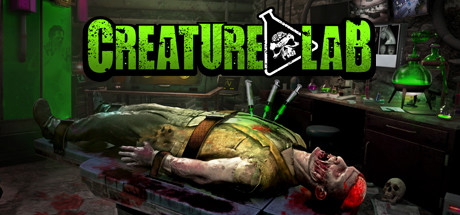
If you ever wanted to be Frankenstein and make your own monsters, here ya go!!! Do dangerous experiments and don't let your monster kill you.
Players by region
Where this game's players are, estimated from review languages.
Players also reviewed
The games this title's players most often review too — audience affinity.
Related
| Game | Estimated lifetime revenue | Reviews | Review score | Price |
|---|---|---|---|---|
| $33.1K | 166 | 89% | $5.99 | |
| — | 0 | — | — | |
| $386.5K | 1.7K | 74% | $5.99 | |
| $295.3K | 1K | 63% | $9.99 | |
| $133.7K | 583 | 95% | $5.99 | |
| $57.5K | 90 | 61% | $14.99 |
Related
| Game | Estimated lifetime revenue | Reviews | Review score | Price |
|---|---|---|---|---|
| $250.8K | 216 | 59% | $49.99 | |
| $251.1K | 2.2K | 94% | $2.79 | |
| $250.8K | 1.1K | 92% | $11.99 | |
| $251.2K | 4.7K | 67% | $4.99 | |
| $250.6K | 2.3K | 51% | $4.99 | |
| $250.6K | 287 | 78% | $24.99 |