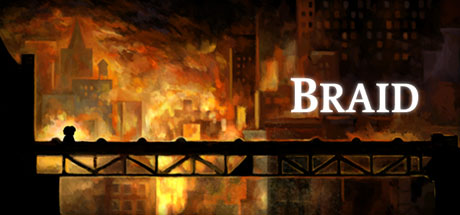
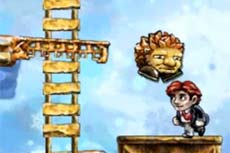
Braid is Jonathan Blow's breakout indie game gem, with 2D puzzle-platforming gameplay interwoven with a pretty poetic story. The first time I played this months ago, it proved challenging, and I didn't beat it. Today, I restarted from the beginning and whooped the game's ass in a matter of hours.
The game is significantly short, but a tightly contained experience, and an ending which is so ♥♥♥♥♥♥♥♥ cool. Apart from one particular puzzle which didn't communicate it's rules effectively, every puzzle was greatly rewarding to figure out.
A note of praise I have is for this game's art, hand painted by David Hellman. (Cool ♥♥♥♥♥♥♥ name.) It is stunning, and really adds to the depth of the content taking place, back-dropping every puzzle with gorgeously rendered, vividly colourful artwork.
If you note my love for the Witness, this game is not quite the visual masterpiece which that game is, but if anything, it shows a strong start for Blow's sense for game design interweaving with his storytelling. There's a layer of thematic depth to whatever the man produces. His works are simple, yet deviously complex, and it makes me eagerly anticipate whatever third game he develops.
8/10
* * * * * * *
Below I will be discussing thematic and substantive material that's best observed blind. This game is ambiguous as all hell in it's presentation and any one given meaning could easily be read in many different ways. However it's rich with content, I feel free to provide my personal view on more complex aspects of the game. Spoilers ahead, nerds.
Jonathan Blow is a deconstructionist at heart, this game being a kind of post-modern Super Mario Bros. The major gimmick being one of the major thematic concepts the game provides, the manipulation of time. Holding shift (or whatever button assigned to the controller) immediately rewinds time, and it's played to a major effect, as it effectively eliminates any 'threat' the conspicuously goomba-behaviour 'enemies' may have held in other classic games. If you get hit, you can just immediately rewind time, and some puzzles actually require you to get hit to progress. But it's one of many ways Braid subverts common game design elements in 2D platforming games, and what we're to expect of the genre. The effect is a complete transformation of the way we think about how we can interact with simple mechanics.
Braid's narrative is laid out in text passages which allude to the stage's mechanics at hand, but also through it's environmental design. It tells the story of Tim, or, the boy, attempting to search for 'The Princess' or the girl, and those two elements of a traditional damsel in distress narrative are shattered when we consider their metaphorical implications. Starting on Chapter 2, Tim, as laid out in the narrative, is an academic scientist, searching for a princess, whom he somehow lost connection to due to 'a mistake.' But through the game's ending, the moment he gets close to her for the very first time, the game wholly subverts the damsel in distress trope, rewinding the entire ending and painting Tim as a monster chasing after something wholly elusive. Perhaps, one could interpret a closer nature of this unfolding relationship by reading each of the chapter's introductory cloud segments in reverse order.
The game's epilogue reveals the true nature of what Tim and 'The Princess' really represent as metaphors, and even then, hides that truth from the viewer in plain sight. What really, I'd like to highlight, is a matter of the altered perspectives contained within the hidden text passages, which are their own puzzles to crack. She could represent the victim of a relationship due to her significant other's ignorance, Mother Earth and mankind's destructive influence on her, or a perhaps concept of absolute scientific understanding and unity of fundamental law, or a mother to a son separated by age and understanding. What I highlight in these ending revelations, is the dynamic can only be seen when Tim is off-screen, facing away from these texts. The fact of the matter that this is hidden in such a way implies the impossibility of Tim ever seeing and contemplating the notion that his own perspective may be wrong. It's why so much of what we have come to know about traditional 2D platformers is challenged through the gameplay and design. Thematically, these concepts parallel each other.
For the sake of not bogging down this already lengthy review with details, every opening cloud segment preceding a chapter highlight's prose that alludes to the mechanics of the game. Chapter 2: Time and Forgiveness, is the only chapter which doesn't have a central gimmick, except for one star, which requires you to wait an hour and a half of real time to acquire. But it's also the introduction of certain concepts involving the rewinding of time. It's preceded by the notion:
[i]"What if our world worked differently? Suppose we could tell her: “I didn't mean what I just said,” and she would say: “It's okay, I understand,” and she would not turn away, and life would really proceed as though we had never said that thing? We could remove the damage but still be wiser for the experience."[/i]
The fact of the matter is that every mistake required to progress, is still made, and we may watch Tim die over and over again to obtain only a piece of a bigger picture. Despite the traversal of the fourth dimension, are we not to suggest that these threads don't continue? The presentation of the game itself is the only thing stopping the continuing trajectory of time, no other real, intermittent influence over the games world actually prevents Tim from his miserable death, and it's never established that Tim has 'powers.' Each chapter continues to introduce and expand upon a philosophical concept through it's gameplay.
It's of note that I couldn't be ♥♥♥♥♥♥ getting any of the stars. They are deviously hidden, and upon finding all of them, shows the constellation Andromeda. I don't know how this influences the thematic core of the game, but reading on Greek Mythology, it broadly creates many implications. Despite the alternate ending being such a sick reward, I'm not going to restart my already-beat campaign because one of them requires a sickening twist of pre-established mechanics. I wholeheartedly respect the artistic choice, but I have too many games I've yet to beat to bother, and my time on earth is limited. My apologies Jon.
But nevertheless, this was a wonderful experience.