
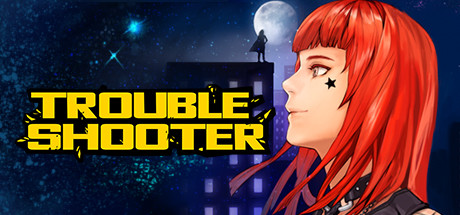
TROUBLESHOOTER: Abandoned Children is the first season of a turn-based strategy SRPG that takes place in the world of Troubleshooter.
Modeled estimate, not a reported figure. How we estimate →
Prices
Each in the currency that store quoted — not converted: the gap between two rows is the publisher's pricing, not an exchange rate.
Every market we collect.
Discounts
Every price cut of more than 20% we have observed, in each market that quoted one, with this game's chart position on either side of it. These are episodes, not a model: a sale is one event, and one event cannot tell you what the next one will do.
About
( * Unofficially supports translation for German, Italian, French. Those translations are written by gamers and some part of it is written by machine translation. You can select those translations in the game option. )
TROUBLESHOOTER: Abandoned Children is the first season of a turn-based strategy SRPG that takes place in the world of Troubleshooter.

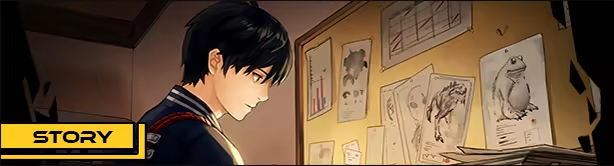
Valhalla is a free trading nation erected by three world powers for their own benefits after the world war. In an attempt to control the nation, the three world powers banned the army from Valhalla. Due to these circumstances, public order in Valhalla is always unstable and thus after ten years the Valhalla government made a bold decision.
The Valhalla government granted civilians the right to investigate and arrest criminals in order to lower the rising crime rate. People call them Troubleshooter.
10 years have passed since the introduction of the troubleshooter system. Albus, a 20-year-old young man, becomes an official troubleshooter. Albus first starts his company on his own but soon takes in many colleagues as he solves more cases. All these new members of the company have their own motivations and stories. You will be experiencing a variety of missions in Valhalla through their stories.
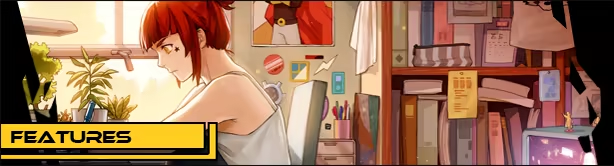
All characters in Troubleshooter have their own unique classes. Each character can rank up to the upper class, and the role of your character changes according to the class.
All characters in Troubleshooter can acquire various masteries according to their levels and classes. Furthermore, you can activate additional effects by combinations of masteries. Utilizing this, you can make a character for your unique strategy.
Such masteries can be acquired by leveling your character up. However, in most cases, you can acquire masteries from enemies. In other words, you can take your enemies' unique traits and apply them to your characters.
There are more than 100 unique missions in Troubleshooter. All missions are designed independently, and all of them have their own unique circumstances.
Troubleshooter uses more than 500 cut scenes to portray the story.
As new characters join your company, playable content will be unlocked according to their roles. For example, if you recruit a hunter character, you will be able to tame beasts. You will be able to craft drones if you recruit engineers.
※ We support offline mode, which is for those who have an unstable internet connection.
※ Multi-playing contents will be added continuously, and for safe and fair user information, we require your internet connection on online mode.
※ There will be updates and maintenances, which will be announced in advance. You will not have access to the online mode of the game during this time.
- Time Required: 2 hours (Can change)
- The period of the update can change according to the contents at work.
※ If you want to get more information about the game, please visit the Troubleshooter Discord channel (Unofficial).
-
Updates
Build ids and update times come straight from Steam's PICS — the same source SteamDB reads. Patch history grows as we record new builds.
Engagement
Reviews
Themes across 869 recent reviews and how positive each mention is. A keyword signal, not full sentiment analysis.
Reviews
This is a "yes...but" recommendation. The actual turn-based combat system is extremely fun, on that count it's one of the best X-COM likes I've played in a long time. The music and sound effects are excellent. But it's wrapped in a SRPG layer that's on the grindy side with lots of subsystems, and the pacing and scale are "off." By that I mean you don't get interesting characters until 10+ hours into the game, and some of the missions -- these aren't even boss fights -- drag on and on because of the number of units + map design. TROUBLESHOOTER is one of those single-player games that has several "momentum killers" you just have to push through. The devs respond to most reviews here, and it sounds like they've taken this feedback to heart. I look forward to the sequel because the combat system is really that good. Hopefully the sequel has full Steam Deck support as this style of game is perfect for it.
A deep and engaging SRPG with some innovative ideas. The mastery system is really fun to play around with and the combat is fun. Don't let the pile of DLC fool you. You only need the base game and Crimson Crow to see everything the game has to offer. At full price the game is well worth your money. On sale it's a steal if you like tactical RPGs like X-COM. The rest of the DLC is cosmetic or stuff like soundtracks and art books. I ended up buying all of it on sale to support the developer, but it isn't necessary to play and enjoy the game. Dandylion has done a lot of good things with this game, and they've continued to support it and add to it over the past 5+years. A sequel is in the works and I'm excited to see how they refine the formula and game play systems they created for Troubleshooter. If I had one complaint it's that the translation could be better. Hopefully they hire a professional for the sequel. Nothing deal breaking, everything is understandable here, but it's also slightly off in English. It's a minor gripe though and should not dissuade you from buying this immediately if you enjoy SRPGs! Edited: Thank you for the reply. Your dedication to making quality games is admirable. Whether you succeed or fail, you and the entire Dandylion team have my deepest respect for the effort and work you've done. I wish only the best for you and the team and hope the sequel is profitable so you can continue your excellent work!
Media

Related
Related
Price dynamics, follower growth, revenue and sales trajectories with interactive tooltips
This and every other Pro feature is free until October 20, 2026. A free account is all it takes.
Reviews, worldwide (the counter carries no country): 1/day in the week to Aug 4 → 2.57/day in the week after.
For scale, across Steam · Top Sellers · Brazil over the last 30 days: the 25 chart moves that followed a price cut of more than 20% went a median of 10 places towards #1, and the 2,413 moves with no price cut behind them went 2 away. One store, one chart, one country — it is the only place we have enough observations to say even that.
Prices outside the United States have been collected since 6 August 2026 and chart positions since 19 July 2026, so a cut older than that has no market to compare and a market that joined later has no history yet. Nothing here is converted between currencies.
Genres
Stats
All-time low is the lowest price we've recorded for this game since we started tracking it.
Languages: English, Korean, Simplified Chinese, Japanese, Traditional Chinese, Russian
Hours played at review time, across 872 reviews with recorded playtime.
positive critical· bar length = how often the theme comes up
this game is really amazing. it's without a doubt the best TRPG I ever played, and is a solid contender for the best indie game I ever played. the systems are really deep without being overwhelming, each character has a unique playstyle and the game just feels great to play overall. the mastery system allows you to tailor craft really interesting character builds that are almost always viable depending on what your team needs. for 8$ on sale, you will get hundreds of hours of value. the only negative thing I can say is that the game is a bit lacking on the tutorial side, so I had to use youtube a bit a the beginning to really understand the mastery system. like others mentioned, the translation can be a bit konglish sometimes but I personally didn't mind it.
Yet another game developer shows that being passionate, having a vision and actually caring about the art you create matters a lot more than nonsense like "having a budget" and "following trends". With innovators like MAIET, Hakkyu Kim, Project Moon and now Dandylion coming out of South Korea I'm starting to believe that Good Game Enjoyers:tm: need to pay more attention to releases coming out of that country in general. As an avid enjoyer of tactical RPGs(Tactics Ogre: LUCT being my favorite) I've been stuck in a limbo ever since Stella Glow for the Nintendo 3DS released where not a single game I played has fit my particular sensibilities in quite the way this one clicked for me. I've been obsessed ever since purchasing it and I regret not doing soon earlier. This is a masterpiece worthy of every cent I spent on it and probably more and I look forward to the sequel given the transparency we've been given with it so far. Finishing the review I'd just like to point out some random relevant(or not) observations I've made throughout the game that made me go "huh", spoiler alert below the line for obvious reasons (there is no rhyme or reason for any of what i wrote, apologies for my feedback being all over the place) ------------------------------------------------------------------- + I really like the immersion of things like having to pay your employees, pay rent, being unable to give alcohol to minors and a lot of mechanical decisions being decided by the development of the story. I like being given control of alternative units and building up our roster slowly while doing so, it lets you get used to the game without having to build a bunch of character pages and it makes the game feel way more real + The combat system is the love of my life and i could just farm random crabs for 600 more hours without a complaint in my head. It's so fun to play with character builds + Why is there always an edgy overpowered gun dual wielder in a trenchcoat? This is like a cultural pillar of South Korea or something and I'm here for it but it's so funny and specific to me + I like the idea of turning a single player campaign game into a pseudo-long term endgame live service by making it online and giving you a bunch of NPCs to farm reputation with and a bunch of little things to unlock like the baddies board and the masteries. it incentivizes me to keep playing for something even if i would play it just for the love of the game + The second DLC's constant references to "fixers" and "red mist district" had me going "Hm? There's no way, right?" + Albus is a good protagonist. This is SO RARE. you have no idea how ♥♥♥♥♥♥♥ rare it is to play a videogame that had me going "yeah you go protag man!!! you show them!! i'm cheering for you!" you have no idea how much it means to me to have a character be just a regular responsible adult and be actually interesting + The voice acting is actually REALLY GOOD? I would've loved to have more voice acting throughout the game, actually. I look forward to seeing what Dandylion does with VAs in the sequel ~ the hunter and the hacker having a minigame within themselves to customize little helpers are a very good class mechanic for replayability but please make the summoning action less clunky next time it's really sad that your character with the largest range and your character that can refresh other peoples turns(and thus wants to keep up the pace) are effectively left behind for having to summon their little guys turn 1 of most maps. summons should either be a free action the first time every battle at the very least, imo. Very minor grievance though ~ I appreciate that the characters are all unique and have their own many different builds, and I appreciate all the difficulty change options that the game offers, but I really wish recruiting "generics" was an option in the postgame for the purposes of experimentation with different classes and builds ~ I am confused by the ability to obtain certain weapons that can never be used by player characters. Especially because I was really looking forward to having an assault rifle or a bat character on my team! ~ Some of these animals/monsters have really unfortunate naming schemes when translated into English. I'm sure there was no ill intent from the devs and it's definitely a minor nitpick, but i'd consider looking into better localized names for the creatures in general, I think. None of them are curse words or directly slurs or anything, they just sound... Cacophonic? I guess is the best way I'd describe it ~ This game would benefit SO MUCH from randomly generated combats/levels. A simple roguelike mode would go so hard! - The default settings for the game felt very unintuitive and it definitely took me a bit to get used to the game's systems before I could understand what I was doing in the settings. Once I did, it felt a lot better to play throughout the rest of the game with stuff like grids and better ways to navigate maps. I definitely think there's some improvements to be done w.r.t. specifically the tutorial and the default set of options in the game to help new players. - There was an inkling of social commentary in this game and I was really looking forward to seeing that social commentary develop into something meaningful but I feel like the story was cut short too soon. I really liked the plot points that developed the different enemy factions into more believable people and I liked that the endings suggested there are deeper schemes happening at large, but... A few points I'd like to see explored more are things like 1. the corruption within the police, as well as the very clear manipulations happening behind the scenes by government entities to spur gang wars and such. 2. the fact that until the very end of the game our heroes were, for the most part, being led along as part of these plots, but they never quite got to figure it out or handle it? so it kind of ends on a note of "we became heroes for the shadow government that is making people miserable woo!" which is kind of a hopeless tone to end a story, I guess That's all, those are the two negative things I have to say about this game. I would proudly go out in public with a hero irene merch t-shirt if one such thing existed frankly. 10/10 would have liked to beat up more corrupt cops, thanks for existing in my life
这绝对是一款有门槛的战棋游戏(特别是习惯无脑推图的玩家需要适应期),但它的策略深度、角色魅力和真诚的叙事,是对得起你投入的时间和思考的。
When it comes to combat complexity, this is like the super smash bros of TRPG. You can get by with the basics, or go down the rabbit hole.
On the whole, very enjoyable, but that comes with some notable caveats. The art and art design was of great quality, though I felt it clashed with the story quite a bit. Particularly in every scene where your characters were alongside police forces. The police are wearing practical, efficiently designed tactical gear, as you would see on police in our world, while your characters are dressed as though they are about to go to a nightclub or something. It creates an odd contradiction. The story was... sub-optimal. Poorly written, partly due to it just not being well written, partly due to the English translation not being very good. I would suggest a translator whose first language is English, or at least with a fully fluent grasp of English, with the latitude to change some words to better express English colloquialisms might deliver a better result. The overarching story was fine, but as above, the way it was written, not so much. One area that wasn't so great was tutorials. The introduction to mastery research was not good, and it wasn't clear how mastery research functioned. Discovering the function of most mechanics felt like trial and error was more useful than the tutorial descriptions. Game mechanics were generally fine, once you figured them out. Combat was fine, and pretty easy to understand. Music was fine, not particularly to my personal taste, but it wasn't too intrusive. This might seem to be a generally negative review, but it is actually a fun game, I have just focused on the areas I would like to see improved in a sequel, or any expansions. As a whole the game works pretty well, and is enjoyable.
An underrated masterpiece. A hidden gem. Criminally overlooked. A diamond in the rough. How a small Korean indie studio managed to knock it out of the park on their first try, price it at a humble 25 USD, and support it over the years with free content (a whole extra chapter and new characters!) and an extra DLC chapter is nothing short of amazing. Better wordsmiths than I have put into words what makes it such a thrilling, addictive game, but I will try my best to do the game justice. The Mastery system is a game-changer in all aspects. The game encourages you to create absolute monster units by applying creative thinking and by mixing and matching the right masteries and set bonuses. This also means you have clear, definite progression, since the next level-up unlocks more slots on your mastery board, and new classes and enemies unlock new masteries. The other neat thing about the Mastery system is that it gives you plenty of freedom in how to build your characters and how you tackle the encounters. Enemy casts a party-wide buff that cause knockback and burning upon death? Equip anti-burn masteries, ranged skills, or inflict bleeding on them and kite them out. Goons have a skill that maxes out the damage they take at 50% of their max health? Invest in some multi-hit skills, give your ranged attackers the Fire Support mastery so they can follow-up on attacks, or create a dodge-counter tank to lure them in and finish them off with one AoE. This gets pretty crazy in the late game, but I genuinely enjoyed going back to the drawing board and coming up with ways to deal with new threats. Another thing that doesn’t get mentioned as much, but all playable characters are great and none of them feel underpowered, even on the hardest difficulties. Genuinely, a crazy feat. Another great thing about Troubleshooter is Quality of Life features. Big fan of games that go “Yeah sure, we got a Super Fast animation speed setting for you”. Researching masteries sounds like it’d be tedious and bothersome? Nah fam, we got that auto-research button for you. Wanna see if your sniper’ll be in range to hit that enemy over there if she moves to this specific tile without having to move and reload? Just hit that V key, brother. Have to retreat from a mission? You still keep your levels, some of the loot you got, and most importantly, retain intel on the enemy for the ingame Pokédex. Difficulty? Adjust it on the fly, whether you want to fight harder enemies for more loot and experience or want to have less mobs on the field so you can get past a tougher mission (I recommend starting on Hard and eventually veering to Cruel Mode around Chapter 5, going back and forth between the two as required). I think the story is just there for the most part, but it’s the characters that really shine in Troubleshooter. I love the way that characters (both protagonists and antagonists) have their own backgrounds and relationships with one another (some very neat twists/surprises) that we come to learn through both flashbacks and over the course of the story. There are certain parts of the game I’m less fond of, though. I understand why the game relies on quantity over quality when it comes to the amount on enemies per map (an average of 40-50 on Hard Mode, which dwarfs XCOM 2 numbers, for comparison), as your characters are just that strong, but I do think the curve is a bit uneven, as missions in chapters 2 and 3 really ramp up enemy density, but your clearing potential isn’t quite there yet, resulting in mission times ranging from 30 to 45 minutes. I would much rather the game have gone with more frequent use of stronger elite enemies, which A) provide more challenge; B) require less time per mission. The “Jigsaw” story mission is a good example of this done right: lots of unique bosses, backed by one or two minions each. The backup provided by police forces is appreciated in the beginning of the game, when you don’t have a full crew yet and your characters are meek, to say the least, but they quickly become liabilities and fall behind (literally) your actual crew. I think having more police unit types (like an ESP user for AoE damage, perhaps) or the ability to use your own masteries to upgrade or keep them up-to-date could be considered. Lots of other miscellaneous things I noted that bug me: the animation for going up and down stairs, boxes, ledges, etc. needs to be sped up becau—oh, their latest update on the sequel mentions them fixing exactly this. Nice. Things like certain types of equipment being dropped by enemies (why even have baseball bats and pistols and whatnot be in the loot table if no characters can equip it?), the quests all being three variations of the same concept (pick up crates, rescue the trucker, capture Javier), the arena mode being locked behind quests and barely being mentioned (which is a shame because it’s an excellent way to grind unique-exclusive masteries) are what I’d love to see ironed out in the sequel. But the biggest, and frankly, main problem with the game, is the English localization. Yeah, the dialogue is not idiomatic, but at least you get the gist of things, even if the whole Spoonism thing sounds exactly like you think it sounds. I’m less forgiving of mastery descriptions leading to ambiguity or tutorials on game mechanics going on for ten paragraphs and only creating further confusion. Improving the translation would make everything else about the game shine even further. An underrated masterpiece. A hidden gem. Criminally overlooked. A diamond in the rough. Go get ‘em Dandylion, I’ll be rooting for y’all.
I think overall this is a good game. The gameplay is great for turn based fans, the story is serviceable and the characters had me invested in their stories. The lore and world feels good, like one of those korean webtoons I usually read I was interested to know more about the world, especially when new characters popped up in cutscenes. My main issue with this game is it gets tiring and tedious. I have 77 hours so far and most of those hours are grinding the same maps over and over and over for side quests and materials and enemy info. The grind is rough, especially since maps are not short and can be long and drawn out, don't even get me started on the loot chests situation which can make the maps even longer trying to get all those chests. It seems the devs made a great single player game, but then felt the need to drop a RNG grinding system which is reminiscent of a free to play mmorpg/gacha game where it begins to feel like a tedious slog to get through. I play JRPGs so I am used to side quests spam, but on this game, I am already burnt out and have not even finished the story yet, that is not a good sign....
After 200 hours I think it's fair to say I've got plenty TO say about this game. The long and short of it is that while this title probably isn't for everyone, if it's something you enjoy you're going to have a great time. For me this was a solid 9/10. This game is a tactical turn based RPG in the isometric style of FF tactics, Fire Emblem, etc. Characters will move in turn across a grid battlefield and perform actions selected by the player, most often with the goal of defeating the enemy units on the field. When the player is not in combat they will manage a roster of characters by equipping gear and changing their abilities to develop a strategy that will allow that character to maximize their impact in battle. Effective gameplay involves making the right decisions, both in and out of combat, and mistakes are punished accordingly. There is no time limit on making decisions, so it's important to plan ahead and act with a strategy in mind. Combat missions often have you extremely outnumbered, so many of them can take a significant amount of time to complete. This title stands out from its competition by doing a few things differently: 1: There are a ton of simple mechanics to learn that will all be necessary to master the game. The game's systems seem expansive, but they are surprisingly easy to learn. In my opinion this was a great design choice, as it helps to keep the learning curve smooth and manageable. The end result is a level of character customization that is unmatched by just about any other title in this genre on the market. Systems include: Gear crafting, gear sets with set bonuses, monster taming (catch a wild creature to assist you in combat), machine building (get your own custom robot pet), targeted farming via story replay and extra missions if you need money or certain types of items, Character classes (with the ability to save multiple loadouts per character if you like to switch things up), multiple layers of passive abilities (most of which apply to the individual character, but some that also apply to the entire team), passive ability set bonuses (if you have certain combinations equipped you get bonus effects) and more! 2: Many missions allow you to utilize generic police units to assist you in combat. These units can be controlled directly, or set to a few different automatic behaviors if you don't want to bother. Unlike a lot of other games, these units are actually quite helpful in tougher missions. While they are unlikely to win the fight on their own, they provide enough assistance to make them feel like highly trained police officers, and valuable assets on the field. 3: Random enemies. Many missions (especially side missions) have rare enemies that pop up occasionally. These enemies offer unique rewards (like special passive abilities or crafting materials) that can help keep farming interesting. 4: Optional engagement. While the game has a ton of systems, on its easiest difficulty there's really no need to take full advantage of them. However, the more you learn the game the more you'll want to farm to engage with it. This game doesn't hold your hand when it comes to learning how to optimize your characters, so figuring out how to farm money or materials quickly requires you to actually use the tools the game gives you to study your opponents and work up a strategy. When you start to see how the systems work together it becomes a giant rabbit hole of discovery. The story is refreshingly "low-stakes" for a superhero setting, and the conflicts are firmly grounded at the street level. No Galactus type threats here, which means the storyline stays character driven. The writing is solid, the characters have clear motivations and pursue their goals accordingly, and the game spends just enough time on the story to give you context without taking too much time away from gameplay. However, it is important to note that the major plot line does remain unresolved (a sequel is currently in development). The graphics and music give the game a unique atmosphere I can only describe as "cel-shaded noir." Think Humphrey Bogart meets Golden Age Batman, but with significant Eastern influence. The vibe is immaculate, and does much to sell the game on its own merits. Areas I felt needed improvement: the amount of time needed to 100% this game is staggering. This is largely due to the fact that the massive number of passive abilities in this game are generally acquired from defeating enemies, many of whom need to be defeated multiple times to gain access. The character motivation system in this game seems like an idea that used to serve a purpose but was ultimately trivialized later. The only reason to engage with the system was for obsessive completionist purposes, and it had no impact on the difficulty of the game if ignored. Some of the storyline fights (the one on one duels in particular) are almost entirely up to RNG. There was very little I could do to make those fights feel like something other than a coin toss, although in most cases winning or losing did not have any impact on progressing through the storyline. Learning mastery sets requires a ridiculous amount of money, which means a ridiculous amount of farming. Whether you're just experimenting with random combinations, or buying recipes from the vendor, it all leads back to a massive currency sink that cannot be managed without running certain missions over and over again. Finally, some missions have some pretty crazy difficulty spikes (lookin at you golden beasts!). Watching a fully optimized team get absolutely bodied because they took one step too many into a blind hallway half an hour into the mission is one of the more frustrating things I've dealt with. Overall this is mostly because damage values can have extreme ranges depending on what you're targeting and how they defend. Doing 22k damage on a lucky shot to a target with 7k hp is fun, but doing 1k damage to the same enemy with the same ability because they got to activate a bunch of passives beforehand makes combat feel random unless you take the extra five minutes to review the enemy's stats before you confirm your hit. More predictability would go a long way. If you enjoy tactical RPGs I think this game is a must-have (especially for the price). I'm eagerly looking forward to the sequel, and wish the developers all the best!
Selling now
See how fast this game is selling right now — estimated copies and revenue per day from recent review growth.
Active players
Estimated daily and monthly active players (DAU/MAU) modeled from peak concurrency.
Players by region
Where this game's players are, estimated from review languages.
Players also reviewed
The games this title's players most often review too — audience affinity.
Related
| Game | Estimated lifetime revenue | Reviews | Review score | Price |
|---|---|---|---|---|
| $1.1M | 3K | 95% | $16.99 | |
| $1.1M | 1.2K | 69% | $49.99 | |
| $1.1M | 1.2K | 78% | $14.99 | |
| $1.1M | 1.6K | 85% | $19.99 | |
| $1.1M | 4.3K | 94% | $19.99 | |
| $1.1M | 2.5K | 67% | $19.99 |
Related
| Game | Estimated lifetime revenue | Reviews | Review score | Price |
|---|---|---|---|---|
| $19K | 62 | 81% | $6.74 | |
| — | 0 | — | — | |
| — | 0 | — | — | |
| — | 0 | — | — | |
| — | 0 | — | — | |
| $4.3M | 6.4K | 88% | $29.99 |