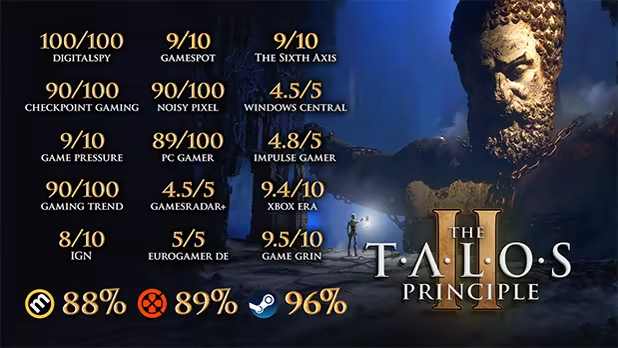
The Talos Principle 2 is a thought-provoking first-person puzzle experience that greatly expands on the first game's philosophical themes and stunning environments with increasingly mind-bending challenges.
Modeled estimate, not a reported figure. How we estimate →
Prices
Each in the currency that store quoted — not converted: the gap between two rows is the publisher's pricing, not an exchange rate.
Discounts
Every price cut of more than 20% we have observed, in each market that quoted one, with this game's chart position on either side of it. These are episodes, not a model: a sale is one event, and one event cannot tell you what the next one will do.
Reviews, worldwide (the counter carries no country): 2.57/day in the week to Jul 23 → 4.57/day in the week after.
About

Add-ons
Each DLC is estimated with the same model as a game, then summed — a modeled figure, not reported DLC sales.
Sums Steam only; PlayStation, Xbox, GOG, Epic publish no volume signal, so the true total is higher by an unknown amount.
| Store | Price | Audience | Score | Chart | Est. revenue |
|---|---|---|---|---|---|
SteamYou are here | $29.99 | 13.4Kreviews | 95% | — | $9.4M |
| $29.99 | 3.1Kratings | 91% | — | not modelled | |
Updates
Build ids and update times come straight from Steam's PICS — the same source SteamDB reads. Patch history grows as we record new builds.
Engagement
Reviews
Themes across 905 recent reviews and how positive each mention is. A keyword signal, not full sentiment analysis.
Reviews
Just a note this is coming from someone that loved The Talos Principle, and did everything in the original game. 1st This is the only Non-VR Game to ever give me notion sickness. Tried the motion sickness options, and while experimenting to not want to vomit I didn't notice I spent over 4 hours trying to make the game work so I don't need a bucket next to me, and now can't refund this thing. So if you get any form of motion sickness in the 1st hour REFUND THIS GAME IMMEDIATELY it only gets worst. In truth I didn't start feeling sick till about 30-40 minutes in(but that was also a lot of long cutscenes), and now if I play for 5 minutes I feel sick to my stomach. The entire section of the menu dedicated to motion sickness doesn't seem to help at all, and IMO is just there so you spend time monkeying with the settings so you go past 2 hours of play, and can't refund it as how can you tell if a setting has worked without playing for a few little bit each tweak to see if it lessened. That isn't the only reason for the negative 2nd is the puzzles from what I seen so far are about as difficult as the put the square block into the square hole puzzles for toddlers. Even the extra ones which are supposed to be difficult are extremely short.(note I've gotten to act 2 so this is over 27 puzzles done and I think it too me more then 20 seconds to figure out maybe 2 puzzles... Will they get harder? Who knows from my understanding what I read it would take another 10-15 hours of playing to see any form of difficulty increase which I won't do as I so far the most difficult thing about the game is not keeping my lunch, or dinner from not vomited up. 3rd is the walking it takes longer to find the puzzles then do the puzzles. This game is a walking simulator with short breaks in between more walking, and from what I seen as far as I got it just gets worst and worst. 4th is the awful writing, and non stop chatting the 1st game would just pose philosophical thoughts while leaving you to do puzzles in isolation giving you time to think about what was said. This game is non stop chatting to where you just want it to end.
Media

Related
Related
Price dynamics, follower growth, revenue and sales trajectories with interactive tooltips
This and every other Pro feature is free until October 20, 2026. A free account is all it takes.
Every market we collect.
For scale, across Steam · Top Sellers · Brazil over the last 30 days: the 25 chart moves that followed a price cut of more than 20% went a median of 10 places towards #1, and the 2,413 moves with no price cut behind them went 2 away. One store, one chart, one country — it is the only place we have enough observations to say even that.
Prices outside the United States have been collected since 6 August 2026 and chart positions since 19 July 2026, so a cut older than that has no market to compare and a market that joined later has no history yet. Nothing here is converted between currencies.
Genres
Stats
All-time low is the lowest price we've recorded for this game since we started tracking it.
Languages: English*, French, German, Spanish - Spain, Japanese, Korean, Polish, Portuguese - Brazil, Russian, Simplified Chinese, Traditional Chinese, Turkish*languages with full audio support
| $29.99 |
| 811ratings |
| 88% |
| — |
| not modelled |
| $8.99−70% | 133ratings | 92% | — | not modelled |
| $29.99 | — | — | — | not modelled |
Matched by title — a reused name can pair the wrong games. * is a critic aggregate. Prices and positions are each store's United States storefront; Epic charts worldwide. Audience and Score too, except Steam's, which is worldwide.
Hours played at review time, across 906 reviews with recorded playtime.
positive critical· bar length = how often the theme comes up
Talos Principle 1 posed open ended philosophical questions and didn't force the player really into assuming almost any imperical claims or metaphysics. You really could come away interpreting most of the thought experiments and ideas a variety of ways, while talk of motive, purpose, ontology and ethics were all ultimately up to you to realize. Road to Gehenna became a much more specific discussion about community, social rules and standards, created and implicit meaning. Due to the specific subject matter, the dialogue felt more constrained, and I can grant some grace due to the scope of the game being more limited. Talos Principle 2 has lost the script regarding nuance and keeping the door open for interpreting meaning. Instead, the game is hardcoded into a position of secular humanism, granting and assuming all kinds of metaphysical, scientific and ethical claims. The only "Skepticism" or pondering is essentially do we create a world we want or pursue the vision our forefathers gifted us. But in a super sloppy way. The voice logs are ok, but lack the depth and weight of Alex's from the first game, the terminals are lame and dreary, the social media system feels empty and dull compared to Gehennas forum and is filled with lame useless ♥♥♥♥ like talking about cats and what's everyones favorite color and blah blah blah. It does feel like social media, I can give it that. Nobody has anything important to say. Including the main characters. The game will be interrupted by a video conference call where everybody goes "holy cow what are we gonna do". Then the game has a proverbial angel and devil on your shoulder, the Sphinx and Pandora characters. The Sphinx is the absolute worst character in this game. They'll ask a massively loaded ethical "dillema", and the game might give you 6 options for responses, but none that really say anything. Then whatever you pick, it responds with an "erm, actually". There are no hard or real questions in this game, and the story and characters are bad. Such a shame considering the excellence of its predecessor. However, the puzzles are pretty good. The new mechanics feel good and don't feel too far out of place. The pacing is weak for the difficulty, and I believe TP1 was overall more consistently challenging, especially considering the star puzzles were asymmetrical and hidden. Being forced to platform and smuggle objects out to solve a puzzle that you'd miss if you didn't explore the map? Amazing and so rewarding. Now, nothing is hidden/secret. The bonus puzzles have an indicator painted to the top of your hud pointing exactly where they are. Good puzzles, Awful story.
The Talos Principle is one of my all-time favourite games, so after almost a decade of waiting, did the sequel live up to the expectations? To touch upon the plot as spoiler-free as possible, I will say that while the first game was borderline science fiction, The Talos Principle 2 was inevitably going to be more speculative in nature, but I still ended up a bit surprised about how much it veered towards being a space opera. The first game could very well have been a perfect stand-alone story, since the ending had unlimited potential and was almost better when left to one's imagination. Though if Croteam wants to provide more gameplay – which is unanimously a good thing – the story must go on as well. While I'm not entirely unhappy with the direction they chose to take the trilogy, it still feels like more of a soft sci-fi approach than what I had been imagining for over ten years, and thus the storyline had near-zero chance of living up to my personal expectations. With all that said, the story is still told well and works excellently if you take off your thickest science goggles. On the other hand, one might look at all of my criticisms and say that I merely have yet to internalise one of the game's core messages. The new story beats and worldbuilding leaks into gameplay via the fact that you spend a large portion of your time in conversation with others. One could argue that it's identical to interacting with the terminals in the first game, and to some extent it is, but it also has a vastly different atmosphere to it and in some parts you keep jumping from conversation to conversation for an extended amount of time. I liked all of the interactions and the reading in itself, but the amount occasionally felt detrimental to the pacing. I expected philosophical dialogue with my puzzle game, but I received more of a conversation simulator with some puzzling elements. As an example, it took me between three and five hours to get through the prologue, which essentially consisted of conversations and exploration. The twelve main areas all contain 8 + 2 + 1 puzzles, one explorable location, two differing challenges, three terminals, three different audio logs and between zero and two of some lesser collectables. On one hand it felt handy to know exactly what to look out for in every new area, on the other hand it was almost detrimental to the exploration aspect, since it made every area feel like a new checklist to go through. This was counterbalanced at least a bit by including a large amount of Easter eggs and other small secrets to discover. The points of interest are mostly spread out in such a way that you organically stumble upon them as you proceed through the eight main puzzles of the area. For some people (me) it can be tempting to systematically check off all the additional items before starting on the puzzles, which is one more nail in the coffin of the pacing. And of course, for those so inclined, it is possible to skip all the fluff and speedrun through the main puzzles in a dozen(ISH) hours. Meanwhile, my first playthrough of the main game took something in the ballpark of 70 hours. The DLC, split into three different parts, added a chunky 4,5 + 9 + 9 hours of content that fleshed out the story nicely. After 580 words it's finally time to talk about the puzzles (which might tell you something). This entry introduces some fresh new puzzle elements to the series, while still keeping the majority of the familiar mechanics from its predecessor. Though especially after playing through the first and third DLC, you'll have laser puzzles coming out of your eyes and ears. The main game's puzzles were generally in the easier half of all puzzles, with many of them taking around five minutes to solve. If I recall correctly, only one short puzzle where I got stuck on the wrong solution took me 40 minutes. Since this game is much, [i]much[/i] tougher to run it makes puzzles that can be soft-locked annoying as you might be waiting in the loading screen for a while. Thankfully that was barely ever the case during the main game, unlike during some parts of the DLC... Comparatively, many of the new mechanics were especially at first much less intuitive, and there was a host of puzzles where I had to stop and take another look back while wondering "What did I actually do?!" after successfully solving it. Puzzles that leave you with questions like "Was that how I was actually supposed to solve it? Did I break something? What [i]actually[/i] happened?" result in an unsatisfactory feeling instead of "Yes! I finally cracked it!". In total, there was only a handful of puzzles that made me think "Wow, that was super cool!" afterwards. The first DLC introduced some cool new laser mechanics and also featured an annoying puzzle that I stared at for at least 90 minutes until my eyes hurt before finally proceeding to solve it in a minute. The second DLC provided the all-round best experience in the whole game, and I really loved The Hexahedron. The third DLC was by far the hardest, with multiple puzzles taking an hour or two to solve. Still, I managed to solve all puzzles in the game after a bit of grumbling, so not too badly balanced, I suppose. As a more divisive point that's still important to take into account: The Talos Principle 2 looks (in theory) multiple times more impressive and realistic than its predecessor, but at the cost of needing much better hardware to run. If your computer is up to it then no problem here; enjoy the pretty graphics. For me, after having a buttery smooth experience in The Talos Principle, it was a bit jarring to run around with 20–50 FPS with mostly Low-settings enabled and still having major graphical ghosting and flickering textures. Sometimes it would get stuck on 15 FPS for a long while, at which point I'd quit for a while just to have it hopefully cool off a bit. For reference, I'm still running a GTX 1660 Ti from 2019 as my GPU. Achievements were a bit more numerous than in the median game, but you essentially get all of them during a normal, full playthrough. There were only two or three exclusive achievements that had me do a new almost ten hour playthrough, which honestly made for a fun memory game speedrun. All in all, despite suffering from some pacing issues and from how good the first game is, The Talos Principle 2 is nonetheless an extremely solid puzzle game with more sci-fi elements than its predecessor. I can't wait to see how Croteam wraps up the trilogy! (Just kidding – I can wait years for any game! :D) [h1]9,5– / 10[/h1]
The Talos Principle 2 is a tough game to review. On the one hand, it's an amazing puzzle game that improves on the gameplay of the first game with interesting puzzle mechanics, fantastic environments and a nice chill soundtrack (that unfortunately does get a bit repetitive). On the other hand, the story and lore are confusing and nonsensical at times and the philosophy is all over the place, and doesn't really make sense in the context of the established lore of the first game. I think the biggest mistake with this game was trying to bring the fantastical environments and puzzle mechanics into the real world. The first game took place in a simulation where this all made sense once you understood the nature of the game's reality. However this all kind of falls apart in this one, and to attempt to make it make sense the writers included literal magic (theory of everything) to attempt to justify how these physics defying puzzles and larger than life environments could exist in the real world. Also the social interactions in the city areas feel like nearly everyone is a bit of a caricature and don't really mesh well with the rest of the game. Theoretically the story is about moving forward vs embracing tradition (in this case limiting growth to avoid destroying the planet), but there's really no reason to not choose moving forward when you have literal magic that can fix everything. Also the game gets really preachy about how humanity basically destroyed the earth resulting in its demise when in the first game the lore made it super clear that it was an incurable pandemic, not some eco disaster and the rest of the biosphere was perfectly fine. The whole story is also centuries after the first game, which personally I think was a big mistake with how much time was skipped. Personally I think a much better approach would have been to set up this game similar to how Assassin's Creed handles things, with the majority of the game in a simulation (so the fantastical puzzles and environment can still logically exist) with a real world area the player can return to at any time to explore and find clues that can help in the simulation and interact with other robot humans. Have the story be within months of the original awakening at the end of the first game with the newly created robots exploring the remains of human civilization, while exploring the philosophical nuances of what it means to be human. I do recommend the game simply on the strength of its puzzles and environments, but beware that the writing, lore and philosophy aren't up to the same level.
If youre coming from Talos Principle 1 and expect more of the same, you'll be disappointed. Story in the first game was delived subtly, and you only found out as much you cared to. Here, it is heavy-handed. I recommend ESC -> Options -> Audio -> Dialogue Volume to 0% and then enable subtitles, which you can or cannot read at your own leisure. This made it more immersive and enjoyable for me. Overall though, a disappointment so far, having had huge expectations from the 1st.
After finishing the first game, I put it in my top 10 favorite games without a second thought. Naturally, my expectations for the sequel to a game I loved so much were pretty high. The Talos Principle 2 certainly is a amazing game but I guess I was hoping for a bit more. Almost all the mechanics from the first game make a return and they've added a ton of new ones on top of that. Normally, this sounds like a great thing but the game is actually quite stingy when it comes to using them. There are 12 areas in total and we are introduced to a new mechanic in every single one except the last. For some reason, whenever you finish an area and move on to the next, the game completely tosses the previous mechanics in the trash and focuses entirely on the new one. This loop continues throughout the whole game and it annoyed me quite a bit. Since they didn't fully utilize the potential of these mechanics, I got the impression they were added just for the sake of variety. Additionally, there's a serious drop in puzzle difficulty. The first game wasn't incredibly hard either but it wasn't this easy. Another criticism I have is the distance between the levels. They placed the puzzles in massive maps but since there is absolutely nothing interesting going on in these areas, all you end up doing is walking from one puzzle to the next. It's not a dealbreaker flaw but I still wanted to point it out because it bothered me a bit in the beginning. If there's one thing that is a step up from the first game, it's that the map themes are completely distinct. It really helps keep the game feeling fresh. I can't think of much else to say. Aside from the issues I mentioned above, I thoroughly enjoyed playing it. I'm thinking of writing a separate review for the DLC too. In my opinion, the first game is still better. I definitely recommend giving this one a try too if you enjoyed first game or like any other puzzle game.
Головоломки - ок! Проще, чем в первой части, но интереснее. Сюжет... ну, довольно антропоцентричный и местами наивный, но немного веры в разум сейчас действительно не повредит. Особенно на планете долбoeбов.
They took a really tight and fun puzzle game and turned it into a walking simulator where you occasionally get to do some puzzles. In between those puzzle moments you'll spend your time walking back and forth across environments that seem designed to waste your time. The areas where you die if you try to go directly between points are the absolute worst. To make this time even more annoying if you engage with the social media or talk to the other robots you'll hear the same ideas hashed out over, and over, and over, and over and over.... And, while I don't want to throw shade at the actors and will chalk it more up to the direction and scripts, the voice acting is not good. Unless you like really cringy characters and really bad fake french accents. The writing is cliched and heavy handed and every point is belabored ad nauseam. The new puzzle mechanics are interesting and the puzzles start getting nicely challenging about halfway through the game. It's just too bad my annoyance level rose in tandem with the puzzle challenges.
Pros: some interesting new mechanics, looks beautiful. Cons: Maps are stupidly big, end level is just running back and forth to drag it out, all dialogue is horrendous. Glad to be done with it
Decent puzzles but the graphics were so unbelievably botched it seriously detracted from the game's tone. Imagine looking at a lake while standing beside a tree, and seeing the tree that is beside you reflected in the lake. Imagine shadows flickering on and off alternatively every frame because of some poorly programed TAA system. The opening cutscene of the game includes a moment where you stare out a window while lore is being given to you, and the reflection of a nearly plant in that window is so buggy that I remember being appalled by it SPECIFICALLY nearly 2 years later. I didn't even know it was possible to manage some of the graphics bugs in this game until now. Which is extra sad because the original 'The Talos Principle' was actually so much more beautiful using carefully positioned moderate-quality graphics. Then this comes along and tries to shoehorn in so much ultra fancy modern graphics on an unfamiliar engine that they ended up looking far far worse.
Active players
Estimated daily and monthly active players (DAU/MAU) modeled from peak concurrency.
Players by region
Where this game's players are, estimated from review languages.
Players also reviewed
The games this title's players most often review too — audience affinity.
Related
| Game | Estimated lifetime revenue | Reviews | Review score | Price |
|---|---|---|---|---|
| $35.5K | 69 | 93% | $19.99 | |
| $56 | 2 | 0% | $1.79 | |
| — | 0 | — | — | |
| — | 0 | — | — | |
| — | 0 | — | — | |
| — | 133 | 92% | $8.99 |
Related
| Game | Estimated lifetime revenue | Reviews | Review score | Price |
|---|---|---|---|---|
| $9.4M | 16.7K | 82% | $24.99 | |
| $9.4M | 11.4K | 81% | $29.99 | |
| $9.4M | 19.1K | 94% | $14.99 | |
| $9.4M | 17.6K | 97% | $24.99 | |
| $9.4M | 13.9K | 98% | $19.99 | |
| $9.4M | 227.6K | 87% | $3.99 |