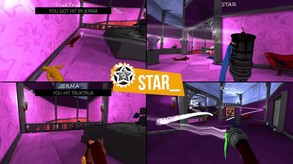
Screencheat is a ridiculous competitive split-screen first-person shooter where everyone is invisible, so players are forced to look at each other’s screens to win. Supporting both local and online multiplayer, combat in Screencheat is fast and furious with a wide variety of one-hit kill weapons.
Modeled estimate, not a reported figure. How we estimate →
Prices
Each in the currency that store quoted — not converted: the gap between two rows is the publisher's pricing, not an exchange rate.
Discounts
Every price cut of more than 20% we have observed, in each market that quoted one, with this game's chart position on either side of it. These are episodes, not a model: a sale is one event, and one event cannot tell you what the next one will do.
Reviews, worldwide (the counter carries no country): 0.14/day in the week to Aug 25 → 0.14/day in the week after.
About
Screencheat is the ridiculous split-screen shooter where everyone is invisible, so you have to “screencheat”!
Screencheat: (verb) to look at your opponent’s screen.
e.g. “Stop screencheating you cheater!”
Master a wide variety of one-hit kill weapons, including a blunderbuss, a car engine that shoots bouncing plasma balls, and a teddy bear loaded with explosives. Train your skills in the solo time trials, then engage in fast and frantic combat with up to eight players locally or online.
With colourful maps, unique modes and a huge number of customisation options, including wacky mutators, Screencheat is the ultimate party FPS.

Ranging from the dependable Blunderbuss to the heroic Hobby Horse and completely crazy Chefolet, all weapons are designed to deliver deadly satisfaction. Their unique advantages and disadvantages encourage wildly different play styles, including not only the way a weapon shoots, but also the 'tells' the weapon leaves behind. Watch out for the smoke from the blunderbuss, or the trail of fire behind the Hobby Horse...

From traditional favourites like Deathmatch to the unique Murder Mystery, Screencheat's nine game modes provide something for everyone.
Play in teams or all against all! Enjoy the split-screen fun by challenging up to seven of your mates on the couch or online, or even a combination of both. When your friends aren't around, train your skills and learn the maps in the solo time trials, or play against AI bots.

In the spirit of the best arena shooters, you’ll traverse 11 maps via air vents and trampolines until you’ve acquired your target. Each map is designed with colour-coded areas and plentiful landmarks, such as statues, paintings and furniture, that allow you to quickly locate other players using your screencheating skills!

Inspired by games like Towerfall, we've provided players with a highly granular level of customisation to play the game their way. Choose which weapons you'll allow, how and when they can be swapped or reloaded, apply time limits, adjust the victory conditions, add penalties and more. To really mix it up, try stacking on some mutators, like slow mode, low gravity or flappy jump.
Sums Steam only; Xbox, PlayStation, GOG publish no volume signal, so the true total is higher by an unknown amount.
| Store | Price | Audience | Score | Chart | Est. revenue |
|---|---|---|---|---|---|
SteamYou are here | $14.99 | 1.9Kreviews | 92% | — | $691.5K |
| $14.99 | 708ratings | 74% | — | not modelled | |
Engagement
Reviews
Themes across 52 recent reviews and how positive each mention is. A keyword signal, not full sentiment analysis.
Reviews
Back in the early (19)90s, in the now non-existent era of LAN (local area network) gaming, people packed up their computer, took it to their friends' house and played multiplayer (mostly) first-person shooter games together. This had a very simple reason: internet was VERY expensive, but at least slow :) Playing in such networks provided great speed without additional costs and had another advantage: one could take a peek at the other screen, roughly estimating where that player was. And this is exactly what [i]Screencheat[/i] is all about with a twist: since players are invisible, we have to take a look at the other 'screen' - in split screen form - in order to have any idea where our opponents are, so we can kill them. In fact we'll probably spend more time gazing at the other 'screens' than at our own. Of course we can also fire randomly - hoping to hit someone - but our weapons create different visual effects - giving our position away. Maps are vividly coloured with easily identifiable spots, so we can better guess where our opponents are and blast them away - or at least try. There are 10 of them and despite being small they build on height, so there are a lot of stairs and plenty of propelling devices which we can use to jump high. There's no fall damage, so we don't have to worry about that, but we can land outside the game area which results in a lost point/death. Unfortunately some of the maps look rather similar and are hard to distinguish from the others (these tend to be rather small thus feel crowded as well). The Garden was a letdown for example, as I was expecting a hedge maze of sorts and instead got a tiny straightforward map, where fighting was insanely chaotic. There are also 10 weapons to choose from (at the start or at respawning) and they are all fairly unique - and almost equally usable. Since there's no health, all weapons are '1 shot kill' types. What they differ in are fire effect, spread, range and reload speed. They are also the weirdest weapons even seen in a first-person shooter and by weird I mean in a funny way: the HobbyHorse for example is the well-known child's toy horse, with which we can run over enemies in a straight line after charged up and it's also great to move fast and dodge enemies' attacks... however it's also very visible, leaving a trail of fire (this doesn't do damage) behind us + we can also fall into our doom on most of the maps by using it mindlessly. The wall_Hacker is also a weapon that does what its name suggests - it can fire through walls and despite its fairly long recharge time it can be a dangerous tool in the hands of an expert. For those who wish to use a traditional and somewhat more reliable gun, the Blunderbuss is the ideal choice, which is basically a shotgun (again - even a single pellet can kill our opponent, although obviously the further they are, the less chance we have to hit them). Most game modes are derived from other multiplayer FPSs with slight alterations: - My First Deathmatch - free-for-all where the 1st player who kills 5x wins - Capture The Fun - kill the player who carries a unicorn-like thingie, we get a point for every second while holding onto it - Hillcampers - a specific area must be defended from other players, we get a point for every second while no one else is within the area, it moves from time to time to a different part of the map - Murder Mystery - kill a specific player with a specific weapon, other kills don't count There's also a mode called "One Shot" which makes recharge/reload times slower, "Juggernaut" which is another take on capture-the-flag, "Elimination" with no respawns/last-man-standing and "Party Mode" which just randomly changes the game mode after each match. Unfortunately when I played it (4 years after its release), barely any people were available to play with and I guess the situation got worse ever since. We can play against bots but it's obviously not as much fun, not to mention the point of the game is lost this way :/ Despite the simple, but colourful and functional graphics some levels look way better than the others like the Arabian themed 'Emir' or the oriental styled 'Temple' (and they add more variety in gameplay than the simpler ones as well). There's a crazy exaggerated ragdoll effect (players/corpses become visible when killed) which I liked, I mean there are many, serious games where it's done similarly (badly), here it fits the goofy atmosphere of the game. And we also don't see our own hands like in 'VR' games :) Sounds are below average which one could say is intentional: mostly pew-pew weapon sounds and amateurish announcer yellings (they are quite funny though as are the various messages we receive after a kill). The music is also something what could be expected - dull, but still slightly annoying. While unique with its refreshing formula and initially entertaining due to the large variety of game modes, once the uniqueness fades the game fails to impress and becomes less enjoyable. Again I would blame this on the majority of the maps, which look and feel just too similar. Despite this, it's still worth checking it out, as it represents a truly unique take on the multiplayer FPS genre. PROS + unique idea, requires different thinking (and point of view) + plenty of crazy weapons + lots of game modes... CONS - ...but can still get boring relatively fast due to the similar maps - some of the game modes are practically the same - way to simplistic sounds RATING 5.5/10
Media

Related
Related
Price dynamics, follower growth, revenue and sales trajectories with interactive tooltips
This and every other Pro feature is free until October 20, 2026. A free account is all it takes.
Every market we collect.
Reviews, worldwide (the counter carries no country): 272.25/day in the week to Jul 15 → 0.29/day in the week after.
For scale, across Steam · Top Sellers · Brazil over the last 30 days: the 25 chart moves that followed a price cut of more than 20% went a median of 10 places towards #1, and the 2,413 moves with no price cut behind them went 2 away. One store, one chart, one country — it is the only place we have enough observations to say even that.
Prices outside the United States have been collected since 6 August 2026 and chart positions since 19 July 2026, so a cut older than that has no market to compare and a market that joined later has no history yet. Nothing here is converted between currencies.
Genres
Stats
All-time low is the lowest price we've recorded for this game since we started tracking it.
Languages: English*, French, German, Spanish - Spain, Dutch, Portuguese - Brazil, Russian, Japanese, Korean, Simplified Chinese*languages with full audio support
| $2.99−80% |
| 517ratings |
| 88% |
| — |
| not modelled |
| $2.99−80% | 34ratings | 76% | — | not modelled |
Matched by title — a reused name can pair the wrong games. * is a critic aggregate. Prices and positions are each store's United States storefront; Epic charts worldwide. Audience and Score too, except Steam's, which is worldwide.
Hours played at review time, across 52 reviews with recorded playtime.
positive critical· bar length = how often the theme comes up
type of game that you play with your friends once when the stars align and never again, game gets boring incredibly quick , sure there might be a lot of different game mods but they get boring after a minute , like i have said you play this game with your friend once and probably never again, even on sale i wouldn't recommend it. 3/10
My kids absolutely love this game and prefer it to more straightforward 4-player splitscreen games because it's so crazy. It's a wonderful couch multiplayer game that encourages everyone to look at the other players' screens, and while that can be a bit mentally taxing, the gameplay is so much fun it's worth the effort!
Screencheat, developed and published by Samurai Punk, is one of those rare indie titles that takes a simple idea and turns it into something entirely unique within the first-person shooter genre. Its premise is delightfully absurd yet brilliantly nostalgic: every player is invisible, and the only way to track down your opponents is by “screen cheating”—the once-forbidden act of peeking at your friends’ screens to see where they are. What was once a form of multiplayer misconduct has been transformed into the central mechanic, reinventing the way players think about spatial awareness, perception, and fair play. The result is a game that feels both familiar and refreshingly original, reviving the energy of old couch multiplayer games while twisting it into something new and unpredictable. At its core, Screencheat is a fast-paced arena shooter where matches are defined not by reflexes alone, but by observation and deduction. Since opponents are invisible, the only clues to their location come from their movement across the color-coded arenas displayed on their own screens. Each map is divided into bold, distinct colors and memorable landmarks, designed specifically to help players identify where someone else might be. Players are forced to juggle two streams of information simultaneously—what they’re doing and what their opponents are doing—and this dual focus creates a frantic, almost puzzle-like rhythm to each match. Unlike traditional shooters that rely on pinpoint aiming and map control, Screencheat’s challenge lies in reading the environment, interpreting visual cues, and acting faster than the other player who’s also watching you. The weapon selection further contributes to the game’s chaotic charm. Every weapon is an instant-kill, so a single well-placed shot can end a round instantly. Each has a distinct feel and visual signature, making it easier to track where shots are coming from and harder to stay undetected. The Blunderbuss, for instance, fires wide and loud but reveals your position, while the Hobby Horse propels players across the map in bursts of manic speed. These eccentric tools of destruction keep the tone lighthearted even when the competition turns fierce. The developers also introduced a number of different game modes to add variety, from classic deathmatch and king-of-the-hill setups to more unconventional challenges like Murder Mystery, which assigns players specific targets and weapon requirements. Every mode plays into the game’s sense of unpredictability, ensuring that no two matches feel quite the same. Visually, Screencheat embraces a bright and abstract art style that perfectly complements its gameplay. Each map is deliberately built with strong contrasts, making use of color coding, shape variety, and clear architecture so players can identify locations even when focusing on multiple screens. The levels themselves range from cozy mansions and museums to outlandish floating arenas, all designed with readability and movement in mind. The game’s cartoony tone extends to its sound design as well: weapon effects are exaggerated, announcer quips add to the humor, and the upbeat soundtrack matches the frantic pace of the gameplay. There’s a deliberate lightness to the presentation that reinforces the idea that Screencheat is meant to be playful first and competitive second, a party experience as much as a test of skill. What truly sets the game apart, however, is how it captures the essence of local multiplayer from the late 1990s and early 2000s. Screencheat thrives when played with friends in the same room, with everyone shouting, laughing, and scrambling to figure out where their opponents are hiding. It’s a throwback to the split-screen era of GoldenEye and Halo, when part of the fun came from peeking over at another player’s quadrant to get the upper hand. Samurai Punk’s genius lies in embracing that behavior and designing an entire experience around it. The sense of shared chaos and physical presence adds an element that online multiplayer can rarely replicate. While the game does support online play, its magic is most potent in local sessions, where reactions and rivalries feel immediate and personal. Despite its brilliance, Screencheat’s narrow focus also limits its longevity. Because the central mechanic remains the same throughout, extended play sessions can start to feel repetitive once the novelty wears off. Without a progression system or deeper customization options, players mainly rely on the variety of maps and modes to keep the game fresh. The single-player component, which allows practice against bots, offers limited satisfaction since the core joy comes from human unpredictability and laughter. It’s a game that thrives on social interaction, and while it works as a party centerpiece, it lacks the depth to hold solo players for long stretches. Still, the simplicity of its design is part of its charm, and its value lies in short, memorable bursts of chaotic fun rather than long-term commitment. Technically, the game runs smoothly across platforms, with responsive controls and clean optimization even on modest hardware. The minimalist art direction helps maintain steady performance, and the intuitive user interface ensures that players can jump straight into matches without friction. Its simplicity is intentional—there’s no clutter or overcomplication to distract from the action. The overall polish, combined with the smartly designed arenas, makes the game easy to learn but surprisingly tricky to master. The sense of flow it achieves when players are simultaneously moving, observing, and reacting creates a level of engagement few party shooters manage to capture. In the end, Screencheat stands as one of the most creative twists on the multiplayer shooter formula in years. It turns a forbidden practice into a legitimate and essential skill, encouraging players to think differently and engage more actively with their environment. Its humor, visual style, and accessibility make it perfect for casual gatherings, while its mechanics reward quick thinking and situational awareness. Though its appeal may fade for those looking for long-term depth or progression, it remains an excellent example of how innovation can emerge from simplicity. Samurai Punk succeeded in creating a game that is both nostalgic and novel, one that reminds players why shared-screen experiences remain some of the most fun gaming moments ever created. Rating: 8/10
Cool
This is the best game to play at a sleepover period There is nothing better, buy it, on sale its like 3$ (+2.95€ for all my European brothers) and its well worth it!
A very fun, one-of-a-kind split-screen multiplayer FPS where you hunt invisible enemies by watching your teammates' screens and learning where to shoot. You get one shot and reloading takes time, so you can’t just spray bullets until you hit something. The game is stylish, and the soundtrack is excellent. The achievements are fun, too. As of 2026, the online is pretty much dead, but the developers added AI bots as part of the latest huge free update and calibrated them correctly. I managed to win a match on the new map, so they shouldn’t give you much trouble.
Stop looking at my screen scrub before i drop this box tv on your forehead. cheater!
Get some friends on if it's on sale, good fun for a few hours
great fun to play once or twice with a friend
Players by region
Where this game's players are, estimated from review languages.
Players also reviewed
The games this title's players most often review too — audience affinity.
Related
| Game | Estimated lifetime revenue | Reviews | Review score | Price |
|---|---|---|---|---|
| $21.3M | 28.7K | 88% | $29.99 | |
| $177.7K | 5.6K | 93% | $1.99 | |
| $34.4M | 84.3K | 90% | $24.99 | |
| $9.6M | 125.4K | 93% | $4.99 | |
| $405.1K | 3.5K | 96% | $5.99 | |
| $141K | 359 | 92% | $17.99 |
Related
| Game | Estimated lifetime revenue | Reviews | Review score | Price |
|---|---|---|---|---|
| $691.3K | 3.3K | 90% | $7.99 | |
| $691.9K | 1.9K | 87% | $14.99 | |
| $690.9K | 8.6K | 69% | $3.74 | |
| $690.8K | 1.1K | 81% | $24.99 | |
| $692.5K | 5.2K | 84% | $5.99 | |
| $692.5K | 1.4K | 84% | $9.99 |