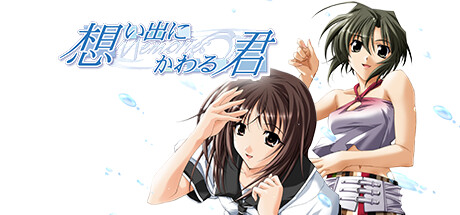
Omoide Ni Kawaru Kimi Memories Off is a romance-focused visual novel that places emotional baggage at the center of its story rather than treating love as a simple journey toward a happy relationship. As the third main installment in the Memories Off series, it carries forward the franchise’s interest in nostalgia, separation, difficult choices, and relationships shaped by the past. The game was developed by MAGES. Inc. and published by Spike Chunsoft Co., Ltd. This PC release preserves the character-driven nature of the original while presenting its artwork in Full HD, making it more suitable for modern displays without abandoning its early-2000s visual novel identity.
The protagonist, Shogo Kaga, is a university student living alone and attempting to maintain an ordinary life. Beneath that routine is an unresolved relationship that continues to affect him. His former girlfriend, Kanata Kurosu, disappeared from his life several years earlier without giving him a proper explanation. Shogo has continued moving forward in a practical sense, yet emotionally he has never completely escaped what happened. The story gains momentum when he unexpectedly encounters Kanata again at a café. Her sudden return forces him to reconsider feelings he has spent years carrying and raises the uncomfortable question of whether a relationship interrupted by abandonment can ever genuinely be restored.
This reunion gives the narrative considerably more weight than a straightforward romantic setup. Kanata represents both someone Shogo once loved and a painful chapter of his life that never received a satisfying conclusion. The game explores the difference between remembering a person and actually knowing who that person has become. Shogo must confront whether his attachment is based on present feelings, nostalgia, unanswered questions, or some combination of all three. That emotional uncertainty creates much of the drama and gives the story its characteristic bittersweet atmosphere.
The café also becomes an important meeting point through which Shogo encounters several other women. These relationships expand the story beyond Kanata and provide alternative romantic directions. Rather than presenting the supporting heroines merely as distractions from the central reunion, the branching structure allows different characters to become meaningful parts of Shogo’s life. His decisions gradually determine which relationship receives greater attention and ultimately which ending the player reaches. This makes replaying worthwhile for anyone interested in seeing the complete cast rather than following only one route.
Gameplay follows the familiar visual novel formula. Most of the experience consists of reading dialogue, observing character interactions, listening to Japanese voice performances, and making occasional decisions at important moments. There is little conventional gameplay outside these choices, so the appeal depends heavily on enjoying narrative progression and character development. Players looking for puzzles, exploration, combat, or complex simulation systems will find the interaction minimal. However, that simplicity also keeps attention firmly on the emotional consequences of Shogo’s decisions instead of introducing mechanics that would distract from the story.
The package includes the main scenario alongside AfterStory content, giving players additional material beyond the core narrative. Multiple endings encourage experimentation with different choices, while achievements connected with progression and collection provide extra goals for completionists. Unlockable music and album-related elements further reward players who thoroughly explore the available routes. Although the underlying structure reflects the design philosophy of an older visual novel, the amount of branching material provides enough incentive to revisit important sections and discover outcomes that a single playthrough cannot reveal.
Visually, the Full HD presentation improves usability on contemporary monitors while retaining the distinctive appearance of its original era. Character artwork is particularly important in a game where portraits and dialogue carry most of the storytelling, and the designs by Yukihiro Matsuo and Takayuki Koshimizu give the cast a recognizable identity. The aesthetic inevitably looks more traditional than that of newly produced visual novels, but this can also be part of its charm. The presentation feels like a preserved piece of Japanese visual novel history rather than a modern game attempting to imitate an older style.
The supporting cast gives the narrative considerable variety, including Neo Kashima, Mifu Kashima, Kako Narumi, Takano Suzuna, Nayuta Kitahara, Hibiki Kodama, Tamaki Momose, Shizuru Shirakawa, and several additional characters. Their presence creates a broader social environment around Shogo and prevents his personal struggle with Kanata from becoming the story’s only source of drama. Japanese voice acting further strengthens these interactions, especially during emotionally delicate conversations where tone can communicate uncertainty or affection more effectively than text alone.
The most significant accessibility problem is language support. The Steam release provides Japanese, Simplified Chinese, and Traditional Chinese options but no official English localization. Because this is an extremely text-dependent game, that limitation matters far more than it would in an action-oriented title. Players who cannot comfortably read one of the supported languages will struggle to appreciate the subtleties of the relationships, choices, and emotional conflicts.
Steam Deck compatibility is officially categorized as Playable rather than fully Verified. Performance with the default graphics configuration is considered suitable, and the game can run successfully on SteamOS. However, handheld players should expect compromises. Some functionality is not fully accessible through the default controller configuration, touchscreen interaction or a community controller layout may occasionally be useful, and text entry can require manually opening the virtual keyboard. Some interface text may also appear small, while certain prompts can display keyboard, mouse, or non-Steam Deck controller icons. It is therefore functional on the Deck, but the experience is less seamless than a fully optimized handheld release.
Overall, Omoide Ni Kawaru Kimi Memories Off succeeds through its mature treatment of romantic memory rather than mechanical complexity. Its strongest quality is the way it asks whether returning to an old relationship means rediscovering love or simply refusing to release the past. The branching romances, multiple endings, additional story content, voice performances, and nostalgic presentation make it an appealing entry for dedicated visual novel fans. Its traditional mechanics and limited language support narrow its audience, but players who can access the story will find a thoughtful romance built around reunion, regret, emotional uncertainty, and the possibility of moving forward.
Rating: 8/10