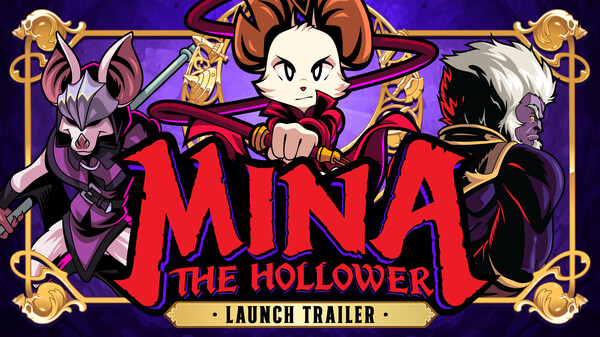
Take control of Mina, a renowned Hollower hurtled into a desperate mission to rescue a cursed island. Whip foes, burrow through the ground, and explore a pixel-perfect world in Mina the Hollower, a brand new game from the developers who brought you Shovel Knight!
Modeled estimate, not a reported figure. How we estimate →
Prices
Each in the currency that store quoted — not converted: the gap between two rows is the publisher's pricing, not an exchange rate.
About

Descend into a frightful world of action-adventure in Mina the Hollower. Take control of Mina, a renowned Hollower hurtled into a desperate mission to rescue a cursed island. Burrow beneath hazards and monsters, whip foes into oblivion, and gear up with an arsenal of sidearms and trinkets.
Explore a vast world filled with pixel-perfect graphics, masterful gameplay, beastly bosses, and infectious music. Encounter a cast of bizarre characters, search out secrets in an array of exotic locales, and illuminate the omnipresent darkness in Mina the Hollower, a brand new game from the developers who brought you Shovel Knight!
Hauntingly authentic 8-bit visuals in the style of Game Boy Color, refined for the modern era.
Modern touches abound: detailed animation, widescreen visuals, and rock-solid controls!
Leap, dodge, and burrow through the ground to battle monsters or navigate the world.
Lash at foes with your trusty whip, Nightstar- or choose from an arsenal of weapons, each with a totally different move set.
Discover and utilize a reliquary's worth of unusual Sidearms to gain the advantage in combat.
Collect and equip Trinkets to acquire a variety of exotic effects. Level Mina up to suit your unique playstyle.
Electrifying soundtrack by chiptune virtuoso, Jake Kaufman.
Descend into the depths of madness with a bone-chilling, yet heartwarming tale inspired by Victorian Gothic horror.
Explore a huge, dark world brimming with secrets, challenging battles, and interconnected level design.
Genres
Add-ons
Each DLC is estimated with the same model as a game, then summed — a modeled figure, not reported DLC sales.
Sums Steam only; PlayStation, Xbox, GOG, Nintendo publish no volume signal, so the true total is higher by an unknown amount.
| Store | Price | Audience | Score | Chart | Est. revenue |
|---|---|---|---|---|---|
SteamYou are here | $19.99 | 7.6Kreviews | 88% | — | $4.1M |
| $19.99 | 1.7Kratings | 90% | — | not modelled | |
Updates
Build ids and update times come straight from Steam's PICS — the same source SteamDB reads. Patch history grows as we record new builds.
Engagement
Reviews
Themes across 1194 recent reviews and how positive each mention is. A keyword signal, not full sentiment analysis.
Reviews
The game is undeniably brilliantly designed, whether or not it's actually fun to play is up for more debate. Level design ranges from interesting and unique to outright genius at times. They managed to make several environments that are simultaneously thematically unique and have individual mechanics that match the aesthetic. Combine that with a ton of trinkets that add a sandbox element to all levels and a TON of secrets, and you have a game that should probably be a case study on level design for years to come. It's the highlight of the game and it isn't even close. Art direction and score are both outstanding. Bright colors, tons of unique models, a retro and robust score, sound design that bring you back to 90's gaming, it's all great. My only complaint is that at times the readability of the environments could be quite difficult, especially having played the whole game on steam deck Combat and difficulty were... a mixed bag. The weapons were all quite unique and fun to use, and there was a ton of variety in enemy encounter design. I will also always take a game being too difficult over too easier, and this gsme definitely falls under the former at times. I think the biggest problem this game suffers from is awkward enemy attack animations paired with a much slower and more restrictive skillset from Mina. This might just be me, but my first full playthrough completelt kicked my teeth in (I died over 400 times when credits rolled). It often felt like some enemies were placed in such a way to make it nearly impossible to deal with them appropriately, some platforming was confusing and had controls that were a little too finicky to ever master, and some bosses... yeah NGL a couple were kind of BS, genuinely felt like they had certain animations that were unavoidable. Another issue that plagues the game is that some of it's systems were simply too obtuse. One great example of this is fast traveling; to fast travel in the game, you need to walk directly into a mirror for a few seconds until you ultimately get telepprted to a realm that let's you take shortcuts to other places. Here's the problem: the game never tells you this, so if you naturally interact with a mirror or walk into for a second and go "huh, guess these don't do anything", well guess you're out of luck! There are a couple of other examples of things like this where I either would have never guess in a million years how something works or felt the game withheld a bit *too* much crucial information at times. Overall: I really did mean it when I said that this game is genius and I am quite happy I played it. I think it should and will get some love at the game awards, and for $20 you're absolutely not going to find many new titles that can offer the same level of design, content, and polish. BUT: I absolutely got incredibly frustrated for large portions of my playthrough and found that there are some bad parts of this experience that you just have to be willing to take with the good.
Media

Related
Related
Price dynamics, follower growth, revenue and sales trajectories with interactive tooltips
This and every other Pro feature is free until October 20, 2026. A free account is all it takes.
Every market we collect.
Stats
All-time low is the lowest price we've recorded for this game since we started tracking it.
Languages: English, French, Italian, German, Japanese, Korean, Portuguese - Portugal, Portuguese - Brazil, Russian, Simplified Chinese, Traditional Chinese, Spanish - Latin America +1 more
| $19.99 |
| 220ratings |
| 92% |
| — |
| not modelled |
| $19.99 | 119ratings | 88% | — | not modelled |
| $19.99 | — | — | — | not modelled |
Matched by title — a reused name can pair the wrong games. * is a critic aggregate. Prices and positions are each store's United States storefront; Epic charts worldwide. Audience and Score too, except Steam's, which is worldwide.
Hours played at review time, across 1.2K reviews with recorded playtime.
positive critical· bar length = how often the theme comes up
GOTY
Ein super Zelda-like mit allen was man braucht: "Open World", Levelsystem, viele Rätsel und Sidequests, witzige Dialoge gute Steuerung im schönen 16bit Pixel Look . In 20-30 Stunden kann man hier eine richtig gute Zeit haben.
emmm无论是打击感、音乐、前期怪物强度还是画面整体表现以及解锁捷径的推图过程,我都认为很不错,但是但是,它能不能给主线或者说你要进行的任务,加一丁丁儿引导?我第一次卡关是在序章需要钥匙的地方,我在那里反复转了十来分钟,然后搜索攻略才发现,TM那个打击后地图上留下来的一条小缝是要钻进去的!!!!我说好的我知道了,还是在序章第一次有箭头拦路,我又是撞墙撞了半天来查攻略,TM那个像是房檐处的一个凹形又是能挖进去的,我挖NM我挖。序章过了我淌火往下走,叛军大营里救了个NPC一直给你丢回复,但是路呢?我把看得见的按钮都踩了,自己往两边门跳那NPC都说,哎呀你要丢下我吗?我丢你老母!把骨片存着回去也不行.......总之不推荐。
REALLY good game
Awesome sauce
Muy divertido
Il y a une tendance étrange dans la manière dont les joueurs modernes perçoivent la difficulté. À force d'être habitués à des jeux accessibles et confortables, certains semblent considérer que tout ce qui est frustrant est automatiquement « exigeant ». Ajoutez une petite barre de vie, des dégâts élevés, des morts punitives et de longs runbacks, et le jeu est immédiatement perçu comme difficile. C'est mon principal problème avec Mina the Hollower : le jeu semble régulièrement confondre difficulté, punition et perte de temps. Ce qui rend un jeu difficile intéressant n'est pas simplement sa capacité à punir le joueur. Un bon jeu difficile demande de comprendre ses systèmes, d'améliorer ses réflexes, d'apprendre les patterns ennemis ou de résoudre des situations complexes. La difficulté devient alors une forme d'apprentissage : on échoue, on comprend pourquoi, puis on revient meilleur. Les runbacks, eux, ne rendent pas un combat plus difficile. Ils rendent simplement chaque tentative plus longue. De la même manière, une petite barre de vie n'est pas intéressante si les dégâts viennent surtout de problèmes de lisibilité, de collisions étranges ou d'ennemis difficiles à anticiper. Le problème du Souls-like moderne est qu'il est parfois réduit à une formule : rendre le joueur fragile, le faire perdre quelque chose à la mort et lui imposer un long retour après chaque échec. Mais la punition n'est pas automatiquement du challenge. L'un des plus gros problèmes de Mina the Hollower vient de sa perspective. Dans un jeu où le positionnement et la précision sont importants, le joueur doit pouvoir comprendre clairement ce qui est dangereux. Pourtant, les ennemis peuvent parfois toucher avec une partie de leur corps difficile à voir ou située hors de l'espace lisible à l'écran. Pire encore, ils infligent souvent des dégâts simplement en entrant en contact avec le joueur, et pas uniquement lorsqu'ils effectuent une attaque identifiable. Une grande partie des dégâts semble donc venir du fait qu'un ennemi vous marche dessus plutôt que d'une mauvaise lecture de ses attaques. Le combat devient parfois un pari : est-ce que mon coup va créer une ouverture, ou est-ce que l'ennemi va simplement l'ignorer, continuer à avancer et me faire des dégâts avec son corps ? Une bonne difficulté devrait permettre au joueur de dire : « J'ai été touché parce que j'ai fait une erreur. » Ici, on a parfois plutôt l'impression d'avoir été puni simplement parce qu'on a essayé de combattre. Le jeu utilise également des situations qui ressemblent davantage à des pièges destinés à surprendre qu'à de véritables défis. Vous sautez sur une plateforme et un ennemi situé hors de l'écran vous frappe immédiatement, vous envoyant dans le vide. Vous mourrez sans forcément avoir eu le temps d'identifier le danger. Ce genre de surprise peut fonctionner occasionnellement, mais lorsqu'elle devient une mécanique récurrente, la difficulté repose davantage sur la mémorisation que sur la maîtrise. On ne réagit pas mieux : on sait simplement désormais où le jeu a décidé de cacher son prochain piège. Le level design donne souvent l'impression d'être une succession de salles et d'affrontements sans véritable logique mécanique. Il manque cette sensation que l'on retrouve dans un Zelda, où une zone introduit une idée, demande au joueur de la comprendre, puis la développe progressivement à travers des puzzles et de nouvelles situations. Dans Mina the Hollower, il y a peu de véritables énigmes ou de situations demandant réellement de réfléchir à son environnement. Le jeu demande surtout de rester prudent, de combattre et de mémoriser les dangers. Le système de soin semble vouloir encourager le joueur à combattre, mais son fonctionnement crée une contradiction. Prendre des dégâts peut vous faire perdre les ressources nécessaires pour vous soigner. Le risque associé au combat devient donc parfois tellement important que la meilleure stratégie consiste simplement à éviter l'affrontement. Au lieu de créer une boucle de risque et de récompense, le jeu peut encourager une approche beaucoup plus passive : pourquoi risquer de perdre ses ressources contre un ennemi que l'on peut contourner ? L'ouverture du monde ne semble pas toujours servir une progression claire. Le joueur peut tomber sur une zone où les ennemis sont beaucoup trop puissants, simplement parce qu'il est parti dans la mauvaise direction. À l'inverse, il peut revenir plus tard dans une zone et la traverser sans aucune difficulté. Un monde ouvert fonctionne lorsqu'il permet des choix intéressants et maîtrisés. Ici, il donne parfois surtout l'impression de créer des problèmes d'équilibrage. Les améliorations devraient idéalement transformer la manière dont le joueur interagit avec le monde et ouvrir de nouvelles possibilités. Ici, certaines donnent plutôt l'impression de contourner des limitations ou des frustrations créées par le design précédent. Un power-up ne devrait pas simplement être agréable parce qu'il permet enfin d'éviter une mécanique pénible. Il devrait enrichir le gameplay, pas servir de pansement. Les side arms illustrent parfaitement cette philosophie. Ces armes secondaires sont récupérées à des endroits fixes, mais elles sont perdues à la mort. Leur utilisation demande également du mana, une ressource qui disparaît elle aussi lorsque le joueur meurt. Le problème est évident : pourquoi expérimenter avec une arme et construire une stratégie autour d'elle si une seule mort vous oblige à retourner à son emplacement tout en vous privant des ressources nécessaires pour l'utiliser ? Au lieu d'encourager l'expérimentation, le système peut pousser le joueur à économiser ses outils, voire à ne pas les utiliser du tout par peur de les perdre. Chaque mort devient alors une couche supplémentaire de runback, puisque vous devez reconstruire votre équipement avant de retrouver les mêmes conditions qu'avant votre échec. La frustration n'est pas le challenge C'est finalement le problème fondamental de Mina the Hollower : le jeu semble parfois partir du principe que plus une expérience est punitive et frustrante, plus elle est difficile et donc satisfaisante. Mais un vrai challenge pousse le joueur à développer ses compétences. Un rage game, lui, pousse le joueur à recommencer jusqu'à ce qu'il connaisse les pièges, accepte les incohérences ou obtienne enfin une tentative où rien d'absurde ne se produit. La différence est essentielle. Dans un grand jeu difficile, lorsqu'on meurt, on a envie de recommencer parce qu'on sait ce qu'on peut améliorer. Dans un jeu frustrant, on recommence surtout en espérant que la prochaine tentative sera moins injuste. Mina the Hollower possède une identité forte et de bonnes idées, mais son design me semble trop souvent remplacer la complexité par la punition et la maîtrise par la mémorisation. Un jeu difficile peut être brutal et impitoyable. Mais il doit rester lisible. Il doit donner au joueur les outils nécessaires pour comprendre pourquoi il a échoué. Le véritable challenge consiste à donner envie au joueur de recommencer parce qu'il peut devenir meilleur; pas simplement parce qu'il connaît désormais l'endroit exact où le jeu avait décidé de le punir.
I love this game a lot! Its probably an evergreen. Im after my first playthrough working through new game plus and the randomizer at once and im having a blast still (only thing abt the randomizer is that its kindof sad there isnt a key system that forces you to do areas in a certain order). But im having amazing fun, i didnt care that much about shovel knight, even though it played well, but this one is a stay for me on my steamdeck
Probably game of the year, besides literally the first 5 minutes of gameplay i was smiling the entire journey, I love this title so much and there is a lot of love put into it. There's a good challenge but competent exploration rewards the player with a lot of maneuverability mechanic-wise. The game has a lot to it, and if you're having trouble you can just find something else to do in game and it's so enjoyable. The story is simple but it's endearing! doesn't take itself seriously but still showcases an immersive threat. There is so much charm and so much fun please get this game. I wish I was able to articulate why I love this game so much beyond “Good Game Design” but I really really think you should just play it blind and let the Good Game Design carry you through in its tender grasp.
Selling now
See how fast this game is selling right now — estimated copies and revenue per day from recent review growth.
Active players
Estimated daily and monthly active players (DAU/MAU) modeled from peak concurrency.
Players by region
Where this game's players are, estimated from review languages.
Players also reviewed
The games this title's players most often review too — audience affinity.
Related
| Game | Estimated lifetime revenue | Reviews | Review score | Price |
|---|---|---|---|---|
| $507.9K | 11.9K | 93% | $1.99 | |
| — | 0 | — | — | |
| — | 0 | — | — | |
| $1.1M | 3.3K | 92% | $10.19 | |
| $741.1K | 1.3K | 82% | $12.49 | |
| $120.3K | 312 | 71% | $14.99 |
Related
| Game | Estimated lifetime revenue | Reviews | Review score | Price |
|---|---|---|---|---|
| $4.1M | 3.6K | 97% | $29.99 | |
| $4.1M | 2.5K | 79% | $49.99 | |
| $4.1M | 21.7K | 91% | $11.24 | |
| $4.2M | 2.7K | 73% | $49.99 | |
| $4.1M | 11.9K | 92% | $19.99 | |
| $4.1M | 15.2K | 94% | $6.99 |