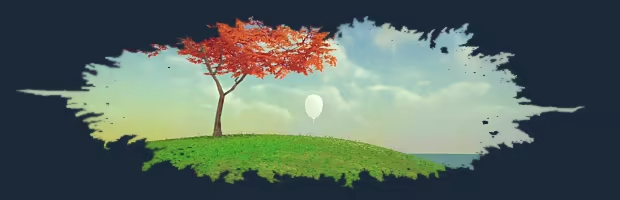
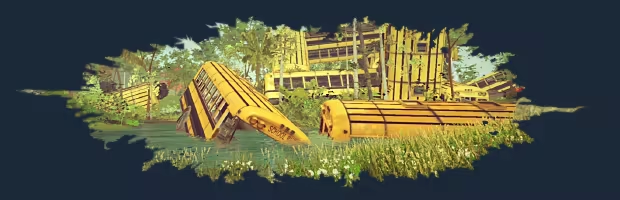
Lost at Sea, developed by Studio Fizbin and published by Headup, is a deeply personal and introspective narrative adventure that explores life, memory, and mortality through an allegorical journey across a mysterious island. It’s a first-person experience that abandons conventional gameplay complexity in favor of emotional storytelling and symbolic exploration. You play as Anna, an elderly woman reflecting on the defining moments of her life—her childhood, love, family, and eventual solitude. The island becomes a manifestation of her memories, a surreal landscape that constantly shifts between beauty and melancholy as you uncover fragments of her story. The developers at Studio Fizbin have created a reflective experience that invites the player to confront themes of aging, regret, and acceptance through simple but poignant interactions.
The game begins with Anna adrift at sea before she awakens on the shores of a strange, deserted island. Guided only by a compass, the player must explore different biomes, each representing a stage of Anna’s life. The structure of the island mirrors her psychological landscape—sunlit clearings evoke joy and nostalgia, while darker, misty areas embody fear, grief, and the uncertainties of growing older. Throughout the journey, you collect symbolic objects linked to key moments in Anna’s past, which unlock short vignettes and puzzle sequences. These puzzles are modest in design—often revolving around memory association, spatial awareness, or simple logic—but they serve more as emotional triggers than mechanical challenges. The act of finding and restoring memories becomes a metaphor for piecing together one’s sense of identity, giving the game a meditative rhythm that suits its tone.
Visually, Lost at Sea embraces minimalism and surrealism. The environments are stylized rather than realistic, with exaggerated colors, shifting skies, and dreamlike geography that evoke the uncertainty of memory itself. Each part of the island feels distinct and purposeful, as though designed to reflect a different emotional state. Childhood areas are warm and inviting, filled with playful imagery, while later regions grow colder and more abstract, marked by decay and emptiness. The sound design reinforces this atmosphere beautifully—ambient ocean waves, distant whispers, and a gentle orchestral score weave together to create a haunting sense of space. Anna’s narration is delivered with quiet sincerity, her voice carrying a blend of weariness and introspection that adds emotional gravity to the exploration. These elements combine to immerse the player in a space that feels deeply human, even when the visuals drift into surreal abstraction.
While its emotional ambitions are admirable, Lost at Sea does not escape the pitfalls common to many narrative-driven walking simulators. The gameplay itself is limited, and much of the experience involves slow movement across large areas with little interactivity. The puzzles, though conceptually tied to the story, are simplistic and rarely challenge the player intellectually. There is also a recurring mechanic involving a dark, creeping force that represents Anna’s fears and regrets. This element introduces a mild sense of tension, but its execution is uneven—it functions more as an obstacle that interrupts exploration than as a meaningful metaphor integrated into the gameplay. Navigation can at times feel cumbersome, with unclear objectives and a lack of environmental guidance leading to moments of disorientation. These issues occasionally break the immersion that the game otherwise works so hard to sustain.
Where Lost at Sea truly succeeds is in its emotional resonance. The narrative, though simple, strikes a universal chord. Anna’s reflections on love, parenthood, and loss are delivered with a raw honesty that transcends the boundaries of the medium. The game invites you to consider not just her life, but your own—to pause and think about the connections you’ve made and the moments that define who you are. It doesn’t rely on grand plot twists or dramatic revelations; instead, it builds emotional weight through quiet introspection. Each recovered memory feels intimate, as if you are trespassing into the personal thoughts of someone struggling to make peace with her choices. The ending, though understated, brings closure through acceptance rather than resolution, leaving a lingering sense of calm reflection rather than sorrow.
From a technical standpoint, the game performs adequately, though not without imperfections. Its graphical presentation is modest, with some texture inconsistencies and occasional frame dips. Lighting effects, while atmospheric, can at times obscure important environmental details, and object interactions occasionally feel unresponsive. However, these technical limitations rarely detract from the core experience. The art direction and narrative design carry enough emotional weight to overshadow the rough edges. It’s evident that the developers prioritized storytelling and theme over mechanical complexity, and while that choice may alienate players seeking more traditional gameplay, it aligns perfectly with the project’s artistic intentions.
In its entirety, Lost at Sea stands as a reflective meditation on life’s fleeting nature. It’s not a game designed for thrill or mastery, but for contemplation—a quiet, human experience that encourages the player to slow down and think. It belongs to the same emotional lineage as titles like What Remains of Edith Finch and Gone Home, though its symbolism leans heavier toward abstraction and existential thought. The simplicity of its design might limit its appeal to those who crave interactivity, yet for players open to emotional storytelling, it offers a profound sense of empathy and peace. Lost at Sea may not redefine the narrative adventure genre, but it succeeds in what it sets out to do: it reminds us that every memory, even the painful ones, contributes to the person we become, and that coming to terms with our past is the truest form of finding our way home.
Rating: 5/10