Kingsvein is the kind of tactical RPG that quietly demands your full attention, not through spectacle or narrative drama, but through the sheer density of its systems. Developed and published by Rad Codex, it follows the studio’s established design philosophy of prioritizing mechanics over presentation, creating an experience that feels closer to a carefully constructed strategy sandbox than a traditional story-driven adventure. At a glance, it may appear modest—retro visuals, minimal dialogue, and a subdued tone—but the moment its systems begin to unfold, it becomes clear that this is a game built for players who enjoy dissecting mechanics and mastering interlocking systems.
The premise is intentionally understated. You are sent into the sealed underground city of Kingsvein to investigate its sudden silence, taking on the role of a Wisp Slayer tasked with confronting the strange forces that have overtaken the area. The narrative rarely pushes itself to the forefront, instead offering fragments of lore and environmental storytelling that gradually build a sense of mystery. Characters are functional rather than deeply developed, and the story acts more as a framework for exploration than a driving force. This approach may feel sparse to those expecting a more character-focused RPG, but it aligns with the game’s overall design, where the emphasis is placed firmly on player-driven discovery and mechanical engagement.
Combat is where Kingsvein truly establishes its identity. Battles take place on grid-based maps, but unlike many tactical RPGs that rely heavily on stats and straightforward ability usage, this game emphasizes interaction—between units, terrain, and abilities. Positioning is critical, not just for maximizing damage but for controlling the flow of battle. Environmental elements can be manipulated in ways that directly impact outcomes, turning the battlefield into something closer to a dynamic puzzle than a static arena. Success often comes from understanding how different mechanics overlap, whether that means combining abilities for greater effect or using terrain creatively to gain an advantage. Each encounter feels like a problem to solve rather than a test of raw strength, and this gives the combat a satisfying depth that rewards thoughtful play.
What sets the game apart further is how seamlessly it integrates these mechanics into exploration. Abilities are not confined to combat; they extend into the world itself, allowing players to interact with the environment in meaningful ways. Freezing water to create paths, breaking through obstacles, or manipulating objects to uncover hidden areas transforms exploration into an extension of the core gameplay rather than a separate activity. This design creates a strong sense of cohesion, where every tool at your disposal has multiple purposes. It also introduces a layer of progression that feels organic, as new abilities open up previously inaccessible areas, encouraging players to revisit earlier locations with fresh possibilities in mind.
Character progression is built around flexibility rather than rigid specialization. The game offers a variety of classes and abilities that can be mixed and matched, allowing players to shape their party according to their preferred strategies. This system encourages experimentation, as there is rarely a single “correct” approach to a given situation. Instead, the game rewards creativity and adaptability, giving players the freedom to develop solutions that suit their playstyle. Importantly, progression does not simply make you stronger—it expands your options, reinforcing the idea that mastery comes from understanding the systems rather than overpowering them.
However, this focus on systems can also be a barrier. The early hours of Kingsvein can feel slow and somewhat restrictive, as players are introduced to its mechanics with a limited set of tools. Without a strong tutorial or clear guidance, it can take time for the game’s depth to become apparent. This learning curve may discourage players who are not immediately drawn to its methodical pace. Additionally, while the streamlined scope helps maintain focus, it also means that the game lacks the breadth and variety found in larger RPGs, which may leave some players wanting more in terms of content and narrative development.
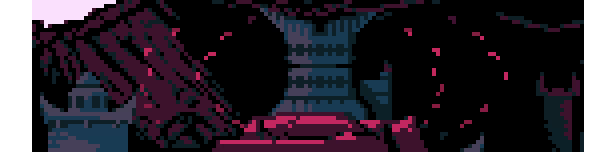
Visually, the game adopts a retro-inspired pixel art style that prioritizes clarity and readability. While it may not stand out in terms of technical achievement, it effectively supports the gameplay, ensuring that important elements are easy to identify during both exploration and combat. The environments convey a sense of decay and isolation, reinforcing the game’s tone without relying on elaborate visual effects. The overall presentation is functional and cohesive, designed to serve the mechanics rather than distract from them.
In the end, Kingsvein is a game that knows exactly what it wants to be and commits to that vision without compromise. It is not concerned with broad appeal or accessibility; instead, it offers a tightly focused experience for players who enjoy deep, system-driven gameplay. Its strengths lie in the way its mechanics interconnect, creating a world where every action has purpose and every decision carries weight. Its weaknesses—minimal narrative, slow early pacing, and a lack of guidance—are byproducts of that same design philosophy.
For those willing to invest the time and attention it demands, Kingsvein delivers a deeply rewarding experience that stands out for its thoughtful design and mechanical depth. It may not capture everyone’s interest, but for players who appreciate tactical complexity and player-driven discovery, it offers something genuinely special.
Rating: 8/10