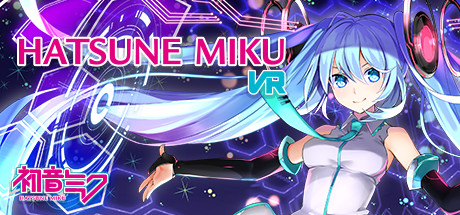
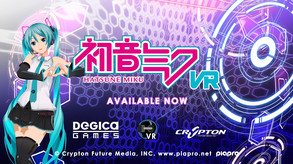
Hatsune Miku VR is a compact rhythm experience that understands exactly where its strongest appeal lies: putting players physically close to a virtual concert performance rather than simply presenting another conventional music game on a flat screen. Developed by Crypton Future Media and published by KOMODO, it transforms Hatsune Miku's music into an interactive VR stage show where rhythm, motion controls, choreography, and fan service work together. Its scope is relatively modest, but the feeling of standing in front of the stage while Miku performs gives the experience a distinctive character that would be difficult to reproduce without virtual reality.
The core gameplay is easy to understand. Musical symbols travel toward the player while Miku sings and dances on stage, and the objective is to strike or catch them with tracked motion controllers at the correct moment. Longer riff patterns add variation by requiring more continuous movement rather than a single accurately timed gesture. This physical approach makes rhythm participation feel more active than simply pressing buttons according to prompts. There is a satisfying connection between hearing the beat, seeing an incoming symbol, and physically responding to it, particularly once a song becomes familiar enough that the player can concentrate on the music instead of constantly anticipating the next instruction.
Scoring provides the main incentive for mastering the mechanics. The pursuit of a perfect performance encourages repeated attempts, while two difficulty options give less experienced players an approachable starting point before tackling more demanding patterns. The mechanics are deliberately uncomplicated, however, and players accustomed to rhythm games with elaborate note systems or extensive progression may find the design somewhat basic. Its challenge comes primarily from improving accuracy and learning patterns rather than discovering increasingly complex systems.
The included music selection is an important part of the appeal. The base package contains ten songs, including recognizable tracks such as Ievan Polkka, SenbonZakura, Ghost Rule, Hibikase, Sharing The World, SLoWMoTIoN, Singularity, Stella, Amagoi Miseinen, and Lucky Orb. This collection provides a reasonable mixture of musical styles and energetic performances, although ten tracks can feel restrictive for a game built heavily around replayability. Additional music is available through separate content, but anyone evaluating only the base experience should understand that repetition becomes an important part of its longevity.
Presentation does much of the heavy lifting. Miku performs choreographed dances during songs rather than functioning as a static background attraction, and VR gives these performances a convincing sense of scale. Watching a character normally seen through a monitor suddenly occupying a life-sized virtual stage can be surprisingly effective. The visual design does not depend on extreme graphical realism; instead, colorful environments, recognizable character styling, animation, music, and spatial presence create the atmosphere. Fan-oriented additions such as costumes and the familiar Negi glow stick strengthen the feeling that this is as much a virtual Miku attraction as it is a score-driven rhythm game.
The music video mode is one of the more worthwhile supplementary features because it allows players to appreciate performances without concentrating entirely on rhythm prompts. Different viewing positions, stages, and outfit selections provide a more relaxed way to experience the songs. This mode complements the main game nicely, especially for players whose interest is divided between rhythm gameplay and simply watching virtual performances. It also demonstrates how VR can make even passive viewing more engaging by giving the audience control over perspective and creating a stronger impression of occupying the same space as the performer.
Beyond the individual songs, the structure remains intentionally straightforward. Steam achievements and leaderboards provide additional reasons to return, especially for completionists and competitive players interested in improving scores. There is no elaborate campaign or extensive progression system connecting everything together, so enjoyment largely depends on whether replaying tracks for better performances remains satisfying. Players wanting a large adventure surrounding the music will find little of that here, while those comfortable with an arcade-like choose-a-song-and-play structure will have an easier time appreciating its simplicity.
The VR requirement is simultaneously its defining strength and biggest restriction. Motion-controlled interaction creates the physical involvement that separates the experience from traditional rhythm games, but it also means the title has essentially no value to someone without appropriate VR equipment. The standing and room-scale nature of play works well with the mechanics because reaching for notes naturally encourages body movement. Sessions can therefore feel more energetic than the simple rules initially suggest.
Steam Deck compatibility is especially important to clarify. The game is officially categorized as Unsupported for Steam Deck because the handheld does not support the VR functionality the title requires. This is not merely a situation where controller mappings need adjustment or performance needs tweaking. VR is fundamental to the game, making normal standalone Steam Deck play impractical. Anyone specifically seeking a portable Hatsune Miku rhythm experience should therefore consider another title rather than purchasing this one for Deck use.
Ultimately, this is best regarded as a specialized VR rhythm attraction for existing Hatsune Miku enthusiasts rather than an enormous, content-heavy rhythm platform. Its accessible controls, physical note interaction, lively choreography, recognizable music, score chasing, leaderboards, achievements, viewing options, costumes, and virtual stage presence create an enjoyable package when approached with appropriate expectations. The limited base soundtrack and relatively simple mechanics keep it from offering exceptional depth, but the sensation of participating in a Miku performance provides an identity that compensates for some of those shortcomings. For a player with compatible VR equipment and enthusiasm for Vocaloid music, it can be charming and memorable, while rhythm enthusiasts seeking a much deeper mechanical challenge may find its appeal considerably shorter-lived.
Rating: 7/10