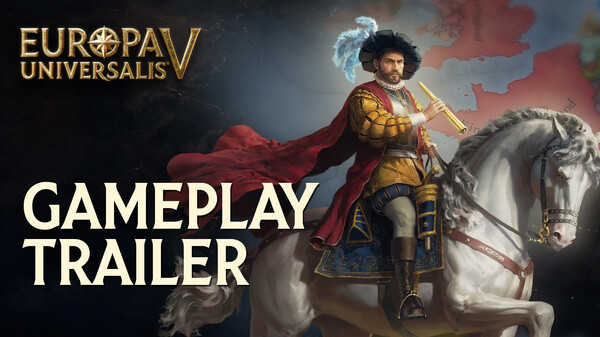
Use war, trade or diplomacy to satisfy your grandest ambitions and dominate five centuries of history in the newest version of Europa Universalis, Paradox Interactive's flagship historical grand strategy game.
Modeled estimate, not a reported figure. How we estimate →
Prices
Each in the currency that store quoted — not converted: the gap between two rows is the publisher's pricing, not an exchange rate.
Every market we collect.
About
Almost five hundred years of history unfold before you in Europa Universalis V, the latest version of one of the greatest strategy games of all time. Guide the destiny of any of hundreds of nations and societies in a simulated living world of unparalleled depth and complexity.
Europa Universalis V builds on the franchise’s core concept of developing and advancing nations from around a deeply researched historical world, adding more detailed diplomacy, a more sophisticated economic model, a revised military system and greater logistical depth that will challenge even the most experienced strategy gamers.
RULE a land of your choosing. Hundreds of nations are yours to command, as you guide the destiny of millions of people through the late Middle Ages up to the Age of Revolution - from the mighty Yuán Dynasty to the city-states of Italy, from the warring clans of feudal Japan to the Pope himself.
DECIDE which course your nation will take. Historical events and situations await as you chart a unique path through a new history written by your decisions. Experience The Hundred Years’ War, the Protestant Reformation, the collapse of old dynasties and rise of new ones.
EXPLORE alternate histories as you shape the world to meet your ambitions. What if England succeeded in pressing its continental claims? What if China pursued an overseas empire? What if Mongol supremacy in Russia persisted? Every action opens the possibility for an original history.
IMPOSE domestic peace in a divided realm. Keep your nation’s factions in line as Estates jockey for power in your nation. Offer privileges to one group of citizens while you limit the power of another, all in the service of keeping your population under control.
NEGOTIATE your way through an uneasy peace. Use diplomacy to entrench your dynasty across realms or build an invincible alliance. But remember that nations have no permanent friends - only permanent interests; so use your ambassadors carefully. Exact favors from friends, send threats to enemies, and keep an eye on everyone in-between.
CONQUER new lands to expand your borders. Wage War on those who impede your ambition in a completely new Europa Universalis military system. Start in the age of levies and mercenaries and, through social development, evolve to vast standing armies and impenetrable fortresses. Choose skilled commanders to oversee both land and naval forces.
BUILD a strong economic infrastructure in the most detailed trade system yet seen in a Europa Universalis game. Dozens of goods and crops are available for production and trade on a map filled with new riches to discover. Invest in feeding a growing population or trade your surplus to less bountiful societies.
MOLD your society to meet the historical moment. Choose your societal values, with new options opening as the ages move on. Centralize power at court or share it with your nobles. Pursue a tolerant policy for all faiths or condemn heretics. Emphasize massed armies or an elite cadre of quality soldiers.
GOVERN a nation composed of many cultures and faiths in a detailed simulation of the past. For the first time in Europa Universalis, populations are represented on the map in detail, so provinces may be divided by religion or culture. Your decisions will determine how these populations will fare under your leadership.
PREVAIL in the greatest strategic challenges of the past. Test your expertise in grand strategic planning on a worldscape larger and more detailed than seen in any previous Paradox Interactive game. Challenge yourself to outdo the most famous rulers of the past, eclipsing their grand accomplishments and building your own vision of a richly detailed globe.
Add-ons
Each DLC is estimated with the same model as a game, then summed — a modeled figure, not reported DLC sales.
Updates
Build ids and update times come straight from Steam's PICS — the same source SteamDB reads. Patch history grows as we record new builds.
Engagement
Reviews
Themes across 1505 recent reviews and how positive each mention is. A keyword signal, not full sentiment analysis.
Reviews
The first thing the game teaches you to do is how to automate most of the systems. Dozens of systems that I don't fully understand because the tutorial just said, "Lol, we'll handle that!" So... what kind of decisions am I making? What's the point of all of this in depth ♥♥♥♥ when I'm not doing anything with it? I'm sorry, you went for complexity over fun here and missed. Badly.
Every patch somehow feels like it breaks the game even more. Instead of fixing the core systems to have a solid base with everything working, and then add new content on top of it, it feels like they keep trying to balance things on top of broken mechanics (which will never work because things are not working as designed) It has been almost 8 months since launch, and the game still feels just as broken as it was on day one, but Paradox seems more focused on pushing out DLC to squeeze more money out of players (which is ironic because the DLC came out broken too) I will not even get into how the game pushes you toward playing with a vassal swarm, when countries in that era were supposed to centralize power under a single crown rather than feudalize into autonomous vassals. It feels like the game forces you to play tall by severely punishing you for playing wide. For the price of the game I would expect AAA quality, not a broken mess for more than half a year.
Media

Related
Related
Price dynamics, follower growth, revenue and sales trajectories with interactive tooltips
This and every other Pro feature is free until October 20, 2026. A free account is all it takes.
Genres
Stats
All-time low is the lowest price we've recorded for this game since we started tracking it.
Languages: English, French, German, Spanish - Spain, Japanese, Korean, Polish, Portuguese - Brazil, Russian, Simplified Chinese, Turkish
Hours played at review time, across 1.5K reviews with recorded playtime.
positive critical· bar length = how often the theme comes up
Definitely getting a lot better with each passing update. its a good game now.
remove Johan, make EU great again
I really want to like the game, i was hyped when it first came out. Now 9 months later, here is what i want to say, Paradox, please fking read it: The Core Issue: Data Cleaning vs. Strategic Role-PlayGames Are for Fun, Not Unpaid Labor: Players buy grand strategy games to experience the high-stakes drama of history, not to perform data cleaning. If a player does data science or bookkeeping for a living, the last thing they want to do in their free time is open a historical version of Excel. The "God-Emperor" Fallacy: No ruler in human history—not even the fictional God-Emperor of Warhammer 40k—single-handedly managed raw census data while simultaneously leading armies, executing diplomacy, and judging court cases. Playing the Ruler, Not the Bureaucracy: The entire purpose of human civilization was inventing bureaucracy so the leader wouldn't have to look at raw data. Players want to play as the Emperor making macro decisions, not act as the entire administrative state. To help you understand, let me give you an Car Analogy: The Engine vs. The Cockpit, Build a Cockpit, Not Just an Engine: A deep simulation is fine, but developers confuse the engine with the dashboard. A driver needs a comfortable cockpit with air conditioning, a steering wheel, and pedals. Shoving the player’s face directly into a hot, oily engine block and asking them why they don't know how to drive is terrible user experience design.The "Gas Pedal" Principle: A driver presses the gas pedal; they do not manually fire the spark plugs or push the gearboxes. Under-the-hood math (population data, market dynamics) should safely route in the dark. The player just needs the macro control levers to make the car move. The Imperative Dual-Gauge Dashboard: To run a massive state like Ming across 400 years, a ruler only needs two primary indicators in the center of the steering wheel: The Gas Gauge (Power & Reach): Tells you how much actionable fuel (gold and manpower) you have left in the tank and the burn/flow rate. If it hits empty, you coast to a stop. The Water Temp Gauge (Internal Stability): Aggregates national unrest, low stability, and estate anger. If the needle creeps into the flashing red zone, the engine is about to explode. Actionable Solutions Over Deep Inquiries: When the temperature gauge hits red, an emperor needs to pull immediate executive levers to stabilize the car—like borrowing money, lowering taxes, launching minor military campaigns, establishing colonies, or promoting immigration. The UI should let you trigger these fixes smoothly, rather than forcing you to diagnose which specific radiator hose cracked across 1,800 municipalities. The UI Failure: Dumping Math vs. Actionable DataInformation Overload is Lazy Design: Shoving a massive, unfiltered database dump into the player's face is not "depth." It is a failure of interface design that abdicates the job of synthesizing data to the player. The EU4 Tooltip Success: EU4 succeeded because it gave the "policy implication" upfront (e.g., “Unrest is high because of recent conquest and unaccepted culture”). The raw mathematical breakdown was hidden away like an appendix—accessible if you hovered to see the "why," but never mandatory to read. The Grand Secretary Workflow: The front-facing UI must act like a Grand Secretary or Prime Minister. A lower-ranking official processes the data and presents a concise three-point executive memo: Identify the Problem -> Present the Solutions -> State the Immediate Fallout. Mechanistic Bloat: Why EU5 Risks Killing FlavorThe Municipality Nightmare: Breaking the map down into thousands of tiny locations and municipalities turns the game into a tedious zoning-management chore. It creates massive decision fatigue that fries the player's brain before they can make grand strategic choices. Bloated Tech Trees Lose Meaning: When an advancement tree is larger than Victoria 3’s (an era of actual explosive technological growth), choices lose all historical weight. Universities just become background structures built to make a "Research Speed" bar go up. Sandbox Convergence Erases Identity: When you strip away unique, rule-based advantages (like EU4’s unique national ideas and mission trees) and replace them with a flat sandbox, every country eventually feels the same. If a Native American tribe and the Ashikaga Shogunate use the exact same underlying population sliders, role-play is dead.
While in some ways more polished than an average Paradox release still has many of the same problems. The game design team, I'm assuming Johan, also has a bad habit of hitting a panic button and resorting to hard coded solutions. They didn't like what was happening in the HRE, so blammo, obnoxious hard coded peace treaty system. Did you stomp that coalition, doesn't matter, obnoxious hard coded peace treaty system. Hate the obnoxious heir killing RNG event? That's now a locked seed event. (That solution was used as far back as CIV 3. It was a terrible solution then, its a terrible solution now. You're not improving the game experience, its just a gimmick by game designer who doesn't understand the problem, doesn't have a solution, or is too obsessive to let go) Dear game design team, I do not care about your grand vision for specific mechanics. It's my single player game and I'm going to do what I want. If I can't I'm just going to play something else, and its high time I did. Paradox's abuse of a workable business model, half baked products like Vic3 and HOI4, its just one more player grievance and I'm done. Learned it, played it thoroughly, sunk cost fallacy went whizzing by a long time ago.
Countries with 10k population hire 10k mercs and every single war ends up becoming a world war. You fight for 4-5 years with tiny countries and you get only 2 provinces because that's all they have.
Somehow managed to run Bohemia's (richest country in Europe) economy into the ground by... *checks notes*, mining too much gold, iron and silver. Do like a furry and do NOT forget about inflation, it'll ruin you.
How can you update the game and make it WORSE???
NOT RECOMMENDED — Three Major Patches Later, EU5 Still Feels Like an Unpaid QA Job for players Europa Universalis V is ambitious, but ambition means nothing when the mechanics are poorly tested, badly balanced, and frequently work against the player for no logical reason. The scripted wars and “Situations” are a perfect example. Try participating in the Italian Wars or the Wars of Religion. If your side starts losing, you may discover that you cannot negotiate a separate peace or meaningfully leave the conflict. An ally can betray you, switch sides, and attack you while the game leaves you trapped inside its rigid rules. These are not rare cosmetic bugs—they can destroy an entire campaign. Did anyone in QA actually play these Situations from beginning to end? The Swiss Confederation is another disappointment. It should offer a unique political path toward unification, built around diplomacy, internal reform, cantonal politics, and the gradual centralization of the Confederation. Instead, the practical solution is to conquer everyone. Why create a special Swiss system if it provides no satisfying way to form Switzerland through that system? The economy is a complete mess. It is opaque, unstable, excessively complicated, and often unrewarding. Trade automation behaves unpredictably, income fluctuates without clear explanations, and investments can take so long to produce meaningful returns that economic development feels pointless. Complexity is not depth when the player cannot reliably understand the consequences of their decisions. Military balance is equally absurd. Professional armies can be annihilated by outdated units and levies, making technological and institutional progress feel meaningless. Meanwhile, Bohemia can suddenly field around 200,000 soldiers and endlessly run around its own territory. This is not believable military simulation. It is broken recruitment, manpower, logistics, and AI behaviour pretending to be historical depth. QA department—hello? The wider historical simulation is not convincing either. The Ottomans frequently fail against or simply avoid Egypt. Major powers do not rise and fall naturally; they expand in strange directions or remain passive when history, geography, and strategic logic should push them toward obvious objectives. Forming Russia is another example of confusing difficulty with tediousness. You need an enormous number of locations, many populated by foreign cultures, and then must wait an absurd amount of time to core and integrate them. This is not an interesting challenge. It is administrative waiting disguised as gameplay. Religion also lacks meaningful variety. Outside Catholicism and Orthodoxy, many Christian denominations feel mechanically interchangeable. A religious transformation should fundamentally change the politics and identity of a country. Here, it often feels like selecting a slightly different collection of modifiers. Europa Universalis IV was exciting at launch. It immediately created memorable campaigns and made me want to start another one. Europa Universalis V launched as an unfinished, frustrating mess—and after three major patches, it still feels unfinished. Paradox has more development experience, more resources, more community feedback, and better development tools than ever before. Modern automation and AI-assisted tools should make iteration and testing faster, not become an excuse for releasing untested systems. Yet players are still being used as unpaid testers while the developers repeatedly rebuild fundamental mechanics after release. EU5 does not need another impressive roadmap or promotional feature video. It needs a clear design direction, competent balancing, serious end-to-end testing, and developers who actually play complete campaigns using the systems they release.
Active players
Estimated daily and monthly active players (DAU/MAU) modeled from peak concurrency.
Players by region
Where this game's players are, estimated from review languages.
Players also reviewed
The games this title's players most often review too — audience affinity.
Related
| Game | Estimated lifetime revenue | Reviews | Review score | Price |
|---|---|---|---|---|
| $466.8K | 549 | 85% | $29.99 | |
| — | 0 | — | — | |
| — | 0 | — | — | |
| — | 0 | — | — | |
| — | 0 | — | — | |
| $216.2M | 137.4K | 88% | $49.99 |
Related
| Game | Estimated lifetime revenue | Reviews | Review score | Price |
|---|---|---|---|---|
| $52.7M | 82K | 79% | $39.99 | |
| $52.2M | 52.3K | 90% | $34.99 | |
| $52.9M | 113.3K | 80% | $29.99 | |
| $52M | 50.2K | 89% | $59.99 | |
| $53.2M | 135.9K | 90% | $29.99 | |
| $53.5M | 53K | 97% | $47.99 |