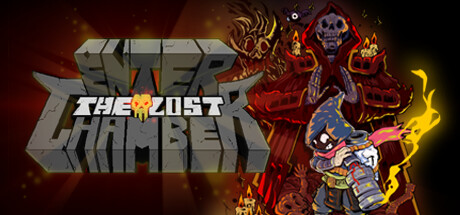
Enter The Lost Chamber is a focused action roguelike built around dungeon exploration, fast top-down combat, randomized equipment, and the constant danger of losing progress. Developed and published by Game Academy, it favors a straightforward gameplay-driven structure rather than an elaborate narrative. The objective is easy to understand: enter dangerous chambers, defeat increasingly troublesome creatures, improve your equipment, overcome dungeon bosses, and eventually confront the Deathkeeper. What gives the formula some personality is the freedom players have in deciding how much preparation they actually need before attempting that final confrontation.
The adventure is structured around cycles containing three dungeons. Surviving a complete cycle leads into another, but the difficulty continues to increase instead of simply repeating the same challenge. Enemies become more threatening and variations in their behavior help make later encounters considerably more demanding. This escalation complements the roguelike format because every additional dungeon creates another question of risk. Continuing onward can result in a stronger character and better equipment, but failure means losing the progress accumulated during the current attempt.
Combat combines twin-stick shooting with elements of bullet-hell action. Movement is therefore just as important as dealing damage. Zombies, bats, demons, and other supernatural enemies frequently force players to reposition themselves instead of standing still and attacking. When several creatures and projectiles occupy a room simultaneously, awareness becomes essential. Learning attack patterns, maintaining sufficient distance, identifying dangerous enemies, and finding openings to counterattack are all important parts of survival. The top-down viewpoint suits this style well by providing a broad perspective of each combat space.
Equipment provides much of the variety between attempts. More than 25 obtainable items can be collected, combined, and upgraded, encouraging experimentation with different configurations. Finding a useful weapon can noticeably change how a run develops, while stronger combinations can make previously intimidating encounters more manageable. Hidden rooms further reward players who thoroughly investigate dungeon environments. Exploration therefore has practical value because discovering additional equipment or resources can directly improve the chances of surviving later battles.
Randomness is expanded through the wheel-of-luck system. Crystals can be used to reroll available rewards, introducing another resource-management decision. Players can accept what they receive or spend crystals hoping for something that complements their existing build more effectively. This mechanic works well within the roguelike structure because it adds uncertainty without completely removing player influence. A poor selection can potentially be replaced, although repeatedly chasing the perfect reward can consume resources that might have been useful elsewhere.
Boss battles function as major checkpoints throughout the experience. Three dungeon bosses provide substantial tests before the ultimate confrontation with the Deathkeeper. These encounters place greater emphasis on movement, recognizing attack patterns, and making effective use of whatever equipment has been assembled. The particularly interesting feature is that the Deathkeeper can be challenged immediately. Players do not necessarily have to complete multiple cycles before attempting the final battle.
That freedom creates an unusual relationship between confidence and preparation. A skilled or adventurous player can attempt the Deathkeeper early, accepting the enormous difficulty that comes with being poorly equipped. Alternatively, players can continue exploring dungeons, collecting upgrades, improving weapons, and developing a much stronger build before taking the risk. This creates a natural form of self-directed difficulty because the player decides when enough preparation has been completed. Repeat attempts can become especially interesting as familiarity with enemy patterns encourages earlier and more ambitious challenges.
The pixel-art presentation fits the supernatural dungeon setting nicely. Dark chambers, monsters, weapons, environmental details, and combat effects establish an appropriately ominous atmosphere without sacrificing the visual clarity needed for fast action. Because projectiles and enemy movements need to remain readable during crowded battles, the relatively clean 2D presentation is an advantage. The aesthetic is deliberately retro in character, but the visual style supports the gameplay rather than merely existing for nostalgia.
Full controller support is another welcome feature, particularly because twin-stick combat naturally translates to analog controls. On Steam Deck, however, the game does not have an official Valve Steam Deck compatibility rating indicated, so it should be treated as officially unverified rather than confirmed Verified or Playable. Its controller-oriented controls and comparatively straightforward 2D design suggest that the basic gameplay format is suitable for handheld play, but individual Steam Deck users may still encounter compatibility, interface, performance, or configuration issues. It is therefore better to distinguish potential playability from official Steam Deck certification.
The relatively compact scope is probably the game's biggest limitation. With a smaller collection of bosses, monsters, and major systems than much larger roguelikes, players seeking dozens of environments and an enormous long-term progression tree may exhaust its variety sooner. On the other hand, that concentrated design also works in its favor. Runs are centered on fighting, exploring, acquiring equipment, and deciding whether to continue preparing or gamble everything against the final challenge. There is little unnecessary complexity getting between the player and the action.
Permanent loss of run progress also means the game will appeal more strongly to players comfortable with traditional roguelike consequences. Losing a promising collection of items can be frustrating, but that possibility is precisely what makes successful progression exciting. Each successful dungeon represents another opportunity to become stronger while simultaneously increasing what can be lost. The escalating cycles reinforce this tension effectively and prevent powerful equipment from automatically turning later stages into effortless victories.
Overall, Enter The Lost Chamber delivers an enjoyable combination of dungeon crawling, twin-stick shooting, bullet-hell pressure, equipment experimentation, hidden discoveries, and high-risk roguelike progression. Its ability to let players confront the ultimate boss whenever they choose is arguably its most distinctive idea, transforming preparation into a strategic choice rather than a mandatory checklist. The amount of content is relatively modest, but the core systems complement one another well and provide a satisfying challenge for players who enjoy repeatable action-focused runs.
It is a compact but engaging roguelike with responsive combat concepts, meaningful risk, flexible equipment progression, and a clever approach to final-boss accessibility. Players who enjoy difficult top-down dungeon adventures and are comfortable starting over after failure should find plenty to appreciate.
Rating: 7/10