Children of a Dead Earth is one of the most technically ambitious space strategy games ever made, and it immediately becomes clear that the game was designed for players who are deeply interested in realistic physics, orbital mechanics, engineering, and hard science fiction. Unlike most space combat games that rely on cinematic explosions, arcade-style dogfights, and simplified systems, this game treats space warfare with near-obsessive realism. Every ship movement, weapon system, heat signature, and orbital maneuver is governed by believable scientific principles. The result is less like a traditional video game and more like a complex military simulation exploring what actual combat in space could realistically look like in the distant future.
The setting establishes a bleak vision of humanity after the destruction of Earth. Civilization has spread across the solar system, where isolated factions now compete over resources, territory, and survival. While the narrative itself remains fairly minimal, the atmosphere created by the worldbuilding is extremely effective. Space feels cold, hostile, and militarized, with every conflict carrying a sense of desperation rather than heroism. The game avoids flashy science-fiction fantasy and instead presents a future where technology still obeys harsh physical limitations. This grounded approach gives the entire experience a very distinctive tone compared to more traditional sci-fi strategy games.
What truly separates Children of a Dead Earth from nearly every other space combat title is its dedication to realism. Ships are not agile starfighters making impossible turns or firing endless energy weapons without consequence. They are fragile machines built around realistic propulsion systems, fuel limitations, thermal management, and vulnerable internal components. Weapons such as railguns, lasers, missiles, and nuclear devices behave according to believable scientific rules. Lasers generate massive heat, projectiles require predictive calculations over huge distances, and missiles must deal with realistic acceleration and interception problems. Even something as simple as radiator placement or reactor output can determine whether a ship survives battle or destroys itself through overheating.
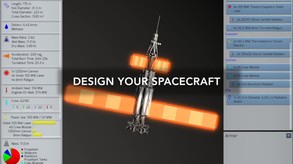
Ship construction becomes one of the most rewarding and intellectually engaging parts of the game. Players can design spacecraft almost entirely from scratch by selecting engines, reactors, radiators, armor thickness, fuel storage, weapons, ammunition types, and support systems. Every design decision has advantages and drawbacks. Heavier armor increases survivability but reduces maneuverability and acceleration. More powerful engines improve tactical flexibility but create enormous heat-management problems. Weapon choices drastically affect engagement ranges and combat doctrine. Designing ships feels closer to aerospace engineering than traditional game customization, and players who enjoy experimentation and optimization will likely become completely absorbed by the possibilities.
Combat itself is unlike almost any other strategy game. Battles unfold slowly and methodically, often beginning long before ships are even within visible range of each other. Orbital positioning, intercept calculations, fuel reserves, and detection systems all matter before the first shot is fired. Once combat begins, players must manage weapon firing solutions, acceleration vectors, heat buildup, ammunition conservation, and defensive positioning simultaneously. The game uses a hybrid pause-and-command system that allows players to carefully analyze situations while still maintaining tension during engagements. Victories feel genuinely satisfying because success comes from planning, engineering, and tactical foresight rather than quick reflexes.
One of the game’s most fascinating achievements is how effectively it communicates the terrifying reality of realistic space warfare. Ships are incredibly fragile, and a single successful strike can cripple engines, destroy reactors, or kill entire crews instantly. Battles are often decided by detection ranges, maneuver planning, and resource management rather than dramatic exchanges of fire. Heat becomes just as dangerous as enemy weapons because managing thermal buildup is essential for keeping systems operational. The game constantly reinforces the idea that space combat would likely be brutally unforgiving and heavily dependent on physics rather than cinematic heroics.
The atmosphere is strengthened further by the audio design and presentation style. Music remains subtle and restrained, creating a cold and isolated mood rather than relying on dramatic orchestral themes. Sound effects are minimal but effective, helping reinforce the sterile and mechanical nature of the setting. The lack of exaggerated spectacle actually works in the game’s favor because it keeps the focus entirely on tension, calculation, and realism. Combined with the scientific approach to gameplay, the atmosphere becomes uniquely immersive for players interested in hard science fiction.
However, the same realism that makes the game fascinating also creates its biggest weakness. Children of a Dead Earth has an extremely steep learning curve that can easily overwhelm new players. Understanding orbital mechanics, propulsion systems, thermal control, targeting solutions, and realistic combat strategies requires patience and genuine interest in the science behind the systems. Tutorials exist, but the game still expects players to invest significant time learning its mechanics. Players looking for accessible strategy gameplay or fast-paced action will likely struggle during the early hours.
The interface can also feel intimidating and overly technical. Menus are filled with engineering data, numerical readouts, and detailed ship statistics that often resemble professional simulation software more than a traditional game interface. Battles can occasionally become difficult to visually interpret because so much of the complexity happens beneath the surface through calculations and invisible systems. Some players may appreciate this depth, while others may feel disconnected from the action because the simulation prioritizes realism over spectacle.
Pacing will also divide players heavily. Combat is slow, deliberate, and heavily focused on preparation. Long stretches of planning and maneuvering are common, which may feel exhausting for players expecting constant action or cinematic battles. The game intentionally sacrifices excitement for authenticity, and that design choice will not appeal to everyone.
Despite these flaws, Children of a Dead Earth succeeds because of how completely committed it is to its vision. It refuses to simplify its systems into conventional arcade mechanics and instead delivers one of the most scientifically grounded portrayals of space warfare ever attempted in gaming. Very few games are willing to embrace realism this deeply, and the result is a genuinely unique experience.
For players fascinated by hard science fiction, realistic military simulations, and highly technical strategy games, Children of a Dead Earth offers an experience unlike almost anything else available. It is difficult, demanding, and occasionally overwhelming, but beneath the intimidating complexity lies one of the most intellectually rewarding space combat simulations ever created.
Rating: 8/10