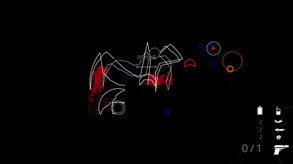
Blindia, developed by IndigoBlue Game Studio and published by PsychoFlux Entertainment, is an experimental top-down action experience that builds its identity around an unusual core idea: navigating and surviving in a world where sound is as important as sight. Rather than presenting players with detailed environments and visually rich enemies, the game adopts a minimalist aesthetic and places heavy emphasis on audio cues translated into visual representations. The result is a hybrid between a twin-stick shooter and a perceptual puzzle, where awareness and interpretation play as large a role as reflexes.
From the outset, Blindia establishes a stark and abstract world. The environments are stripped down to simple shapes and dark tones, with enemies and hazards often represented by geometric forms rather than detailed character models. This deliberate minimalism is not a limitation but a design choice. The visual simplicity ensures that attention is drawn to the way sound manifests in the environment. Sonic waves ripple across the screen, indicating movement, threats, and activity. Instead of relying solely on spotting enemies visually, players must learn to read these patterns as information—an approach that reframes traditional shooter awareness into something more sensory and interpretive.
Gameplay unfolds from a top-down perspective, with movement and aiming following familiar twin-stick conventions. However, the pacing differs from typical arcade-style shooters. Blindia encourages caution and attentiveness rather than constant forward aggression. Enemies react within the confines of the sound-based system, and understanding their audio signatures becomes key to anticipating danger. Each encounter requires players to balance positioning, timing, and interpretation of wave patterns. Combat itself is straightforward in mechanical terms, but the context in which it occurs makes it feel more deliberate and cerebral.
One of the game’s strengths lies in how it integrates its audio-visual concept into both mechanics and atmosphere. The world feels less like a physical landscape and more like a sensory space defined by pulses and vibrations. This creates an immersive quality that is both intriguing and slightly disorienting. The absence of visual clutter heightens tension, as players must rely on subtle cues rather than obvious markers. In moments where multiple sound waves overlap, the challenge becomes deciphering layered information quickly and accurately.
Narratively, Blindia adopts a minimalist approach. There are no lengthy dialogues or cinematic sequences guiding the experience. Instead, the theme is conveyed implicitly through gameplay and environmental tone. The idea of existing in a “blind” world where perception shapes reality suggests a philosophical undercurrent about awareness and interpretation. The game subtly explores how information is processed and how understanding can emerge from abstract signals rather than direct sight. While the story remains understated, it complements the mechanical concept effectively.
In terms of length and structure, Blindia is relatively concise. It does not attempt to stretch its premise into a sprawling campaign but instead delivers a focused sequence of challenges that explore its central mechanic. Some players may find the brevity limiting, especially those seeking expansive progression systems or varied gameplay modes. However, the compact design ensures that the concept remains sharp and cohesive without unnecessary filler.
The visual style, though simple, is purposeful. The restrained palette and geometric design reinforce the sensory focus. Sound design plays a pivotal role, as audio feedback is not merely atmospheric but functional. The interplay between what is heard and what is seen forms the backbone of the experience. Without attentive listening, success becomes significantly harder. This reliance on audio distinguishes Blindia from many other indie shooters and makes it particularly memorable.
Ultimately, Blindia stands out as a thoughtful and experimental indie title that prioritizes concept over spectacle. It challenges players not just to react but to interpret. While its scope may be modest and its mechanics intentionally streamlined, the cohesive integration of sound and visual abstraction gives it a distinctive identity. For players interested in unconventional design and sensory-driven gameplay, Blindia offers a focused and intriguing journey that lingers beyond its runtime.
Rating: 6/10