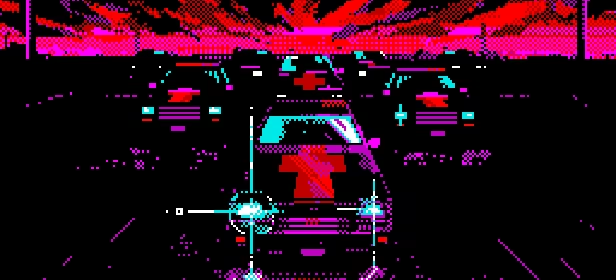
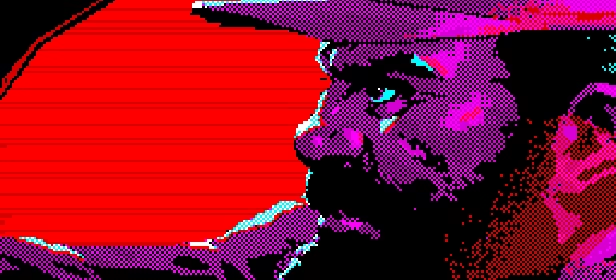
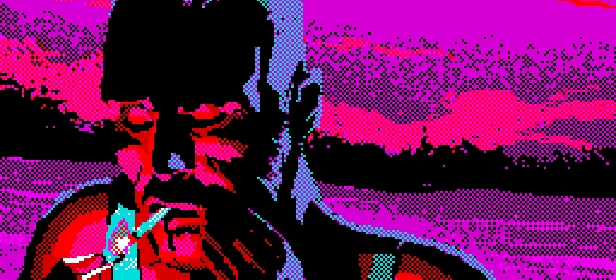
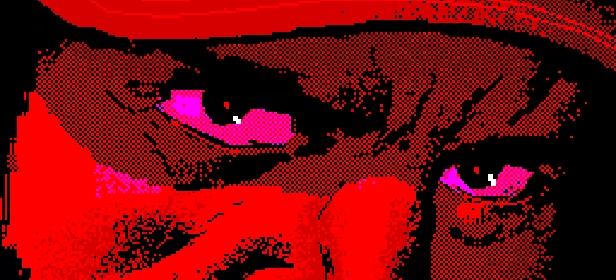
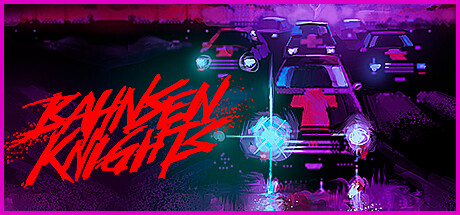
1986, Tornado Alley, USA… Go undercover as Boulder, an agent infiltrating the notorious religious cult known as the Bahnsen Knights. Face off against occultists, biblical storms, and an enigmatic car salesman turned preacher as you investigate the disappearance of a fellow agent and close friend.
Modeled estimate, not a reported figure. How we estimate →
Discounts
Every price cut of more than 20% we have observed, in each market that quoted one, with this game's chart position on either side of it. These are episodes, not a model: a sale is one event, and one event cannot tell you what the next one will do.
Reviews, worldwide (the counter carries no country): 0/day in the week to Aug 27 → 0.14/day in the week after.
For scale, across Steam · Top Sellers · Brazil over the last 30 days: the 26 chart moves that followed a price cut of more than 20% went a median of 7 places towards #1, and the 2,400 moves with no price cut behind them went 2 away. One store, one chart, one country — it is the only place we have enough observations to say even that.
Prices outside the United States have been collected since 6 August 2026 and chart positions since 19 July 2026, so a cut older than that has no market to compare and a market that joined later has no history yet. Nothing here is converted between currencies.
About


Sums Steam only; PlayStation, Xbox, GOG, Nintendo publish no volume signal, so the true total is higher by an unknown amount.
| Store | Price | Audience | Score | Chart | Est. revenue |
|---|---|---|---|---|---|
SteamYou are here | $9.99 | 91reviews | 96% | — | $13.7K |
| $25.99 | 78ratings | 80% | — | not modelled | |
Engagement
Reviews
Themes across 41 recent reviews and how positive each mention is. A keyword signal, not full sentiment analysis.
Reviews
美术这一块
Very conflicted on Bahnsen Knights. This is the first game from LCB I've played, so the style in which you play is a little new, but not completely foreign to me, as I have played visual novel games before. I did love the style overall. Both in the overall tone in how the story played out, as well as the the frames in how it was presented (and the color tone). On the other hand, I would say that for a game this short (which is great and not a negative), it is important that every story beat and choice matters in how the game is presented. And I feel as though this is demonstrated very well until the climax, which then ends the game almost 3-5 minutes later. The abruptness in how the game ends, and how things get to the climax, just seems incredibly out of place; both in the character with which you've come to know, as well as how the story is told. I hate to say that it ended with a thud, but I just feel like this is lost potential on what could have been a really great story, had it not only ended the way it did. With perhaps a little more workshopping, the ending could have falling in line with the character you've been playing. I do understand that games/stories cannot end the way I (or anyone) would like them to, so it's not necessarily the ending itself I'm disappointed with (though it seemed odd), it was the tone of the ending. Felt very much like a John McClane ending, which was not the character you play. Overall, I'd say to play it if it comes on discount, as 3/4 of the game is really enjoyable.
Media

Related
Related
Price dynamics, follower growth, revenue and sales trajectories with interactive tooltips
This and every other Pro feature is free until October 20, 2026. A free account is all it takes.
Genres
Stats
All-time low is the lowest price we've recorded for this game since we started tracking it.
Languages: English, French, German, Japanese, Spanish - Latin America
| $9.99 |
| 16ratings |
| 70% |
| — |
| not modelled |
| $2.99−70% | 6ratings | 76% | — | not modelled |
| $9.99 | — | — | — | not modelled |
Matched by title — a reused name can pair the wrong games. * is a critic aggregate. Prices and positions are each store's United States storefront; Epic charts worldwide. Audience and Score too, except Steam's, which is worldwide.
Hours played at review time, across 41 reviews with recorded playtime.
positive critical· bar length = how often the theme comes up
The outstanding and alluring pixel art-style is what draws me to purchase it. But as soon as I started playing it, the story and the way the game expressed this short story is even more fascinating. Large areas of red and purple pixels create a depressing and mysterious atmosphere, which perfectly fit with the storyline. And it's also interesting that this game used concise text to create many characters with distinct personalities. ps: also giving me some sort of Pulp Fiction feel.
Years ago I played the first title in the Pixel Pulps franchise, [i]Mothmen 1966[/i] and really enjoyed it as a throwback semi-graphic adventure with cool retro style and a few mini-games. So I decided to buy [i]Bahnsen Knights[/i] too after trying the demo, I liked it too but not as much as the previous one. Graphics and sound are still top notch for what they are, but for a supposedly Pulp adventure there's nothing weird, supernatural or absurd about it, it's all very grounded. And the protagonist is not very interesting since, as an undercover cop, we know almost nothing about his "real" identity so we're not too invested in his struggles. Also the fact that the good guy and bad guy look somewhat like Bud Spencer and Lupin III is kinda distracting :D And, like all LCB games, there's always an annoying incomprehensible card game that feels forcefully inserted in the main game, thankfully it's not mandatory to complete the story. In short I liked it but not as much as I thought I would. And, I laughed when in-story one of the characters suggested that LCB stands for "Lewis Carroll Bateman".
Got hooked on LCB games from the very start. The Grizzly Man has the most straightforward story compared to other installments, with easy to follow game mechanics, but at the same time, it pushes pixel-based content to new heights, with easily the most visually rich delivery so far. Despite being a slasher story, it had a perfect blend of gritty and beautiful elements and delivered an overall very satisfying experience. Bahnsen Knights, on the other hand, felt much darker and oppressive, with a strong immersive atmosphere, some of the most ingenious mechanics in similar games, and great dialogue writing. Following on to Varney Lake, which strongly reminded me of Stephen King's The Body, was the most light-hearted story, a nostalgically moody coming-of-age story, but slightly less memorable than the other LCB stories. Lastly, I reviewed these games in the reverse order in which they were played, Mothmen 1966. It felt like something out of the X-Files, and being my first LCB game left me curious and excited to try the other developments. In retrospect, I appreciate how LCB continued to improve and refine their approach to storytelling, use of visuals and creative game mechanics; there’s a lot of thinking and passion poured into these games. Oh, and did I mention that all of LCB's games have banging soundtracks and audio effects? If you grew up playing video games in the '80s - '90s, you’ll love it. PS, this was intended for The Grizzly Man, but Steam bugged out and only recorded 1minute of gameplay instead of ~2hrs, not allowing me to review it.
An incredibly well done experience packed in just roughly 2 and a half hours. It's like playing a pulp comic book that's far above your average read. The writing, pacing, and artwork are all great. Well done for a bar that's not very high in the videogame genre. Definitely worth checking out if you're interested in trying out a visual novel.
Bahnsen Knights is a tightly focused narrative adventure that transforms a bizarre tale of cults, undercover investigation, violent tornadoes, and supernatural uncertainty into something resembling a playable pulp novel. Developed by LCB Game Studio and published by Chorus Worldwide Games, it is part of the Pixel Pulps series, although the story is sufficiently self-contained for newcomers. Rather than relying on elaborate combat or exploration systems, the game places storytelling, player choices, distinctive pixel artwork, and mounting psychological tension at the center of the experience. Set in 1986 across America's Tornado Alley, the story follows Boulder, an undercover agent attempting to infiltrate the Bahnsen Knights. This unusual organization combines religious fanaticism with an obsession surrounding automobiles and terrifying weather phenomena. Boulder has an especially personal reason for taking the assignment because he is searching for a missing fellow agent and friend. The investigation gradually becomes more dangerous as he encounters suspicious cult members, unsettling beliefs, unexplained events, and a charismatic leader whose transformation from car salesman to preacher gives the entire organization an appropriately strange personality. The undercover premise works particularly well because Boulder cannot simply reveal his intentions and question everyone freely. Conversations become part of the investigation, and maintaining credibility around dangerous people is essential. Dialogue choices and decisions give the player some influence over how situations develop, while the possibility of making a costly mistake keeps otherwise straightforward conversations tense. The game is more interested in creating uncertainty than giving players unlimited freedom, so decisions generally operate within a carefully constructed narrative rather than producing an enormous collection of completely different storylines. Its presentation is arguably its most immediately memorable feature. The deliberately limited palette, dramatic character portraits, heavy shadows, and retro pixel illustrations evoke both vintage computer games and inexpensive pulp publications. Instead of treating these graphical restrictions as weaknesses, the art direction turns them into a recognizable identity. Tornadoes, highways, religious imagery, vehicles, and threatening characters can appear surprisingly intimidating despite the low-resolution aesthetic. The visuals complement the writing especially well when the story moves from relatively grounded investigation toward increasingly surreal or disturbing territory. Most of the gameplay consists of reading, selecting responses, examining information, making decisions, and completing occasional puzzles or minigames. Players expecting traditional point-and-click exploration, extensive inventory management, or action sequences should adjust their expectations accordingly. Interactive elements primarily exist to support the narrative rather than compete with it. The additional diversions, including solitaire-related gameplay, prevent the adventure from becoming completely passive and give certain scenes a different rhythm, but none of these systems overshadow the central mystery. The relatively simple mechanics are also where the game may divide audiences. Someone looking for complicated puzzles or a lengthy detective simulation may find the interaction too restrained. Bahnsen Knights often resembles an illustrated interactive novel more than a conventional adventure game, and substantial portions depend on whether the player enjoys reading its dialogue and descriptions. However, this simplicity helps maintain momentum. There are few unnecessary systems distracting from the central question of what happened to Boulder's missing colleague and what exactly lies behind the Bahnsen Knights. The short, concentrated structure suits the material surprisingly well. The premise is intentionally eccentric, and stretching it across dozens of hours could easily have weakened its impact. Instead, the game moves rapidly between investigation, conversations, dangerous encounters, and increasingly strange revelations. Its manageable length also encourages replaying sections to explore different decisions, uncover missed material, pursue achievements, or simply reconsider earlier events after understanding more about the mystery. Although connected to the broader Pixel Pulps universe, prior experience with the other entries is not essential. Returning players can recognize thematic and narrative connections, while newcomers can approach this particular investigation without feeling as though they have entered halfway through an incomprehensible story. The recurring fascination with supernatural Americana, unusual characters, conspiracies, and old-fashioned genre fiction nevertheless gives the game a stronger identity when considered alongside the rest of the series. Steam Deck compatibility is favorable for this style of game. Its lightweight presentation and primarily text-and-choice-based interaction are naturally suited to portable play, and controller-oriented input works well for progressing through dialogue and selections. The small-screen experience is also appropriate for a compact narrative adventure, although players should remain aware that official Steam Deck verification status can change as Valve updates compatibility testing. From a practical gameplay perspective, there is little about its basic design that demands a desktop-style setup. Bahnsen Knights ultimately succeeds through atmosphere rather than mechanical complexity. Its fusion of 1980s Americana, cult fanaticism, extreme weather, undercover espionage, supernatural suggestion, and deliberately pulpy storytelling produces a personality that is difficult to confuse with more conventional visual novels. The retro presentation may not appeal to everyone, and players seeking deep exploration or challenging mechanical systems will probably find it limited. For those who appreciate interactive fiction, unusual mysteries, carefully constructed tension, and striking pixel artwork, however, it offers a memorable and refreshingly distinctive journey. Rating: 8/10
An agent goes undercover in a religious-tinged cult of the Ford Sierra with a charismatic leader. Gather evidence and try not to raise suspicions in this pulpy visual novel. If you've played any of the other Pixel Pulps (Mothmen 1966, Varney Lake, GrizzlyMan (which I haven't yet but it's next on the list)) you know what you're in for. Striking pixel art, terrific writing, and chewable atmosphere. And a clunky (optional) card game… There are a couple "action" sequences where you have to be quick navigating menu choices which too me a couple attempts, but nothing that soured the experience. Would recommend making a save slot at the start of each chapter. So yeah, if you're looking for a quick play and like a good pulp, definitely give Bahnsen Knights a go (or all of the Pixel Pulps)!
Quite a good game, as for me. Love the novel, colors and tension. The only disadvantages that it's kinda the same story as "Mothmen", even some sounds are the same. They couldn't compose a 100% of various songs. Also, freaking card game - even worse than in "Mothmen". Stupid random card drop and idiotic number 48. I don't understand who was that idiot, who created a solitaire in this game. 6/10.
Short, enjoyable, stylish.
Selling now
See how fast this game is selling right now — estimated copies and revenue per day from recent review growth.
Players by region
Where this game's players are, estimated from review languages.
Related
| Game | Estimated lifetime revenue | Reviews | Review score | Price |
|---|---|---|---|---|
| $48.5K | 328 | 91% | $8.99 | |
| — | 0 | — | — | |
| $2.7M | 11K | 98% | $17.99 | |
| $206.1K | 1.3K | 89% | $10.99 | |
| $76.4K | 308 | 91% | $14.99 | |
| $12.8K | 76 | 99% | $9.99 |
Related
| Game | Estimated lifetime revenue | Reviews | Review score | Price |
|---|---|---|---|---|
| $13.7K | 150 | 96% | $6.99 | |
| $13.7K | 54 | 89% | $7.99 | |
| $13.7K | 153 | 70% | $8.99 | |
| $13.7K | 121 | 92% | $4.99 | |
| $13.7K | 117 | 92% | $3.99 | |
| $13.8K | 264 | 78% | $2.99 |