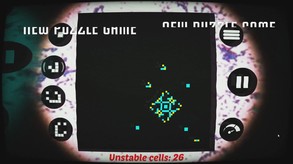
Bacteria, developed and published by Sometimes You, is a peculiar hybrid that sits somewhere between a puzzle game, a simulation, and an abstract experiment. It takes its foundation directly from Conway’s Game of Life—a system governed by simple rules that produce complex, often unpredictable behavior—and attempts to reshape that concept into something interactive. What emerges is a game that is intellectually interesting and occasionally mesmerizing, but also inconsistent in how effectively it translates its core idea into satisfying gameplay.
At its heart, Bacteria revolves around a grid of cells that evolve over time based on a fixed set of rules. Cells live, die, or reproduce depending on the number of neighboring cells around them, creating patterns that shift and transform with each passing step. The player’s role is not to directly control the outcome, but to influence it by placing cells in specific positions. This indirect form of interaction defines the entire experience. Instead of solving problems in a linear or predictable way, you are essentially nudging a system and observing how it reacts.
The game offers structured levels that attempt to turn this system into a puzzle format. Each challenge asks you to eliminate or stabilize certain formations within the grid, often with limited resources or placement options. In theory, this creates a unique type of problem-solving, where understanding patterns and anticipating outcomes becomes key. In practice, however, the experience can feel inconsistent. Because the system is inherently unpredictable, even well-thought-out decisions can lead to unexpected or counterproductive results. This can make success feel less like the result of careful planning and more like a combination of experimentation and luck.
Alongside these structured challenges, the game includes a more open-ended mode that allows for free experimentation. This is where Bacteria arguably feels most natural. Without the pressure of objectives, the system becomes something to observe and explore rather than something to control. Watching patterns emerge, evolve, and collapse can be surprisingly engaging, especially for players who enjoy systems-driven experiences. It shifts the focus away from winning and toward curiosity, which aligns more closely with the nature of the underlying concept.
Visually, the game is extremely minimal. The grid-based interface is clean and easy to read, but it lacks variation or stylistic identity. This simplicity makes sense given the mathematical nature of the system, but it also contributes to a somewhat sterile presentation. There is little to distinguish one scenario from another beyond the arrangement of cells. The audio design, on the other hand, provides a more noticeable contribution, offering a calm and ambient backdrop that complements the slow, methodical pace of the gameplay.
One of the main challenges the game faces is how it frames itself. By presenting its systems within a puzzle structure, it invites players to approach it with expectations of logic and control. However, the underlying mechanics resist those expectations. The lack of predictability can lead to moments where outcomes feel arbitrary, especially in more difficult levels. This disconnect can be frustrating, particularly for players who prefer puzzles with clear solutions and consistent rules of engagement.
Despite these issues, there is a certain appeal in what Bacteria offers. It introduces players to a fascinating concept and allows them to interact with it in a way that is rarely seen in traditional games. For those who enjoy experimentation and are willing to embrace uncertainty, it can provide moments of genuine intrigue. The system itself is compelling, even if the surrounding structure does not ყოველთვის support it as effectively as it could.
However, the experience is not without its limitations. The lack of variety, both in mechanics and presentation, can make extended play sessions feel repetitive. The confined play area also limits the potential for more complex or large-scale patterns, which might have added depth to the simulation aspect. Over time, the novelty of the system can wear off, leaving behind a gameplay loop that struggles to maintain engagement.
In the end, Bacteria is best understood as an experimental title that prioritizes concept over refinement. It does not fully succeed as a traditional puzzle game, but it offers something different—a chance to interact with a system that is both simple and endlessly complex. For a niche audience, this will be enough to make it worthwhile. For others, it may feel more like an interesting idea than a fully satisfying game.
Rating: 6/10