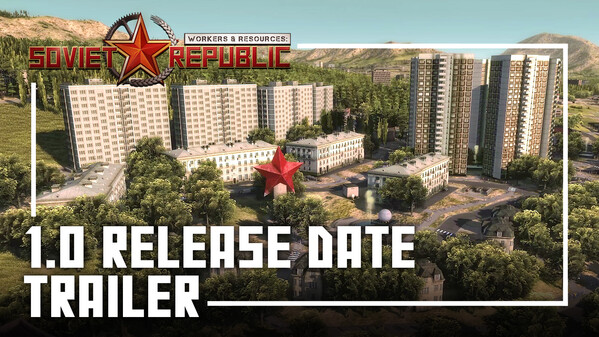
Build a soviet republic from an impoverished country into a rich industrial superpower in a city builder with intricate production chains and a fully simulated global economy. Manage the lives of your citizens from education to work and party loyalty to criminal activity.
Modeled estimate, not a reported figure. How we estimate →
Prices
Each in the currency that store quoted — not converted: the gap between two rows is the publisher's pricing, not an exchange rate.
Charts
Each storefront's own chart, in its own country — the closest public signal to sales where none is published. A country missing from a list is one we don't collect there, not one where the game doesn't chart.
No United States chart position — it charts only in the markets below.
Same day: best RU #84, worst PL #89 · 2 markets collected
Discounts
Every price cut of more than 20% we have observed, in each market that quoted one, with this game's chart position on either side of it. These are episodes, not a model: a sale is one event, and one event cannot tell you what the next one will do.
Reviews, worldwide (the counter carries no country): 11.14/day in the week to Aug 22 → 17/day in the week after.
For scale, across Steam · Top Sellers · Brazil over the last 30 days: the 26 chart moves that followed a price cut of more than 20% went a median of 7 places towards #1, and the 2,400 moves with no price cut behind them went 2 away. One store, one chart, one country — it is the only place we have enough observations to say even that.
Prices outside the United States have been collected since 6 August 2026 and chart positions since 19 July 2026, so a cut older than that has no market to compare and a market that joined later has no history yet. Nothing here is converted between currencies.
About
Manage all aspects of your republic in this soviet-themed city builder game. A planned economy puts you in control of everything from mining resources to manufacturing goods and providing services – use this power to make decisions that impact your citizens’ day-to-day lives and their ultimate loyalty to the nation. Whether it’s construction, transportation, trade, healthcare, education, entertainment, tourism, or any of the countless other facets of a full-fledged city, it’s up to you to determine availability, accessibility, and quality. Contend with a deep simulation of global supply chains as you seek fertile soils, ore veins, and viable lands upon which to build your nation – let the radio stations sing your praises and the citizens rejoice in their glorious soviet republic.

Multiple complex simulations work together to bring your cities to life in Workers & Resources: Soviet Republic – whether it’s the price of goods in the global market, the proper distribution of electricity and water, or the increased supply of heat during the winter months, everything can be manipulated with the right actions. Adjust your game settings based on your appetite for complexity in particular areas – civil engineers, urban planners, economists, and simulation enthusiasts will all be able to experience the mechanics they love.
Run your nation with both rubles and dollars as you strike a balance between eastern and western markets, trading with nations from either side of the Iron Curtain to gain access to valuable currency, resources, and technology. Despite following a soviet-styled planned economy, you are a fledgling non-aligned nation – this sets you free to engage in trade with both the Western Bloc and the Soviet Bloc to your benefit. Loyalty to one side is always an option, but flooding one market with your goods might result in diminishing returns, and shunning the other side might see you cut off from useful technological advances.
Familiarize yourself with the intricacies of realistic supply-chain management with over 30 commodities to acquire, manufacture, and transport. Raw materials, processed goods, and waste material all have specific places where they can be stored, with specific vehicles needed for their transportation, and specific structures needed for loading and unloading. Liquids are stored in tanks and moved with the help of pipes and pumps, or loaded onto vehicles with tanks. Mined ores are stored in aggregate storage facilities, and moved with conveyor belts and flatbed trucks and train cars. Processed goods, meanwhile, are shipped around in covered trucks and train cars, and stored in warehouses. Organize forklifts for short distance hauling, build intricate conveyor belt networks to minimize your reliance on vehicles, or use trains to haul goods from one city to another – supply-chain management is an integral part of operating a nation, and you’ll use everything from cargo planes to freight trains to cargo helicopters to make sure everything is operating smoothly.
Every road, bridge, residential building, and factory is built from the ground up with resource costs reflecting the size of the project. Pay market rates for raw materials to execute quick builds with the help of foreign labor, or establish construction offices and provide employment to your population as they head to construction sites to build everything using locally acquired resources. Buildings can require anything from prefab panels, to steel beams, gravel, concrete, and more – produce and supply them locally, or import them to simplify the process. Will you be a self-reliant republic, or will you exploit the international market for rapid expansion?

A nation is nothing without its people – they work the fields, bake the bread, and operate the heavy machinery that keeps the wheels of industry turning. Ensuring the people remain happy and loyal is essential to your success.
Follow your citizens from childhood to the end of their lives, providing them with essential goods such as food and clothes (and alcohol) while simultaneously ensuring they have access to opportunities in the form of education and employment. Be wary of those that lack loyalty to the republic – they are prone to a life of crime, and their reduced efficiency can hurt throughput. Oftentimes, they are best left without access to opportunities where they can do more harm than good. Monitor your nation’s overall happiness and loyalty to ensure few are choosing to leave – provide them with better lives, or rely on propaganda to get the most out of your citizens.
Your peoples’ needs can be imported from neighboring countries, or they can be manufactured locally through complex production chains. Massive fields will harvest grains that can be turned into bread and booze at food factories and distilleries. Clothes factories will produce clothes as long as they have fabric, which in turn is produced at fabric factories with the help of crops, chemicals, and water. Manufacture or otherwise acquire all manner of goods, from the aforementioned necessities to the luxuries of radios and TVs, and transport them from factories to warehouses to local stores where your citizens can obtain them to fulfill their needs.
There are many essential services your citizens will want access to as well – electricity, water, and heat are necessary for survival, each with their own supply chains to maintain. Watch for demand to ebb and flow with the seasons, and prepare for harsh winters lest your population suffers a sudden tragic drop. Education is provided through schools and universities, with higher levels of education opening up additional employment opportunities for your people, unlocking access to new technologies and production capabilities in your nation. Entertainment comes from local parks and theaters as well as radio and TV stations, while physical fitness is provided by local pools and sports fields. Ensuring these services are available and within reach through an efficient transit system is essential for a healthy, prosperous populace.

From roads to railways, and from sea to sky, managing the transportation of goods and people is vital to the health of your republic. As your nation spreads and cities develop around resource hubs littered across massive maps, you’ll find yourself constantly expanding your transportation network to meet ever-growing needs.
Buses, trams, trains, subways, ships, and planes provide public transportation for people to move greater and greater distances, fulfilling needs at distant shops, or providing their expertise at far-flung factories and mines. Operate interconnected systems to facilitate the movement of people across these massive expanses, even using cable cars and winding dirt roads to provide access to the more remote parts of your republic.
Trucks, trains, cargo planes, and cargo ships are essential for moving resources long distances, with different subcategories of each vehicle determining exactly what type of goods it can move. Limited access to certain vehicles might force you to explore transit methods you would otherwise have left behind – or perhaps you’ll build connections at customs offices along your border to enable trade with foreign powers instead?
Build custom airports, plan the placement of train signals, and design intricate interchanges to truly customize your transit networks. Road signs will influence speed limits and vehicle access, runway length will determine accessibility for various kinds of airplanes, and train stations can be built for passengers or cargo, with access points for pumps, conveyor belts, and forklifts to integrate smoothly into your existing supply chains.
Allow your people to purchase cars for private transit, but consider limiting access to such vehicles based on education levels or party loyalty to prevent the plague of freedom of movement and congestion – with well planned infrastructure and transit networks, you can fully control the flow of workers and resources alike.

Workers & Resources: Soviet Republic has dedicated modding tools and a plethora of extensive player-created mods available in the Steam Workshop. Customize your experience with new buildings and vehicles to build the soviet republic of your dreams.
Add-ons
Each DLC is estimated with the same model as a game, then summed — a modeled figure, not reported DLC sales.
Sums Steam only; GOG, Epic publish no volume signal, so the true total is higher by an unknown amount.
| Store | Price | Audience | Score | Chart | Est. revenue |
|---|---|---|---|---|---|
SteamYou are here | $39.99 | 27.4Kreviews | 91% | — | $34.2M |
| $9.99−75% | 120ratings | 82% | — | not modelled | |
Updates
Build ids and update times come straight from Steam's PICS — the same source SteamDB reads. Patch history grows as we record new builds.
Engagement
Reviews
Themes across 1265 recent reviews and how positive each mention is. A keyword signal, not full sentiment analysis.
Reviews
230 godzin i wciąż odkrywam nowe sposoby na przypadkowe wymordowanie własnej populacji przez głupie niedopatrzenie. Myślę że wraz z postawieniem pierwszej funkcjonalnej republiki gracze powinni dostawać dyplom, odznaczenie państwowe i 100 tysięcy żappsów
Please please add some proper middle-20th Soviet music—not just bombastic COMRADES songs! For example, "Mr. Trololo" and things like that—the internet is full of great examples of Soviet music!
Media

Related
Related
Price dynamics, follower growth, revenue and sales trajectories with interactive tooltips
This and every other Pro feature is free until October 20, 2026. A free account is all it takes.
Every market we collect.
Genres
Stats
All-time low is the lowest price we've recorded for this game since we started tracking it.
Languages: English, French, German, Polish, Russian, Simplified Chinese, Spanish - Spain, Italian, Japanese, Portuguese - Brazil, Hungarian, Korean +6 more
| $39.99 |
| — |
| — |
| — |
| $0 |
Matched by title — a reused name can pair the wrong games. * is a critic aggregate. Prices and positions are each store's United States storefront; Epic charts worldwide. Audience and Score too, except Steam's, which is worldwide.
Hours played at review time, across 1.3K reviews with recorded playtime.
positive critical· bar length = how often the theme comes up
Не то что бы прям я ставлю большой минус этой игре, а скорее даже наоборот: + Модификации зданий и транспорта + Хорошие игровые механики + Приятная графика Но есть то что меня просто вгоняет в депрессию..... Почему нельзя просто поставить остановку уже на существующую дорогу??? Почему казалось бы в совсем давнем Tropico можно не разбирать половину улицы для этого? Не говоря про серию Transport Fever и т.д. Может я что-то не понимаю, и иначе было ну просто никак.... Или я чего-то не знаю, и всё же остановки попроще поставить можно?
Realment es un joc molt bó, tot i que hi ha cops que te alguns petits problemes però es molt recomenable passes les hores sense adonar-te, enganxa molt.
I'm giving this thumb down despite finding this game very interesting. It is honestly an incredibly deep game that could be one of the best management games ever but it's an incredibly frustrating game! The UI & UX is absolute garbage from hell. It's so bad I suspect it's malicious, devs want us to suffer. There are countless extremely tedious steps, unexplained mechanics, annoying tools, etc... I'll take that one example but that's one of MANY: Installing utilities really really suxs. Let's talk sewage. You have to slop the sewer pipes (makes sense). The game gives you ZERO feedback on the slop, so you are left guessing, using the topographic view and hoping you did it right. If you want to modify the network in the future again terribly tedious. Sewage pipes can't just connect to another pipe oh no, you have to use these "hub" buildings?!?! now maybe that would be ok if you could place said building on an existing pipe but, plot twist you can't!! NO BIG DEAL you say, I'm going to delete that section of pipe, place the building and reconnect the pipe. Well, no! The building depth can't be adjusted so now you have a high point in your system. Now could install a pump, which is a different building which uses power or you need to REDESIGN YOUR ENTIRE SYSTEM to be able to connect these two pipes.. I guess the devs don't know that plumbers have a nifty little thing call Ys, where two pipe can combine into one. It's brilliantly simple but I guess to advanced for the socialists :D Anyways I could go on with at least 20 example like this, just quick one, bus stops can't be placed on roads. You have to delete the road, place the stop and rebuild the road connecting both ends of the stop. So here I'm I both love and hate this game. I really want to play it at the hardest difficulty level but the general UX would make this impossible I think. Transport Fever 3 is coming out in a few weeks I can't wait to move on it it...
If you: 1. are from a former Eastern Bloc country 2. live under a socialist-oriented government 3. live in a Third World dictatorship that is still trying to revive the good old days 4. are interested in experiencing the planning hell of a socialist nation with a highly centralized economy 5. enjoy watching and learning about the progress of modernization in the Second and Third Worlds 6. enjoy creating hell or heaven (depending on your vision of life) I can say this game is for you! This game features a highly centralized economy and goes into great detail about urban planning under a socialist state. The concept of state-controlled culture and media is well represented through its small yet lore-rich campaigns. You can roleplay as: 1. a socialist dictator commanding a planned economy across many different aspects of a nation, depending on what resources are available to you. 2. a socialist dictator scared of the concept of disloyalty, opting to propagate loyalty by building monuments, establishing radio and TV broadcasts, and doing your best to demolish any religious affiliation. 3. a careful planner trying to maintain a well-fed, well-kept, and healthy society as it moves towards prosperity. 4. a Third World dictator focusing on raking in oil money and keeping people in depravity so you can oppress them as easily as possible. The game has many gameplay mechanics and gameplay loops to boast about, including: 1. Transportation via many different methods and means, ranging from ordinary buses and trams to extraordinary cable cars and air travel. You dictate access to transportation for each town and city. Taking people from point A to point B has never felt so detailed and thought-provoking. 2. Water and sewage management is not just a matter of "pumping water to people's houses and taking the waste to the river." You have to deal with realistic aspects of water management such as distribution height, slope, and pipe capacity. This makes city planning harder than you might imagine, yet when done correctly and efficiently, you start to feel rewarded. 3. You have to take a methodical approach to society. People are not random entities that rely on food and water to survive. Their needs are based on Maslow's hierarchy of needs. At first, they will seek to satisfy their basic needs, which are "food, clothing, and shelter." You will be building suitable housing and food and clothing distribution systems, and that is just the beginning. People then need jobs and a way to get to them. You have to create an intricate transportation system to give them a reliable way of getting to work. After that, people also have children, from infants to teenagers, for whom you have to provide education. Therefore, you need care and education facilities to provide them with proper education, as literacy is essential for people to be able to work in the different factories and production chains that you establish during your gameplay. 4. Then comes the matter of entertainment. Entertainment is essential for the human soul, and you have to provide an ample and easily accessible number of cinemas, sports facilities, and museums to keep people entertained and their minds and bodies healthy. However, you can also take the easy way out, just like a real Soviet leader, and pump alcohol into the population, which has the effect of increasing illness and accidents. If you are playing as a dictator who is focused entirely on money, this should not be a problem for you. 5. When all needs are met, the matter of keeping people safe from incidents comes next. Hospitals and fire stations are there to provide healthcare and safety. The hospital-bed-to-population ratio is extremely important: a small hospital in a large city will not be able to operate effectively, while a large hospital in a small city will drain your finances. The same goes for fire stations. The size of the firefighter crew, the number of vehicles, and their maintenance costs all affect cost efficiency. Careful placement and planning are therefore needed to create an effective care and prevention system. 6. Crime is separated into two parts in this game. The first is ordinary crime, which police stations are there to keep at bay. The second part, however, is "Thought Crime." People have a loyalty factor, which indicates how much hardship they are willing to endure under your rule. Meeting their basic needs will only increase their loyalty to a limited extent. However, having your small ruling nation located next to a NATO border allows people to tune into Western radio and have their loyalty lowered. People with higher levels of education are also more susceptible to having their loyalty lowered. Now imagine that you have a population on which you have spent money and resources to keep healthy and happy, only for them to become disloyal and escape, causing all of that investment to be lost in a blink of an eye. The creation of a secret police organization therefore becomes a necessity. Keep them happy, but also keep them in check. We cannot have that sort of civil "disorder" in our perfect state, now can we? 7. The production of each good, whether industrial, civilian, or military, involves an extensive production chain that needs to be carefully designed and balanced in order to operate efficiently. The throughput ratio has to be carefully considered to ensure a good reinvestment profit through the sale of final goods. A broken or unbalanced production chain only wastes money and causes a net loss. However, the game has some negative points as well: 1. The graphics have always been a controversial point about this game. The most important issue, in my opinion, is the highly realistic textures being applied to very crude 3D models. The textures demand detail, yet the models have little to offer. This can be an immersion-breaking factor in my eyes. However, the graphics have improved since the early releases and continue to improve with each update, so I am optimistic about this aspect of the game. 2. The way the game handles job-finding for people is janky. Sometimes, people choose factories and workplaces that are located at far-off distances and are meant to be filled by other groups of people that you have already designated for those workplaces. These distant workers will fill up train and bus stations or drive their cars long distances to get to their workplaces. On the other hand, Work/Rest hours dictate how many hours a person may spend at a workplace. Transportation to and from a workplace also counts toward these Work/Rest hours, causing people to spend excessive amounts of time traveling without reaching their job locations or homes. 3. Character portraits in the game UI are made using AI. Although they are not very important to the game and are easy to ignore or turn a blind eye to, they still represent the use of AI. The audience of this game may have varying opinions on AI usage, but to me, it is a negative point, although a very minor one. 4. The background music has a very small playlist and sometimes becomes loud and distracting. The repetition in the music can become like sandpaper on the eardrums. To me, the biggest deterrent to this game is its small music playlist. I tend to mitigate this by having my own selection of Soviet-era music playing in the background and muting the game's music. However, this point is also being addressed, as I have witnessed additional background music being added to the game. Also, we really cannot expect too much from a small studio or producer. The existing selection is already fitting; however, as I said, it gets repetitive. In my opinion, this could be fixed by adding intervals of silence. And so, in my opinion, give it a try. You won't regret your decision to purchase this game.
How this game has 89% is beyond me. Controls are teribble, UX is non-existant, UI looks like from the game from 2000s. You play this more like AI slop game not something human made. For City builders fans i recomend you to stay away from this game
Таких ленивых людей я еще нигде не видел, для них пешая доступность это 500 метров... я бл##ь в больницу на другой конец города пешком хожу, а им лень 501 метр дойти до магазина
Познал плановую экономику через эту игру. Конечно, довольно много нереалистичного, но баланс того стоит. Разобраться с простыми режимами несложно вообще. С реалистичным режимом, конечно, нужно попотеть, но с консультациями с нейронкой тоже вполне возможно
同志,干得漂亮,你的工作成果非常出色,列宁同志会为你感到骄傲的!
Active players
Estimated daily and monthly active players (DAU/MAU) modeled from peak concurrency.
Players by region
Where this game's players are, estimated from review languages.
Players also reviewed
The games this title's players most often review too — audience affinity.
Related
| Game | Estimated lifetime revenue | Reviews | Review score | Price |
|---|---|---|---|---|
| $18.8M | 18.9K | 94% | $29.99 | |
| $2.5M | 2.1K | 91% | $29.99 | |
| — | 0 | — | — | |
| $7.5M | 3.4K | 86% | $39.99 | |
| $3.5M | 3.6K | 92% | $29.99 | |
| $2.5M | 2.3K | 93% | $29.99 |
Related
| Game | Estimated lifetime revenue | Reviews | Review score | Price |
|---|---|---|---|---|
| $34.3M | 30.2K | 93% | $48.99 | |
| $34.3M | 12.8K | 69% | $38.99 | |
| $34.3M | 70.2K | 65% | $29.99 | |
| $34.1M | 88.7K | 97% | $19.99 | |
| $34.3M | 24.2K | 87% | $34.99 | |
| $34.1M | 22.9K | 47% | $69.99 |