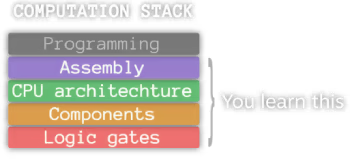
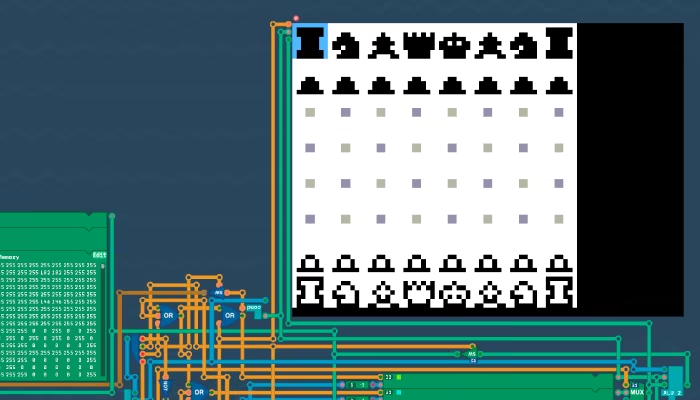
Learn CPU architecture with puzzles
Modeled estimate, not a reported figure. How we estimate →
Prices
Each in the currency that store quoted — not converted: the gap between two rows is the publisher's pricing, not an exchange rate.
Every market we collect.
Charts
Each storefront's own chart, in its own country — the closest public signal to sales where none is published. A country missing from a list is one we don't collect there, not one where the game doesn't chart.
No United States chart position — it charts only in the markets below.
Latest in each market: best FR #86, worst PL #97 · 2 markets collected
Discounts
Every price cut of more than 20% we have observed, in each market that quoted one, with this game's chart position on either side of it. These are episodes, not a model: a sale is one event, and one event cannot tell you what the next one will do.
Reviews, worldwide (the counter carries no country): 3.71/day in the week to Sep 10 → 12.29/day in the week after.
For scale, across Steam · Top Sellers · Brazil over the last 30 days: the 25 chart moves that followed a price cut of more than 20% went a median of 10 places towards #1, and the 2,413 moves with no price cut behind them went 2 away. One store, one chart, one country — it is the only place we have enough observations to say even that.
Prices outside the United States have been collected since 6 August 2026 and chart positions since 19 July 2026, so a cut older than that has no market to compare and a market that joined later has no history yet. Nothing here is converted between currencies.
About


Genres
Updates
Engagement
Reviews
Themes across 992 recent reviews and how positive each mention is. A keyword signal, not full sentiment analysis.
Reviews
The premise of this game is great. It's a fantastic way to get an introduction into how computers work, and how/why low-level manipulations work. However... the solo dev suffers from a severe case of scope creep and lack of ability to finish. It's... common amongst us developers. We get 80% of the way there, and the only work that's left is the boring, tedious stuff, and move on to the next shiny, fun thing. So what we're left with is a game that's mostly complete, but not quite, and will never be complete, because the dev is too busy working on a new "feature" for the game, instead of finishing up the rest of the game. It's been languishing in EA for years now, and the main branch hasn't been updated in over two years. The last update, back in February 2025, was for the new "2.0" branch... because the dev went down a rabbit hole for a new feature they wanted to add, which resulted in a "complete rewrite of the game". But the new version is severely buggy, to the point where community members have developed their own patches to try to make it playable, and the dev hasn't made another update since. I want to see a completed game that I can actually play all the way through, not a perpetually 80% complete game that continually has new, 80% complete features added to it.
Media

Related
Related
Price dynamics, follower growth, revenue and sales trajectories with interactive tooltips
This and every other Pro feature is free until October 20, 2026. A free account is all it takes.
Stats
All-time low is the lowest price we've recorded for this game since we started tracking it.
Languages: English, French, Simplified Chinese
Build ids and update times come straight from Steam's PICS — the same source SteamDB reads. Patch history grows as we record new builds.
Hours played at review time, across 995 reviews with recorded playtime.
positive critical· bar length = how often the theme comes up
This game helped me get hired because I could put "designed a Turning complete computer from scratch" on my resume. 10/10
As a long time advocate of computer architecture education, I am sad to leave a negative review of this amazing game. I have come back to play this game over many years only to be more frustrated every time I return. I will summarize what I love about the game (and unfortunately, what I don't...) in the next few paragraphs. At first, I was drawn to this game because of how accessible it was compared to asynchronous digital logic simulators like Verilator or Cocotb. Because Turing Complete disallows asynchronous logic, it abstracts away details that are not of concern for small, simple synchronous designs that only have have a single global clock. This means that all logic elements in Turing Complete that are clock edge sensitive do not have clock input pins; the clock inputs are implicit at all times. This also means there are no clocking issues such as skew, clock domain crossing, etc. This simplicity works wonders for this game, as this is the regime that a lot of computer implementations can be boiled down to (neglecting dynamic frequency scaling and other related features). Without adding the needless complexity of asynchronous signals for these designs, the scope is clear and the "contract" between the player and the game is clear; "The first rule about [clocking] is: do not talk about [clocking]". The most challenging part of learning digital design for me was system integration; designing (or using someone elses) modular components and then connnecting them in a sensible way to achieve the goals of the design while managing complexity. Complexity and disorganization were tricky for me, and it tought me why computer microarchitecture is also called computer organization, it is truly an essential element of any design that is not trivial. In Turing Complete you are given a component factory which is a small area where you can design modules that can be used in other designs or modules. While this feature is not unique to Turing Complete (the two most widely used hardware description languages, Verilog and VHDL, both implement modules), I thought the implementation was unique, interesting, and fun to use. Unfortunately, this is also where the game started to fall apart for me. The component factory in many circumstances in which I have tried to use it simply does not work. It works for extremely simple circuits but beyond a certain scale, it always managed to break my designs. The most perplexing issue I had with the component factory was when I was designing a circuit that would read binary code from a file and load it into game memory. Whenever I tested the control signals in the component factory, the simulation worked as expected and my circuit passed all of my tests. As soon as I put the circuit in another design, it behaved differently. This bug bothered me for hours until I tried copy and pasting the entirety of the module into the design I was trying to use it in and it once again worked. There is something very, very wrong with the simulation framework of modules in Turing Complete, and for me it completely defeats the purpose of using the component factory. I would rather save myself the headache of using the component factory only to ask myself the question "will it work?" later. This is a deal breaker for me considering how much modularity helps organize my circuits. Also, the main branch of this game has not been updated for more than 2 years (at the time of writing). This means these game breaking bugs have remained in the game for years, still there for me to discover every time I come back. Every time I have come back to play this game, these issues have ruined my experience. The Turing Complete community (and the developer) say that the 2.0 update is coming, and there is a beta branch available for people to try. I switched to this branch to see if it would fix the issues I was having, and alas I wasn't even able to get to the component factory before the game crashed and wouldn't reopen with an empty log file. Whatever state the 2.0 update actually is, it is completely unplayable for me and bricked my game executable, I can only play in the main branch now. This is not the experience I was expecting after 2 years of development. These issues are disappointing because they hold me back from experiencing the full potential of my creativity in a tool that promised that I would be able to express those things. The Turing Complete Steam page even advertises "The game is built on a powerful simulator, that gives you total freedom in how you solve levels or create your own computers." Once I can use the component factory in the intended way without the game crashing or simulating my designs incorrectly, I will change my review because I do love this game. For now, I will go back to Verilator.
Beautiful refresher for computer architecture disguised as a puzzle game. Feel like this could unironically accomplish the same or better level of understanding than an entry level uni course for people who haven't studied the topic yet. P.S. If you added modding support I think I would literally ♥♥♥ in my pants
玩了觉得自己牛的一批,已掌握硅基生物命门。自信满满打开408真题第一题就不会做。
In the years I've owned this game and the 677 hours at the time of this review I've put into it, Turing Complete has changed a lot, both for better and for worse. The game used to be, all things considered, relatively simple (and broken). Learn the basics of logic gates, build up basic components until you can create a simple 8 bit computer sans a clock component, then introduce slightly more advanced concepts to help you build to an 8 bit computer with 4 instruction bytes. After a certain point, both now and then, the sandbox becomes available and the game is what you make of it. So far, so good. The game was initially pretty broken, counting each gate by the number of NAND gates used, but OR gates could be completed with just 2 wires combined together, making each level a challenge of using as many OR gates, then NOR or NAND gates as possible, with AND, XOR and XNOR gates being very high cost. The game eventually was updated to fix that issue by not only making the 4 basic logic gates use the same cost and delay, but also by disallowing 2 inputs on 1 wire at the same time. A very positive change that helped took the game from a cheese fest to how it was intended to be played. The challenge of using De Morgan's law to optimize levels wasn't bad, but obviously it wasn't the way the game was meant to be played. The update was implemented, bugs fixed, great. Not everyone was happy, but nobody's going to get their game perfect on the first try and not everyone is open to change. And then, the game sat silent for years, the only real news being from the Discord server. But finally, the silence is broken and the game is receiving updates! Great, right? Well... no. And that's why I can't currently recommend this game. Updates are still slow and infrequent, as infrequent as meaningful updates on the progress of the game. I understand fully that programming a game where you build and program a computer is hard, very hard. Especially to make it work efficiently and smoothly in a way that allows for future growth without needing to break the game with each update. But therein lies the problem. Progress towards that goal is slow and erratic. One issue gets fixed but another gets implemented. Yes, that is the development cycle, but when entire levels are broken and all it would have taken was one day, quite literally one day of having even a single person who knows what they're doing play through your game to say "Hey, this level is busted, it cannot be beaten without using the console", something average players or someone outside of the Discord might not even know is a possibility, well... it just shows a lack of polish or frankly care in my eyes. We already have to wait weeks or months between updates. You can't push it back for one more day to bug test the new release that people are going to be stuck with? Admittedly, this is all only in the save breaker fork of the game. But when the whole point of that branch of the game is to create something that can be updated continuously without resetting your game, please stop releasing broken versions of that game that force normal players to update to be able to continue in the game that also, in my experience, *still reset your progress in the game*. I.e., you'll get to a level that cannot be beaten normally, be unable to play until the next update, and repeat the exact same cycle. Those are just the programming issues. I've also found as well that, in multiple versions of the game, it suffers from blatantly poor game design. Throughout the early campaign, the premise is simple. You have a level with a challenge. The parameters of that challenge are laid out clearly, and you've built up the tools needed to that point to be able to solve the challenge. It's a puzzle with all the pieces, you just need to put it together. One level, one clearly stated challenge. That's good design, learning by overcoming and then reinforcing that knowledge by needing it to overcome another challenge. However, as you move forward, that stops being the case. If this game is intended to teach, then it needs to be consistent in its mechanics and how they're presented, or it will fail in that respect. When you finally build a Turing complete computer, the namesake of the game, you're given the ability to write code for it. How that's done is dependent on the version of the game you're playing, but the most current version starts to drop off from an educational standpoint around here. You're given the ability to create your own instruction set for your computer and write code with it. So how's that a problem? Instead of being walked through building some of those instructions yourself to see the structure, get an idea of how to write and implement them, and then being tasked with writing new ones to solve a problem, you're thrown into the deep end. You're not taught how to move forward, you have to figure it out for yourself. In and of itself that's not a bad thing. Building critical thinking skills is a great thing. However, they've broken the paradigm of their own game - one level, one problem to overcome. You're presented with a computer with a few instructions, needing to figure out what you need to create to overcome the challenge, how to create what you need to overcome that challenge, then only after doing both of those can you actually work on the challenge presented. That's 3 challenges in a single level, with the only instructions you're given being the parameters of the coding challenge. Not instructions on how to create the code you'll need to use to solve that problem. Not bad in and of itself, but bad for this game specifically. And made even worse by the lack of direction in how even to use the components of the computer itself to get to a point where code can be written, and from there, created to solve the challenge. Gaining the ability to be able to do anything to solve the challenge is itself a challenge. Bad game design. The early game is a great teaching tool, but the mid and late game really only exist for seasoned veterans on this most current version, which is a shame because it's the one that has the most to be able to teach. At the end of the day, the game is currently in a transitory period where it's lost a lot of its strengths. Will it be as good as it was eventually? I can hope so. Is it now, if you're coming into the game to learn from the campaign and not just mess around in the sandbox as someone who already knows what they're doing? No. And I don't know if, or when, it will be.
Maybe I had a misconception about what the game was supposed to be about. I thought it was going to be an intuitive, ground-up approach where you learn concepts by doing. However, if you don't have exposure to these concepts the game would be extremely difficult. Because of this I wouldn't recommend this game to just anybody. If you already have a computer science background, this is a great supplemental material to help solidify everything you already know. The way it is marketed makes it seem like a beginner would be able to grasp the concepts from scratch. For that reason, I can't recommend it. If it was marketed as a way to challenge your fundamental understanding of computing, I would recommend it.
比大学绝大多数计算机课程管用
世界上只有10种人,一种是懂二进制的人
Never thought I'd understand how a basic CPU is actually built. Insanely good game
Active players
Estimated daily and monthly active players (DAU/MAU) modeled from peak concurrency.
Players by region
Where this game's players are, estimated from review languages.
Players also reviewed
The games this title's players most often review too — audience affinity.
Related
| Game | Estimated lifetime revenue | Reviews | Review score | Price |
|---|---|---|---|---|
| $2.3M | 4.5K | 95% | $14.99 | |
| $108.6K | 158 | 93% | $12.59 | |
| $339.8K | 369 | 94% | $25.00 | |
| $199.5K | 321 | 92% | $14.99 | |
| $40.3K | 68 | 91% | $14.99 | |
| $2M | 5.1K | 92% | $9.99 |
Related
| Game | Estimated lifetime revenue | Reviews | Review score | Price |
|---|---|---|---|---|
| $3.2M | 5.5K | 88% | $17.99 | |
| $3.2M | 4K | 72% | $24.99 | |
| $3.2M | 4K | 48% | $39.99 | |
| $3.2M | 17.9K | 83% | $10.99 | |
| $3.2M | 8K | 95% | $24.99 | |
| $3.2M | 3.5K | 85% | $29.99 |