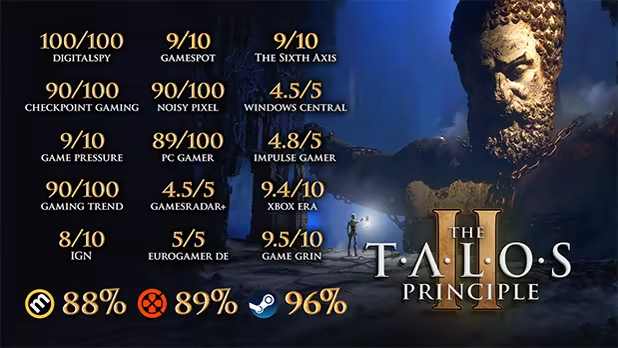
The Talos Principle 2 is a thought-provoking first-person puzzle experience that greatly expands on the first game's philosophical themes and stunning environments with increasingly mind-bending challenges.
Modeled estimate, not a reported figure. How we estimate →
Prices
Each in the currency that store quoted — not converted: the gap between two rows is the publisher's pricing, not an exchange rate.
Discounts
Every price cut of more than 20% we have observed, in each market that quoted one, with this game's chart position on either side of it. These are episodes, not a model: a sale is one event, and one event cannot tell you what the next one will do.
Reviews, worldwide (the counter carries no country): 2.57/day in the week to Jul 23 → 4.57/day in the week after.
About

Add-ons
Each DLC is estimated with the same model as a game, then summed — a modeled figure, not reported DLC sales.
Sums Steam only; PlayStation, Xbox, GOG, Epic publish no volume signal, so the true total is higher by an unknown amount.
| Store | Price | Audience | Score | Chart | Est. revenue |
|---|---|---|---|---|---|
SteamYou are here | $29.99 | 13.4Kreviews | 95% | — | $9.4M |
| $29.99 | 3.1Kratings | 91% | — | not modelled | |
Updates
Build ids and update times come straight from Steam's PICS — the same source SteamDB reads. Patch history grows as we record new builds.
Engagement
Reviews
Themes across 906 recent reviews and how positive each mention is. A keyword signal, not full sentiment analysis.
Reviews
在存储占用体量比前作大了十余倍的前提下,游玩上的体量却只多了不到五分之一,很难称之为高效。虽然本作确实引入了更多有趣的机制和关卡,十二个大关每一关都有独特的核心解谜玩法,但说实在就这点内容量很难称得上是量大管饱,感觉本作有40%以上的时间都在空旷过头的大地图里马拉松,这下知道多出来的空间占用是干嘛用的了。乍一看各类巨构建筑确实会让人眼前一亮,不过我觉得这种景色就让它待在背景里就好,真要在里面探索就算了吧,就算要探索也倒是多设计些激发人探索欲望的互动啊,地图的尺度跟可互动要素的密度完全不成比例,偌大一个地图里只有零星10个小关卡1个实验室1个黄金关卡和一堆无所吊谓的文字记录和遗址收集,再路边的开放世界清问号都比这有趣。哥们是来玩解谜的,不是cosplay机械公敌机器人来后启示录大美自然风光里散步的 同伴对话更是不知所谓,只会让叙事显得更加臃肿和累赘,无意义地拖长游玩时间,虽然一定程度上会显得没那么孤独,但这种孤独感正是前作不可或缺的心流体验的一环,也才让前作结局登上高塔出现其他机器人来帮忙显得更加令人振奋和感动,尽管他们一句台词也没有,但其陪伴感和信任感也要远胜于本作那些只会说些假大空辩经的路人同伴。主题的表达更是一下从前作的”自我意志“降级到小家子气的”爱“,虽然能理解剧作逻辑上确实会出现这样的趋势,当从拟境里苏醒的人格越来越多,形成机器人的社会,不可避免会讨论”社交“”情感“相关的思考话题,只不过让一群仅仅在涂装和语音包上略有不同的机器人表演人类的”爱情“,各方面看起来还是太诡异了些。最后结局走的未来线,感觉纯拿主角当工具人了啊,探索巨型建筑的时候是解谜工具人,到最后接手雅典娜的工作扼杀自我当脑机湿件调控巨型建筑发展社会,不管怎么说都塑造得理想过头了,凭什么雅典娜一家子能开开心心过日子,主角做了这么多以后只能被榨干最后的价值当巨型建筑的齿轮?如果说前作的结局是逃出牢笼,本作更像是为了某些“大义”而主动走进牢笼,莫名觉得很可悲
a lot of walk to get to next puzzle and much a lot of walk to get to next area
Media

Related
Related
Price dynamics, follower growth, revenue and sales trajectories with interactive tooltips
This and every other Pro feature is free until October 20, 2026. A free account is all it takes.
Every market we collect.
For scale, across Steam · Top Sellers · Brazil over the last 30 days: the 26 chart moves that followed a price cut of more than 20% went a median of 7 places towards #1, and the 2,400 moves with no price cut behind them went 2 away. One store, one chart, one country — it is the only place we have enough observations to say even that.
Prices outside the United States have been collected since 6 August 2026 and chart positions since 19 July 2026, so a cut older than that has no market to compare and a market that joined later has no history yet. Nothing here is converted between currencies.
Genres
Stats
All-time low is the lowest price we've recorded for this game since we started tracking it.
Languages: English*, French, German, Spanish - Spain, Japanese, Korean, Polish, Portuguese - Brazil, Russian, Simplified Chinese, Traditional Chinese, Turkish*languages with full audio support
| $29.99 |
| 812ratings |
| 88% |
| — |
| not modelled |
| $8.99−70% | 133ratings | 92% | — | not modelled |
| $29.99 | — | — | — | not modelled |
Matched by title — a reused name can pair the wrong games. * is a critic aggregate. Prices and positions are each store's United States storefront; Epic charts worldwide. Audience and Score too, except Steam's, which is worldwide.
Hours played at review time, across 907 reviews with recorded playtime.
positive critical· bar length = how often the theme comes up
TL;DR: IN CASE YOU DIDN'T PLAY The Talos Principle 1 I wouldn’t recommend playing the first one unless you’re truly a fan of puzzles and want to solve as many of them as possible. If you choose to skip it, I’ll tell you at the very end of this review what you need to know so you can start perfectly in TTP2. ------------------------------------------------------------ In my opinion, this is the best puzzle game by far 10/10. It has a lot of philosophy, and I love that too (like, truly a lot). If you like games such as The Stanley Parable, Superliminal, or especially Portal 2, you’re probably going to enjoy this one as well. But before talking about why it’s so great, I won’t lie: while I love every character in the game and its dialogues, they aren’t as charismatic as those in the games I mentioned before. I also liked the story, but I wouldn’t say that’s its main strength. The reason I think it’s the best is because it has over 100 puzzles. It starts chill, letting you understand new mechanics easily with simple puzzles, and it keeps adding more variables, making them much harder in no time. I didn’t struggle with the normal puzzles, but in the endgame, you unlock golden puzzles, which really made me think, along with other challenging puzzles throughout the game. I won’t spoil any of them. Note: Sometimes you can break a puzzle by forcing mechanics, but if you do it the intended way, you’ll improve your thinking skills a lot more. The game seems to leave it up to you, like saying it’s okay if you can’t solve it the normal way because it’s hard, as long as you thought outside the box. There are also collectibles that let you skip puzzles. While I didn’t use them and don’t recommend using these mechanics, I think it’s great they exist for players who simply aren’t trained in solving puzzles yet. -------------------------------------------------------------------- Now, for those skipping the first game (TTP1 SPOILERS AHEAD): In TTP1, you played as a sentient AI exploring a mysterious world created by Elohim (a sort of God), solving puzzles to prove your intelligence. By the end, you can question Elohim’s authority and, in doing so, achieve the true purpose of the test: demonstrating true self-awareness and freedom, understanding your own consciousness and the nature of existence, therefore becoming human. By now, you realize that what you completed was The Talos Principle, a simulation which was a project by Dr. Alexandra Drennan as a last hope to preserve humanity. You wake up in a world where flesh-and-blood humans have gone extinct, and now you are the new hope. This sets the stage for TTP2, where the first robotic human is now known as the Founder because she created a new civilization, including a goal of reaching 1,000 humans. You are born as the final one, 1K.
Not as good as the first game but still fun enough for the puzzle solving alone. The biggest issue I had was the story. During the first game, you really only had Milton and Elohim as your primary mouthpieces. It was a very straightforward way to tell the story, with Elohim acting as the representation of blind faith, Milton as the nihilist who was eager to argue against everything you believed, and Drennan's recordings somewhere in the middle with her love of humanity, with the terminals adding lots of supplemental material that did make you think about the things you believed. Conversations with Milton were one of the highlights of the first game because you got this sense that Milton really believed in everything he was saying as a result of his understanding of things through the archive, which made conversing with him feel quite genuine. In this game, you have way too many side characters in addition to the party of robots who goes along with you, and nearly all of them broadly agree with what you're doing anyways, which doesn't make them interesting. The worst you get are some "well I don't know...." type responses when you express enthusiasm for some ideas. The very few true dissenters aren't interesting either, because you get the sense that they are only dissenters because the game wants them to be dissenters. It's not like an argument with Milton; at best, it's half of what an argument with Milton would be. The characters themselves aren't particularly interesting, which is made worse by the fact that the robot models have extremely uncanny faces. Terminals do make a return, but there's a lot more of what I would call junk entries in them. The absolute worst part of the story is everything surrounding your OG robot from the first game, which is immediately apparently when you learn that your robot took the name Athena and is using Drennan's voice, which I immediately rolled my eyes at. I don't have the words to properly explain why this whole plot stinks. It just sucks. Everything involving Miranda also sucks. Another huge problem are the huge worlds. The worlds in Talos 1 were very contained, which was perfect as the primary objective was to solve puzzles, and the less time you have to go between puzzles, the better. This game has the same problem that Elden Ring has: the environments are very pretty, but it feels like a total slog to navigate through them. I'm playing the game for the puzzles, not to run around like a ♥♥♥♥♥♥ looking for things on the other side of the map. The puzzles themselves are still good, but unfortunately leave something to be desired. Because of the way the worlds work where they introduce a mechanic and build on that mechanic over subsequent levels, your average world usually has 6 of the 8 standard puzzles feeling incredibly easy, especially if you're familiar with the game. Thankfully, the golden gate puzzles and the abandoned puzzles can offer some challenge, so it's not like you're gonna breeze through the whole game on your first playthough. Some other miscellaneous thoughts: - Prometheus sparks are nice, much better than the messenger mechanic from the first game. I didn't use any, but I can see how they'd be useful. - Tetromino bridges are cool the first game but get old FAST. I think there were more of these than there were tetromino puzzles in the first game. - Pandora and the Sphinx aren't that interesting to talk to. Prometheus is only interesting to talk to because his voice is cool. - Performance wasn't an issue at 1440p on Ultra settings. If you're cautious about buying, get the game on sale.
К моему удивлению, после тягомотной первой части, я с уверенностью могу назвать вторую часть по настоящему кайфовой и интересной игрой. Загадки получились увлекательными и в меру челленджевыми. И даже когда ты ловишь затуп, игра не начинает раздражать, как было с первой игрой, а скорее дарит азарт и желание добить это испытание (исключение составляют разве что некоторые золотые паззлы). В игре теперь есть полноценный сюжет с живыми персонажами, наконец-то есть с кем обсудить все те философствования и мысли, представленные на терминалах, которые как по мне тоже стали гораздо интереснее и заставляют задуматься о многих вещах, которые происходят со всеми нами каждый день, часть из них вроде и были интуитивно понятны, но было важно проговорить их. Сам сюжет тоже получился запоминающимся с довольно воодушевляющей концовкой. Ну и напоследок про графон, благодаря пятому Анрилу местные биомы невероятно красивы и на удивление неплохо оптимизированы.
[i]The Talos Principle 2[/i] in terms of identity is leagues above the preceding title. The artistic design of the world and environments you explore are much more creative than the ancient ruins you explore throughout the original. However, I found there still needed to be improvements for this title to be a fully engaging experience for me. The characters are written for the sole purpose of posing a certain philosophical take or question, and have no depth beyond that. The puzzles still mostly fall on the easy side with a challenging exception scattered between. The game feels like a friend insistently trying to domineer a conversation towards something they want to talk about; [i]The Talos Principle 2[/i] is insistent the philosophical topics it wants to depict are there. Sadly, it feels like the developers are so enamored by these philosophical topics that they forget to make a unique experience out of the game itself.
The Talos Principle 2 is an exceptional sequel that builds on the foundations of the original game. Design of each location is breathtaking and inspiring me, I often stopped to admire and experience the quietness and beauty of my surroundings. The puzzles are inventive each new location introduces new mechanics that feel purposeful, keeping the experience fresh and fun, I was always curious what will await me next What truly shines is the story and philosophy. The first game focused on questions of religion, faith, free will and self-understanding. The sequel asks profound questions about humanity itself and our responsibilities, asking whether intelligence carries moral weight or not, reflecting on humanity's place in the universe and our right The only constant I have ever found is LOVE
too much story and running around between puzzles
Самое сложное в этой игре прочитать все записки и не задушиться
I have fond albeit fuzzy memories of the The Talos Principle and its ponderous mix of puzzles and philosophy. But I’m giving up on it’s sequel The Talos Principle 2 having progressed through a third or so by my reckoning, unable to find much satisfaction in it’s ivory tower of block puzzles. You play as 1K, catapulted from the isolation of virtual space and into the real world, the last of 1000 robots built to create a new vision of humanity, post-apocalypse. There is little anxiety wasted on considering whether the robots are truly human. Afterall, as the games many audiologs love to pontificate, a human is a type of machine, as is a city, a civilisation, a galaxy. But what now? Their primary goal complete, the robots are left to create their own sense of purpose. Embodying the locus of that purpose they’ll show no qualms in projecting their various existential questions on to you. Should we continue building more robots? Should we repair ourselves or embrace death as a core aspect of humanity? Should we trust the giant glowing hologram beckoning us to puzzle island? All of these questions feel like they’re goading the player into absolutist statements only to drop a ‘But what about…’ rejoinder with all the conceit of a debate bro. The many characters you meet are all remarkably fleshed out, metallic exteriors aside, all with their own ideals and consistently strong vocal performances. They’re more interested in the raw principles than the logistical realities of the matter, whether that be overpopulation, the meaning of art or the value of cats. The problem is these questions all feel so…sterile, devoid of any stakes or context, doubly so the snippets of text and audio logs scattered haphazardly and stitched together like a socratic quilt. I’ll admit to not being the most well-read when it comes to Philosophy 101, though I can’t help but feel that just asking questions within a utopian bubble only has so much value. All this has led to a civilization with all the stagnancy of a perpetually hung jury, every character you meet possessing the naive optimism that their ideals will be vindicated in the marketplace of ideas. The game doesn’t really prime you for comprehending its theories, just delivering a never-ending barrage of ‘it really makes you think’ quandaries that are sure to leave you feeling either smugly intelligent or resoundingly stupid. Wait, isn’t this a puzzle game you ask? Occasionally, between dodging robots trying to debate you and schlepping over the enormous landscapes, the game remembers this. 1K and a handful of conveniently eclectic thinkers are contrived upon a quest to an island absolutely infested with the things. Each puzzle you solve fills one bar or another, providing progress to unlocking the island’s various megastructures of increasingly absurd designs and the core mystery of the robots’ missing founder. The puzzles start with variations of those from the first game, finding ways to connect increasingly complex circuits of lasers, fans and gates. Each of the island's dozen areas adds a new tool to recontextualize how these interact. The first few puzzles in each area seem designed to tutorialise how they function. These frequently proved the most challenging to me, their interaction with the games physics not always self-evident or consistent. By the time each area escalates to anything that feels truly clever, you’re basically done and ready to move onto the next area, that mechanic dropped for a new one. There is definitely satisfaction to be found in the puzzles, many falling into the sweet spot of challenge, but they’re finely scattered amidst vast levels along with various collectibles and meta-puzzles that soon feel redundantly formulaic (follow the glowing spark, X marks the spot treasure maps, find the hidden fallout bunker to get a clue of the next puzzle mechanic). The sense of scale is impressive but I’m left feeling this island could have been a menu. Ultimately the puzzles themselves suffer from the same sterility as the game’s philosophy, as physically boxed in as the robots are psychologically. Buried in one of the robots’ mausoleums to the past is an acknowledgement that play is core to human nature, an appealing if self-aggrandizing sentiment. But try as they might to reclaim humanity, the robots give little effort to reckon with this. 1K seems the only one interested in them at all. No context is given to any of the puzzles you’re completing, no rumination on their appeal, just an assumption that there must be a reward. Robot see, robot do. There are fascinating moments of enlightenment and mechanisms to be found, but try as I might I cannot unlock their secrets. Like a fish trying to define water, I cannot see the big picture, just try to solve what’s in front of me, one tetromino at a time.
Active players
Estimated daily and monthly active players (DAU/MAU) modeled from peak concurrency.
Players by region
Where this game's players are, estimated from review languages.
Players also reviewed
The games this title's players most often review too — audience affinity.
Related
| Game | Estimated lifetime revenue | Reviews | Review score | Price |
|---|---|---|---|---|
| $35.5K | 69 | 93% | $19.99 | |
| $56 | 2 | 0% | $1.79 | |
| — | 0 | — | — | |
| — | 0 | — | — | |
| — | 0 | — | — | |
| — | 133 | 92% | $8.99 |
Related
| Game | Estimated lifetime revenue | Reviews | Review score | Price |
|---|---|---|---|---|
| $9.4M | 15K | 82% | $24.99 | |
| $9.4M | 19.2K | 94% | $14.99 | |
| $9.4M | 17.6K | 97% | $24.99 | |
| $9.4M | 13.9K | 98% | $19.99 | |
| $9.4M | 14.8K | 73% | $29.99 | |
| $9.4M | 227.6K | 87% | $3.99 |