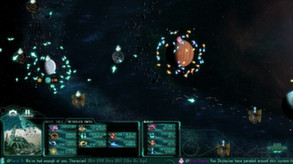
From the creators of AI War: Fleet Command comes an all-new grand strategy title with turn-based tactical combat, set in a deep simulation of an entire solar system and its billions of inhabitants. You are the last of a murdered race, determined to unify or destroy the 8 others.
Modeled estimate, not a reported figure. How we estimate →
Prices
The United States storefront in every case, so this compares stores and not countries.
Discounts
Every price cut of more than 20% we have observed, in each market that quoted one, with this game's chart position on either side of it. These are episodes, not a model: a sale is one event, and one event cannot tell you what the next one will do.
Reviews, worldwide (the counter carries no country): 0/day in the week to Sep 1 → 0.14/day in the week after.
Reviews, worldwide (the counter carries no country): 0/day in the week to Jul 20 → 0/day in the week after.
For scale, across Steam · Top Sellers · Brazil over the last 30 days: the 26 chart moves that followed a price cut of more than 20% went a median of 7 places towards #1, and the 2,400 moves with no price cut behind them went 2 away. One store, one chart, one country — it is the only place we have enough observations to say even that.
Prices outside the United States have been collected since 6 August 2026 and chart positions since 19 July 2026, so a cut older than that has no market to compare and a market that joined later has no history yet. Nothing here is converted between currencies.
About
Sums Steam only; GOG publishes no volume signal, so the true total is higher by an unknown amount.
| Store | Price | Audience | Score | Chart | Est. revenue |
|---|---|---|---|---|---|
SteamYou are here | $19.99 | 508reviews | 75% | — | $361.9K |
| $4.99−75% | 130ratings | 74% | — | not modelled |
Matched by title — a reused name can pair the wrong games. * is a critic aggregate. Prices and positions are each store's United States storefront; Epic charts worldwide. Audience and Score too, except Steam's, which is worldwide.
Engagement
Reviews
Themes across 44 recent reviews and how positive each mention is. A keyword signal, not full sentiment analysis.
Reviews
The Last Federation. A very unique game, like pretty much every game by Arcen Games. This is a combination of a 4X game and a Tactical Action Combat game where you control one ship. How does that work? Well, you are in a 4X game, but you are one single alien with a really powerful ship. The 4X game is the world in which you inhabit, but you do not actually control any of the Civs. To put it another way, you are in a simulated 4X game world, and you are one quite powerful individual who seeks to influence this world. What happened is that you were part of an ancient and super powerful Civ. This Civ held universal sway, controlling and ruling other smaller Civs. But they were all destroyed. You are the last survivor of this Civ. You have one ship left, so you are very powerful, but you are only one person. So you have a much out-sized impact on galactic events for one person, however, destroying a whole Civ army by yourself is probably out of the question. So you watch and wait while the many civs that currently exist, but which are not spacefaring, learn spaceflight and join the galactic community. This waiting period is short, and you can raise any Civ you wish to spaceflight immediately. However, when a civ is space-faring, they become aware of all the other Civs that exist but not at that tech level, and they place their own satellites their planets to watch. So whenever you fly to a planet to lift a Civ, you have increasingly difficult time sneaking through the array of satellites above a planet, because the more people that are space-faring, the more satellites to avoid. This feeds one of the most important mechanics, which is how much each Civ likes you. A Civ will get a boost to how much they like you if you raise them to space. However, every other Civ that detects your action will dislike you somewhat for this act. And it is this balance of actions that drives the experience. Every Civ likes themselves, so helping them makes them like you. But every Civ fears the other Civs, so your actions to help one Civ will make others fear you and dislike you. This seems impossible to manage. However, Civs will form bonds with other Civs. So if two Civs like each other, then helping one makes the other one like you as well. This is why getting Civs working together is so important, because your actions are liked by more people. But this process is difficult. Every Civ has their own political system. One may be essentially a democracy with favours as currency, but another might be a hive mind with one insect leader. The currency of favour for one Civ is completely useless for every other Civ. They have very different desires and buffs and debuffs. However, they all use roughly the same technology. You may worry about how to unite everyone into a single federation. That is actually hard, and not required. You can kill or save whoever you want. You can choose what your goal is, and decide whether you were successful or not in dealing with all the various randomly generated events. The set of actions available to you is mind boggling. It is very vast, but they are all labelled to show you the actual benefit you will get to important things like how much every Civ will like or dislike you for an action. However, some actions have additional benefits and it will take a while to understand those things. It is also the case that there may be multiple pages of actions available. As in, you cannot just open the interaction page for a civ and see everything there. There are multiple pages of different possible actions. The categories make sense, but until you get a real hang of what you can do, it is possible there will be whole sets of actions available that you didn’t even know existed. Time moves forward, but you can speed or slow or stop it as much as you like. I said there was combat, but I haven’t talked about it yet. Remember how I talked about satellites surrounding planets and sneaking past them? This is one of the things you actually perform via the tactical action turn based combat. I say turn based, but it is a weird hybrid, where it is real time divided into bits. You are in an overhead view, and control your one ship. There will be many other ships and structures and turrets and other things. This is a type of bullet hell game, but without reflexes. Time is divided into maybe one or two second chunks. For each chunk, you control how you move and where you shoot, and with which gun. You also control where your energy for the turn goes. It can be divided between Gun power, movement power, and shield power. There is an absolute amount of power, so you choose priority levels. Gun power increases are obvious. Movement power increases both how far you can move for the turn, but also how tightly you can maneuver, which is useful for dodging bullets. Shield power increases shield regen. Guns are quite different, and you also have some special abilities. You may wonder whether frozen time makes it impossible to tell where bullets are moving, but the bullets are shaped so that you can tell where they are moving even when frozen. I don’t remember ever being hit by something I didn’t know was going to be where it ended up being. You can get in combat quite a bit, not only through choice, but through assassins trying to kill you. You cannot die and lose the game, but dying means you spend time regenerating to fully working again, which means lost time to influence the universe. Time will move forward and you have no control over what happens. The Last Federation is very unique. It allows you to do things you would never have thought possible. But that variety can be both difficult to understand, and possibly not interesting to do. Your interaction with the universe is mostly like a 4X. So if you are routinely use your imagination to turn number representations into real felt experiences, then this will be more acceptable. However, even though you have a lot of choices, its not like you are managing completely different mechanics systems. You are largely dealing with a limited set of mechanics with a lot of apparent variety, but not really in that you are picking between different options that largely move the same meters different amounts, and choosing between those things. But also dealing with individual complicated political systems that will take quite a bit to understand. There are also a lot of possible outcomes, because of the inter-relations of many unique groups. The game has changed a lot over the years. When I first played it when it came out, I played for something like 10 hours without resolving a single play through. The second time, years later, I played for three or four hours and completed a run, so there are massive changes that have happened over the years. The Last Federation is very novel, but your interactions can be somewhat obscure, and might not be as varied as you may think at the start. But there is a lot to inspire the imagination. I recommend it, but it is very weird.
Media

Related
Related
Price dynamics, follower growth, revenue and sales trajectories with interactive tooltips
This and every other Pro feature is free until October 20, 2026. A free account is all it takes.
Genres
Stats
All-time low is the lowest price we've recorded for this game since we started tracking it.
Languages: English**languages with full audio support
Hours played at review time, across 44 reviews with recorded playtime.
positive critical· bar length = how often the theme comes up
we need chinese
Pretty good simulation of empire building in space. You can participate in events, influence them, or just observe. One annoyance is a bug that locked up the mouse on exit. Otherwise, pretty good game.
One of the few games I haven't sold all of my cards for because I like the little infodumps in the description. Change this immediately so I can make about 20 cents in steam bucks thank you.
Another big brain game by Arcen! The setting is definitely interesting as are the game mechanics. The majority of the gameplay isn't space-shooting, but managing and negotiating between the different alien space races. YOUR race is already gone, but you can make sure it doesn't happen again!
i dont like..
I really need to come back to this game. It was interesting, it was fun, and it had a neat flavor of you acting as a galactic chessmaster. I'm pretty sure I got one achievement by cheesing it though....
This is one of the rare strategy games where you don't try to be the biggest empire in the world. Instead, you gather and spend political power to unite bickering empires. The new player experience is exemplary. The game gradually gives you more options while not holding your hand like many bad tutorials. The flavor text on actions effectively conveys game mechanics by being funny. Very good lo-fi soundtrack. You have to play in low resolution to be able to read the text. The combat is unique but not very difficult. I think you aren't supposed to lose fights, so it is a bit superfluous. You can probably beat the game without engaging with that system. You can also do it a lot but then you'll be disappointed by how few scenarios there are. I was slightly disappointed that factions immediately stop being difficult when they join your federation. I doubt that there is much emergent gameplay, so it definitely isn't infinitely replayable. But the preprogrammed twists are relatively good. It feels pretty old-fashioned in that way.
Developed and published by Arcen Games, The Last Federation is a strategy game that stands apart by abandoning the familiar formula of building and ruling an empire. Instead, players assume the role of Hydral, the final survivor of an ancient species whose oppressive reign led to its near extinction. With only a single flagship under their direct control, the mission is not to conquer the galaxy through overwhelming force but to guide a fractured star system toward lasting peace by establishing a federation among several competing alien civilizations. This fresh perspective transforms the game into a deeply engaging political and strategic sandbox where influence is often more valuable than military strength. Rather than placing players at the center of a conventional empire-building campaign, the game encourages them to become an unseen architect of galactic affairs. Eight distinct alien races coexist within the same star system, each governed by unique ideologies, economic priorities, diplomatic attitudes, and technological strengths. Every civilization develops independently, expanding its territory, researching new technologies, trading resources, forging alliances, and launching wars without waiting for player intervention. Because the simulation continues to evolve dynamically, every campaign produces different political landscapes, forcing players to constantly adapt their strategies instead of relying on scripted solutions. Diplomacy serves as the true heart of the experience. Every decision has consequences that ripple across the entire system, whether it involves strengthening a vulnerable civilization, secretly sabotaging a dominant power, manipulating trade routes, or carefully orchestrating conflicts between rival factions. Building the titular federation requires balancing competing interests rather than simply defeating enemies. Some races respond well to peaceful negotiations, while others only respect displays of military power or calculated political pressure. This creates a remarkably layered strategic experience where patience, timing, and understanding each faction's behavior are often the keys to success. Although diplomacy receives the greatest emphasis, combat remains an important component of the gameplay. Battles take place in tactical, turn-based encounters where players directly command their customizable flagship. Victory depends less on raw firepower and more on effective management of energy, weapon systems, shields, mobility, and specialized equipment. Ship customization offers meaningful flexibility, allowing players to tailor their vessel toward defensive support, offensive capabilities, electronic warfare, or specialized mission objectives. Every encounter feels connected to the broader political situation, making military engagements an extension of the overall strategic experience rather than isolated skirmishes. One of the game's most impressive achievements is the depth of its simulation. The galaxy feels genuinely alive because every civilization continues pursuing its own ambitions regardless of the player's actions. Wars can erupt unexpectedly, economies may flourish or collapse, and technological breakthroughs can dramatically shift the balance of power. Players frequently find themselves reacting to evolving circumstances instead of following predetermined objectives, resulting in campaigns that generate memorable stories through emergent gameplay rather than scripted narrative events. This unpredictability gives the game enormous replay value, as no two playthroughs unfold in exactly the same manner. Accessibility, however, may prove challenging for newcomers. The Last Federation contains numerous interconnected systems that require careful study before their full potential becomes apparent. Fortunately, the game gradually introduces many of its mechanics through tutorials and progressive learning tools, allowing players to build confidence before facing the complete complexity of the simulation. Even so, mastering diplomacy, economics, military intervention, and political manipulation demands patience and experimentation. Those willing to invest the necessary time will discover an experience with remarkable strategic depth, while players seeking immediate accessibility may initially find its learning curve intimidating. Visually, the game favors functionality over spectacle. The interface presents a substantial amount of information, reflecting the sophisticated systems operating beneath the surface. While the graphics are relatively modest compared to modern big-budget strategy titles, they effectively communicate the state of the galaxy without unnecessary distractions. Distinctive alien designs, readable planetary maps, and well-organized strategic displays help players manage increasingly complicated situations. The writing also adds considerable personality through intelligent dialogue and a dry sense of humor, preventing the complex mechanics from feeling sterile or mechanical. The soundtrack complements the game's thoughtful pace with atmospheric science fiction compositions that reinforce the sense of isolation and responsibility carried by the last Hydral. Rather than dominating the experience, the music quietly enhances exploration, diplomacy, and strategic planning, creating an immersive backdrop for lengthy campaigns. Combined with the game's emphasis on difficult moral choices and the possibility of forging peace among long-standing enemies, the presentation succeeds in supporting its unique themes of redemption, cooperation, and survival. The Last Federation is a rare strategy title that rewards intelligence, creativity, and long-term planning over simple expansion and conquest. Its sophisticated political simulation, highly dynamic galaxy, rewarding tactical combat, and exceptional replayability make it one of the most distinctive grand strategy experiences available. While its complexity and demanding mechanics may discourage casual players, strategy enthusiasts who enjoy mastering intricate systems will find an extraordinary game that continues to reveal new possibilities with every campaign. Rating: 7/10
Played this yeeeaaars ago, had a bit of a recent craving for it again. installed. Ah, the old memories resurface... Good game, enjoying it a lot once again.
Selling now
See how fast this game is selling right now — estimated copies and revenue per day from recent review growth.
Players by region
Where this game's players are, estimated from review languages.
Related
| Game | Estimated lifetime revenue | Reviews | Review score | Price |
|---|---|---|---|---|
| $507.6K | 475 | 59% | $29.99 | |
| $3.4M | 3.8K | 87% | $24.99 | |
| $2.6M | 9.6K | 81% | $9.99 | |
| $7.4K | 20 | 70% | $14.99 | |
| $4.5K | 36 | 83% | $4.99 | |
| $24M | 23.2K | 61% | $39.99 |
Related
| Game | Estimated lifetime revenue | Reviews | Review score | Price |
|---|---|---|---|---|
| $361.9K | 640 | 83% | $10.49 | |
| $362K | 1.2K | 88% | $19.99 | |
| $362K | 817 | 89% | $13.99 | |
| $362.1K | 1.2K | 75% | $14.99 | |
| $362.2K | 1K | 90% | $14.99 | |
| $361.5K | 6.1K | 85% | $2.49 |