Salt of the Earth
An isometric medieval city builder. You hold one manor by charter: lay the roads, work the fields, and raise hovels into town houses by meeting what each household needs. Winters take stores, the Crown takes dues, and raiders take whatever will burn.
Estimated lifetime revenueLow confidence
—gross
—
Modeled estimate, not a reported figure. How we estimate →
Est. copies sold
0
mid estimate
Reviews
0
Review score
—
Concurrent players
About
About the game
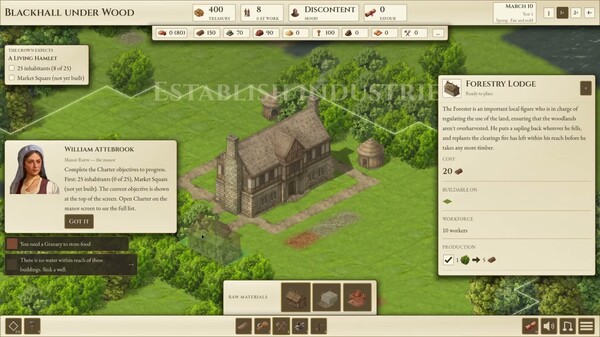
Salt of the Earth is an isometric medieval settlement builder about a single manor held by charter, and the families who live on it. Houses rise from hovel to town house when the household inside is fed and looked after. Workshops take their labour from the houses within walking distance. Every building has to touch the road network.
The year turns through four seasons, and winter gives nothing back. Traders, tithe collectors, couriers from neighbouring towns and raiders with torches all arrive on their own schedule, and each of them remembers how you answered.
Key Features
More than forty buildings, all of them on a road — From a hovel and a well up to a cathedral, a keep, and border outposts on the edge of the shire. Placement determines output: a workshop draws its workers from the houses near enough to walk, so a yard two streets too far from housing stands idle while the one beside it runs full.
Housing that upgrades on needs, not money — Four tiers, hovel to peasant house to half timbered house to town house. A household climbs when its needs are met: food, water, a market in reach, a church, an inn, a school for the children. Variety counts as much as quantity, and a family living on bread alone burns through it far faster than one with bread, meat and fruit on the table. Families whose needs go unmet leave, and the yard behind the house goes unworked.
No research tree — There are no tech points and nothing to unlock with them. Every building becomes available off something already standing: the bakery needs a mill, the tower needs a barracks, the school needs a church and a half timbered house, the goldsmith needs a town house. Industry advances only as far as housing does.
Twenty eight goods and the chains between them — Grain to flour to bread, ore to iron to tools, clay to tiles, grapes to wine, wool to fabric. Surplus sells at the market square, and any good can be forbidden outright so the town stops eating what was meant for sale.
Seasons and weather — Winter is the point of the other three. Everything grown and stored between spring and autumn is aimed at the months that give nothing back. Rain, hail, snow and thunder run on their own schedule, and a downpour is also what saves the roofs on the night something is burning.
Over fifty decision events — Each one is a person at the door. A company of masons come down from an abbey works that ran out of money. The bishop's collector, after a tithe beyond the customary. Families from the manor next door, sitting at the boundary.
Raiders and spreading fire — A market town is a town worth robbing. Raiders walk in off the edge of the map looking for the nearest thing that will burn. Fire runs straight through anything built shoulder to shoulder and stops dead at a gap. A well buys one fire and then stands dry for weeks. What ends a raid is a tower with a soldier in it.
Four neighbouring towns that keep score — Couriers arrive with export offers once the manor is a market town. Each town has its own temper, one exacting and quick to take offence, another patient and slow to complain, and standing relationships build or sour across years.
Four charters and five honours — Charters run from rich river soil to a lean northern frontier. Five honours carry the manor from Minor Lord to Castellan, each unlocking what follows: raiders and foreign correspondence at A Proper Market Town, border outposts and knights at Seat of Power.