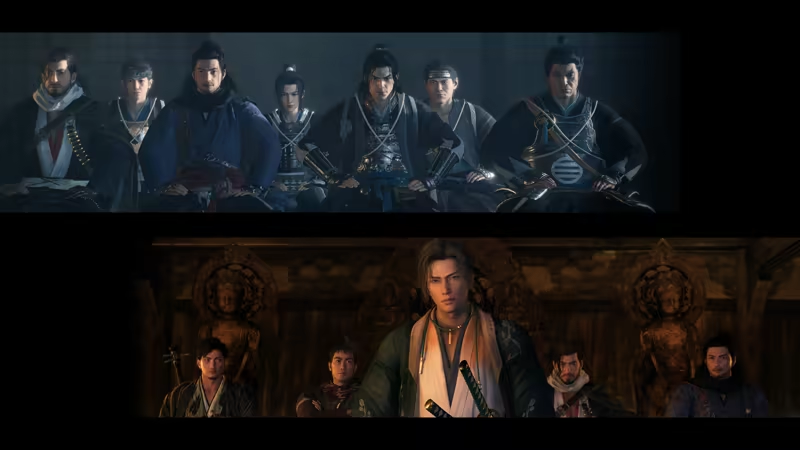
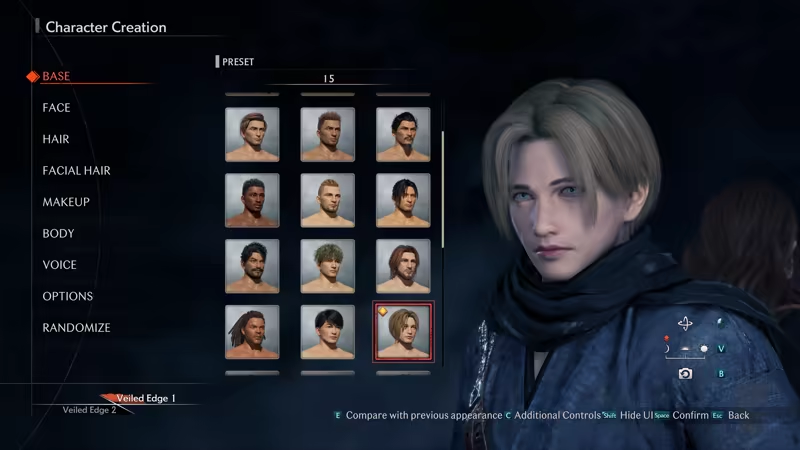
Embark on an epic journey across war-torn 19th-century Japan in this open-world action RPG from Team NINJA, the veteran studio behind "Nioh" and "NINJA GAIDEN."
Modeled estimate, not a reported figure. How we estimate →
Prices
Each in the currency that store quoted — not converted: the gap between two rows is the publisher's pricing, not an exchange rate.
13 of 15 markets; the rest we haven't asked for this title, not markets where it is unavailable.
Availability
We put this game to every storefront we collect. A market that answered not sold has told us something about the game; a market we never asked has not, and the two are never drawn the same.
Discounts
Every price cut of more than 20% we have observed, in each market that quoted one, with this game's chart position on either side of it. These are episodes, not a model: a sale is one event, and one event cannot tell you what the next one will do.
About


Updates
Build ids and update times come straight from Steam's PICS — the same source SteamDB reads. Patch history grows as we record new builds.
Engagement
Reviews
Themes across 1012 recent reviews and how positive each mention is. A keyword signal, not full sentiment analysis.
Reviews
TL;DR: A flawed but enjoyable open-world action RPG carried mostly by Team Ninja’s excellent combat system. The story, visuals, open-world structure, and PC optimization could be better, but the weapon variety and fighting mechanics make it worth playing if you enjoy samurai action games. Rise of the Ronin is one of those games I can recommend while fully understanding why many people have mixed feelings about it. It is not Team Ninja at their absolute best in every area, but when the combat clicks, the game becomes very easy to enjoy. The strongest part of the game is definitely the combat. Team Ninja knows how to make fighting feel satisfying, and that is still true here. There are many weapon types, multiple combat styles, counters, stance-based decisions, and enough variety to keep encounters interesting for a long time. If you enjoyed the combat depth and weapon variety in games like Nioh, you will probably find a lot to like here as well. It is not exactly the same kind of game, but the Team Ninja DNA is obvious in the best way. The setting is also a big part of the appeal. The game takes place in a fascinating period of Japanese history, and even if the execution is not always perfect, I liked exploring this version of Japan. Visually, the game is inconsistent, but there are still many beautiful locations, landscapes, temples, streets, forests, and quiet natural moments that capture the beauty of Japan surprisingly well. It is not a graphical showcase, but it can still look very pleasant in the right scenes. That said, the game definitely has issues. The story could have been stronger. The historical backdrop is interesting, and some major characters are well-designed and memorable, but the writing does not always give the plot enough emotional weight. There are choices, factions, and important historical figures, but the narrative often feels less powerful than it should. It has good moments, but it rarely reaches the level of drama or character depth that the setting deserves. The presentation is also uneven. Important story characters usually look good, and some of them are genuinely well-made, but facial animation and general character expression can feel stiff or outdated. This hurts some dramatic scenes, because the game clearly wants you to care about its characters, but the animation does not always support that emotion. The open world is another mixed point. There is a lot to do, but not all of it feels equally meaningful. Some activities and missions can become repetitive, and the structure sometimes feels more like a checklist than a truly organic adventure. The traversal is enjoyable and the world has charm, but the overall design is not as strong as the combat. Performance is also worth mentioning. My experience was stable, but the PC version clearly has a mixed reputation for a reason. Many players have reported optimization problems, stuttering, and inconsistent performance, so I would not blindly recommend it to everyone without checking how it runs on your hardware first. Overall, I still enjoyed Rise of the Ronin. It has flaws, and some of them are hard to ignore, but the combat carries the experience. The weapon variety, fighting styles, historical setting, and occasional beautiful views of Japan make it worth playing, especially if you are already a fan of Team Ninja’s action games. Recommended, but mainly for players who value combat systems more than story, graphics, or polished open-world design.
Media

Related
Related
Price dynamics, follower growth, revenue and sales trajectories with interactive tooltips
This and every other Pro feature is free until October 20, 2026. A free account is all it takes.
13 on sale2 answered “not sold”0 we did not ask
The 2 “not sold” markets are read from the Steam price pass of Aug 25: that day the store answered for this game elsewhere and gave no price in those. The 13 priced markets are the same rows as the table above — each the latest price we hold, dated here when it is older than that pass. The 0 marked “not asked” were not put to this store at all — either it has no storefront there or we do not collect it yet, and neither is a statement about the game. A refusal is a refusal on one day; a store can list a title again tomorrow.
Reviews, worldwide (the counter carries no country): 6.86/day in the week to Jul 30 → 8.14/day in the week after.
For scale, across Steam · Top Sellers · Brazil over the last 30 days: the 25 chart moves that followed a price cut of more than 20% went a median of 10 places towards #1, and the 2,413 moves with no price cut behind them went 2 away. One store, one chart, one country — it is the only place we have enough observations to say even that.
Prices outside the United States have been collected since 6 August 2026 and chart positions since 19 July 2026, so a cut older than that has no market to compare and a market that joined later has no history yet. Nothing here is converted between currencies.
Genres
Stats
All-time low is the lowest price we've recorded for this game since we started tracking it.
Languages: English*, French*, Italian*, German*, Spanish - Spain*, Dutch, Swedish, Spanish - Latin America*, Thai, Danish, Turkish, Norwegian +9 more
Hours played at review time, across 1K reviews with recorded playtime.
positive critical· bar length = how often the theme comes up
I waited all these years for this game to be playable.... I really needed it to be a nice and polished game... loved the gameplay and concept... but THE GAME runs really BAD, sound cuts off, stutters, NPC load really slow... how tf did the devs leave the game in a state like this .... SHAME ON YOU DEVS
This is the worst running game I have ever played. I've played hundreds of games over the last 30 years, and none of them have run this bad. It is incredible that anyone would spend all of this time developing a game, and then release it in such a poor state. Cyberpunk 2077? 60 fps is no problem. Rise of the Ronin? Literally less than 10fps with DLSS and reduced resolution. I will give this game exactly one more try before refunding, but I am deeply pessimistic.
你他妈的这么垃圾的优化,还这么傻逼的石火机制配上紫电和烈风他妈纯纯左右脑互博,还鼓励压制,我压制你妈呢打两下就没精力了,狗屁闪刃回还就回这么一点精力,除了立身流能取消动作后摇,其他流派武器用闪刃纯纯给自己硬控半秒钟,在配上你这给敌人做的抽帧动作,敌人0.01秒就闪现过来砍你爹了,敌人进入动摇状态1秒,检测到你爹在放武技,0.01秒必出个红光来打断你爹动作,跟你爹玩寸止呢傻逼,红光信号拿来骗你爹,红光里还放个白光,有的红光出现反,有的白光反,有的模型碰到反,有的模型都跟你贴脸动作做完才能反,你他妈是不是脑子有毛病,不带狗屎不会做游戏了,视角也是一坨屎,弹着弹着就到角落里什么都看不到,石火一空直接吃满一套,路边的狗来了你天下无敌的隐刀大人都要背板,你妈天天不忘给你游戏本来就恶心的要死的怪搞个多人战,你妈逼挨打掉精力,被当陀螺抽完一圈之后他妈的压根就没精力了,直接被硬控两三秒,他妈的傻逼烈风切流派还特么一直串到给我切视角去,你妈逼在配上这傻逼视角直接堵在角落里,什么都看不到,还有狗屎都不如的优化一打起来就他妈容易掉帧,直接把体验拉满了,没吃过屎的可以玩一下,优化真是烂的毁天灭地,真他妈畜生,还他妈150g,画质放在十多年前都是最垃圾的一批,真是他妈难看到爆了,还他妈的卡到爆,能同时做到画面超级难看,内存超级大,优化还比画面更糟糕,你们忍组真有外星科技?还卖500w,等光荣倒闭都不知道能不能有,你们赶紧切腹自尽吧。
I’m usually not someone who leaves negative reviews, even when I don’t enjoy a game, but in my personal experience this was one of the most frustrating titles I’ve played in years. Unfortunately, I found large parts of it difficult to enjoy, and at times it felt close to unplayable for me. Here are the main issues I experienced: -The game relies heavily on menus and layered sub-menus, many of which felt unnecessarily complicated and unintuitive. I often found myself struggling just to navigate basic systems or access what I needed. -The combat mechanics felt inconsistent and underdeveloped from my perspective. Enemies frequently reset by running back to their designated areas, which disrupted the flow of battles. Movement, attacking, and parrying all felt stiff and unnatural to me, and the controls didn’t feel very fluid overall. Having separate buttons for blocking and parrying also made combat feel less responsive. In addition, ranged combat seemed overly simplistic and didn’t integrate smoothly with melee gameplay. -Personally, I found the story unengaging and lacking depth, to the point where I ende-d up skipping most of the cutscenes. -The game appears to draw inspiration from several popular genres and mechanics — including open-world exploration, co-op combat, stance-based fighting, souls-like elements, and RPG-style gear management. However, in my opinion, these systems never fully come together in a polished or cohesive way, and the overall experience felt more derivative than innovative. -Performance was another major issue for me. I have a solid gaming setup and regularly play demanding AAA titles without problems, but this game caused my system to overheat even on lower settings, which was surprising and concerning. Overall, this was a very disappointing experience for me, and based on my personal experience, I wouldn’t recommend it.
半价入手,60h左右全成就通关了, 基于上述条件我认为浪人崛起是个不错的游戏,发售两年该修的问题也修的差不多,显得十分有性价比。 开放地图上的堆料我认为相当克制,并且自机的性能足够强,没有难找的收集要素,除了某个滑翔挑战会卡一个中后期才能拿到的科技。 核心机制石火足够带劲,整个流程里也没遇到非常让人恶心的快慢刀boss,土方岁三可能算一个。 另外推荐用DS5,不同场景下细腻的震动很酷,不用少玩50块钱的内容。 推荐半价可以玩一下,比AC影更像AC影。
This game boils down to one thing: "The combat just doesn't feel good." I'll explain the details below. On Combat with Enemies: Rise of the Ronin is a game built around "deflecting enemy attacks with parries." It leans much closer to Wo Long than Nioh. However, because "you can't land your parries," the combat ends up "not feeling good." First of all, every single attack from every single enemy is a feint. Furthermore, there is a mix of attacks where the visual animation and the actual parry timing do not match up (this is similar to the bosses in Wo Long from DLC 2 onwards). Additionally, while parry windows were clearly telegraphed in Nioh 2, they are completely opaque in this game. Because of this, there are some enemies whose parry timings you just won't grasp even after fighting them dozens of times. Now, let's say you try your absolute hardest and successfully parry an enemy's entire combo. Even then, you can't land a critical strike. Normally, this is the exact moment you should be able to launch a counterattack and deal massive damage. That's what creates catharsis. But this game isn't like that. The enemy's Ki (stamina) merely drops by about half, the fight continues as if nothing happened, and of course, their Ki regenerates mid-battle. When fighting enemies out in the open field, you are forced into "1 vs. Many" situations. You can't pick them off one by one, resulting in chaotic, sloppy brawls. This aspect is similar to the first Nioh. There are enemy-occupied outposts, but stealth approaches are unviable. The moment you stealth-kill a single guy, the others instantly notice you, turning it right back into a "1 vs. Many." Because of all this, you eventually settle into a playstyle of "chugging potions and mindlessly brute-forcing attacks. If a parry lands occasionally, great." But don't worry. Just like in Horizon, your potions are constantly restocked. You can also increase your maximum potion capacity via the skill tree, and these upgrades are spread across multiple skills—again, exactly like Horizon. Unlike the Estus Flask system in Dark Souls, the fact that they deliberately integrated potion capacity into the skill tree means the game is fundamentally designed around the idea that "your remaining potion count is the lifeline of the difficulty balance." I've written a lot, but it's easier to understand if you look at it from the enemy's perspective. Put simply: "If the player is recovering full health by chugging potions AND constantly parrying everything, we can't kill them." Therefore, this game is intentionally designed around gameplay where "parries won't land." Most Soulslike games (including Nioh and Wo Long) balance their difficulty using three main patterns: 1. Relentless attack flurries that give you no time to heal. 2. Feint attacks that make dodging difficult. 3. Elemental attacks that deal chip damage even through your guard. However, it's safe to assume that Rise of the Ronin is balancing its difficulty solely through "feint attacks." It makes sense if you consider that the shift to an open-world format increased development costs, and the combat quality ended up paying the price. You might ask: "There's no way the company that made masterpiece Soulslikes like Nioh 1, Nioh 2, and Wo Long would make a game like that, right?" I completely agree. But it exists right here, so it can't be helped. For the record, I played all three of those aforementioned games until I got 100% of the achievements. Of course, this game is neither Nioh nor Wo Long. I believe it should have its own unique identity. But the moments that actually feel genuinely good to play are few and far between. On the Open World: There are event markers displayed on the map, and when you do something there, the marker gets checked off—the usual stuff. There's no puzzle-solving of any kind; it's just an extremely typical, traditional open-world game where you endlessly repeat menial tasks. There are no major surprises, but no major disappointments, either. If you turn your brain off and do "the usual stuff," you'll eventually beat it. This might sound overly negative, but I'm writing it because it can sometimes be a positive. The breadcrumb trail leading you into combat is provided by these "typical events." Basically, even in a simple "Find X" quest, you'll probably end up fighting a tough enemy along the way, right? Though, of course, that relies on the massive prerequisite of "the combat feels good"! Conclusion: Man, this game is a missed opportunity. It's definitely not boring. Steam only allows for a binary thumbs up/thumbs down rating, but if it were out of 100, I'd give it a 70. Ultimately, if they made parrying easier, they would have had to create gameplay depth elsewhere, which would have led to increased development costs. I suppose Koei Tecmo just doesn't have the bandwidth for that right now. That being said, personally, I feel like "I wouldn't mind if you doubled the retail price, just make a fun game." This is just my own selfish opinion. But then again, this entire review is just my own self-indulgent thoughts. I sincerely hope that all of you can find some sort of enjoyment in this game. And I'd be thrilled if you could let me know what that is. Keep at it, Koei Tecmo! I'll do my best too!
なんでレビュー評価が悪いのかわからない。めっちゃおもろいやん!
Giving it a positiive review just due to how good the combat is. If you aren't on a high end pc this can run like ♥♥♥♥, 5x worse optimization than wo long fallen dynasty. Honestly, there should be regulations preventing studios from releasing games or ports in such an unoptimized state.
Rise of the Ronin isn't just another open-world samurai game—it feels like the spiritual successor to Tenchu that I've been waiting decades for. Ironically, while many expected Sekiro: Shadows Die Twice to carry that legacy because of its stealth and ninja themes, it ultimately became something entirely different: a fast-paced action game centered on relentless sword duels and boss encounters. Rise of the Ronin, on the other hand, embraces the deliberate, methodical style of infiltration and assassination that made Tenchu so memorable. The stealth mechanics are where the game truly shines. Assassinations feel meaningful instead of being an afterthought. Scouting enemy positions, using rooftops and tall grass, quietly eliminating guards, and striking from the shadows all create a satisfying gameplay loop. The tools at your disposal complement stealth rather than replace it, and clearing an entire compound without raising an alarm feels every bit as rewarding as it did in the classic Tenchu games. Combat is equally impressive. It strikes a balance between accessibility and depth, with multiple fighting styles, satisfying parries, and fluid weapon switching. Unlike games that force every encounter into a punishing duel, Rise of the Ronin lets you approach situations your own way. You can be a silent assassin, an honorable swordsman, or seamlessly blend both styles depending on the mission. Comparisons to Ghost of Tsushima are inevitable, but I found Rise of the Ronin captured the fantasy of being a masterless samurai far more effectively. Jin Sakai's story is deeply tied to protecting his homeland and reconciling honor with necessity. In contrast, Rise of the Ronin places you in the role of someone truly without a lord, navigating a fractured Japan where loyalties shift constantly and every decision feels personal rather than dictated by duty. The freedom to choose allegiances—or reject them altogether—makes the title "ronin" feel earned rather than symbolic. The historical setting also reinforces that identity. Instead of presenting a straightforward tale of defending one's home, the Bakumatsu era offers political intrigue, competing factions, and moral ambiguity. You're not simply fighting invaders; you're carving out your own place in a nation undergoing immense change. That makes every alliance and every betrayal carry greater weight. No game is perfect. The open world occasionally falls into familiar genre conventions, and some side activities become repetitive over time. Visually, it doesn't always match the breathtaking presentation of Ghost of Tsushima. But those shortcomings fade into the background because the core gameplay is consistently engaging. Ultimately, Rise of the Ronin succeeds where I personally felt Sekiro chose a different path. Rather than simply featuring a shinobi protagonist, it captures the essence of stalking targets, planning assassinations, and giving players the freedom to tackle missions with patience and creativity—the qualities that defined Tenchu. Combined with combat that rewards experimentation and a compelling interpretation of life as a true ronin, it stands as one of Team Ninja's most enjoyable games and one of the strongest modern samurai experiences available.
Active players
Estimated daily and monthly active players (DAU/MAU) modeled from peak concurrency.
Players by region
Where this game's players are, estimated from review languages.
Players also reviewed
The games this title's players most often review too — audience affinity.
Related
| Game | Estimated lifetime revenue | Reviews | Review score | Price |
|---|---|---|---|---|
| $96.7M | 96.6K | 94% | $59.99 | |
| — | 0 | — | — | |
| — | 0 | — | $69.99 | |
| — | 0 | — | — | |
| $935.4M | 1.2M | 93% | $59.99 | |
| $68.8M | 62.5K | 83% | $59.99 |
Related
| Game | Estimated lifetime revenue | Reviews | Review score | Price |
|---|---|---|---|---|
| $7M | 15.7K | 78% | $29.99 | |
| $7M | 9.3K | 94% | $24.99 | |
| $7M | 25.2K | 79% | $9.99 | |
| $7M | 18.8K | 92% | $14.99 | |
| $7M | 34.5K | 77% | $9.99 | |
| $7M | 16.2K | 93% | $12.99 |