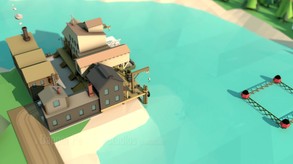
Put your entrepreneurial skills to the test in the first title in the ROI series as you create & optimise intricate production lines. As an early 20th-Century industrialist, grow your empire & adapt to an ever-changing business landscape with unexpected events that could lead to boom…or bust.
Modeled estimate, not a reported figure. How we estimate →
Prices
Each in the currency that store quoted — not converted: the gap between two rows is the publisher's pricing, not an exchange rate.
Discounts
Every price cut of more than 20% we have observed, in each market that quoted one, with this game's chart position on either side of it. These are episodes, not a model: a sale is one event, and one event cannot tell you what the next one will do.
Reviews, worldwide (the counter carries no country): 0.14/day in the week to Aug 17 → 0.29/day in the week after.
For scale, across Steam · Top Sellers · Brazil over the last 30 days: the 25 chart moves that followed a price cut of more than 20% went a median of 10 places towards #1, and the 2,413 moves with no price cut behind them went 2 away. One store, one chart, one country — it is the only place we have enough observations to say even that.
Prices outside the United States have been collected since 6 August 2026 and chart positions since 19 July 2026, so a cut older than that has no market to compare and a market that joined later has no history yet. Nothing here is converted between currencies.
About


Add-ons
Each DLC is estimated with the same model as a game, then summed — a modeled figure, not reported DLC sales.
Sums Steam only; GOG, Epic publish no volume signal, so the true total is higher by an unknown amount.
| Store | Price | Audience | Score | Chart | Est. revenue |
|---|---|---|---|---|---|
SteamYou are here | $29.99 | 4.2Kreviews | 73% | — | $3.7M |
| $7.49−75% | 123ratings | 64% | — | not modelled | |
Updates
Build ids and update times come straight from Steam's PICS — the same source SteamDB reads. Patch history grows as we record new builds.
Engagement
Reviews
Themes across 802 recent reviews and how positive each mention is. A keyword signal, not full sentiment analysis.
Reviews
This game is incredible, but HUGE WORD OF WARNING! The publisher completely screwed the developers on this game and now the devs don't own any part of it financially or otherwise, and the studio is now defunct Kasedo literally killed it. Don't buy this on steam, buy it from a key reseller or any other way that keeps the money out of the publisher's hands. Kasedo is why we won't see more content to this or a sequel from the original devs.
Rise of Industry is an excellent game with a number of barriers that might turn you off before you learn it. It has much more in common with a factory game like Factorio or Satisfactory than a transportation game like Railroad Tycoon or Transportation Tycoon. It's all about complex production chains, often with several intermediate products. You win the game by completing one of the three "prototype" items - a car, a computer, or a TV dinner, all of which have a large number of intermediate products. You're largely focused on profits, but there are reasons to supply towns with products in general. Towns grow when they have their needs met. Larger towns demand more complex, more profitable products. The biggest barrier is learning that the automatic behavior of warehouses is really bad, and you have to turn it off or your traffic congestion will go through the roof and transportation costs skyrocket. The game tries to route all products into the nearest warehouse, and then supply all needs from that warehouse. This leads to most trucks travelling 2x-4x as far as they need to. Worse, warehouses use the inefficient short-distance trucks for this, instead of the more efficient warehouse trucks that carry 2x-3x as much. A related item is that warehouses default to immediate delivery of items, instead of defaulting to "wait until full." If you don't know this, warehouses send out lots of Warehouse trucks with a single item. You can make "Wait until full" the default, but you need to set a game option to do this. Warehouses are very effective at a number of things, such as organizing distribution and medium-distance transport, but you need to turn off all the automatic features and set them up manually. Trains are excellent long-distance transport in the game, costing just a fraction per unit moved of a long-distance truck, but only if they're set to "wait until full." Trains can also *appear* to break in the late game with pathing problems. There's a fix for this, though. Train pathing has some bugs. Trains treat X-type crossings as intersections where they can turn, so train pathing ends prematurely as a result, and don't find a train terminal's entrance track. If you create crossovers near each train terminal, this problem goes away. Trains frequently end up going the wrong way on tracks, but this has few consequences since trains heading in opposite directions on a track can pass through each other. This slows down both trains, so you want to avoid it if you can, but it's not a game-breaker. The economics of the game are quite forgiving on the normal difficultly, but the challenge goes up significantly on the hardest settings. If the game feels too easy, you really need to try with the selling prices reduced and the transportation costs turned up. The AI players aren't really a threat, but they do act as obstacles. They will buy up territories before you can afford them, which means you need to buy them out before you can expand completely. This is important primarily because this delays access to raw materials like iron, copper, and coal. You can choose any territory to start, but it usually makes sense to pick the territory with the largest town which demands the most advanced products, and that territory never has raw resources beyond water, lumber, and fish. The game has some excellent reports, but unfortunately they're wrong. It never calculates the profit margin on a product correctly because it calculates the cost of ingredients using market prices, instead of what they actually cost you. For farms with multiple outputs like cattle, it counts the full cost of the ingredients (wheat and water) against all the output products (beef, milk, leather), so they all appear to lose money when they're profitable. It also double-counts costs. If you produce a product (say milk) and convert some of it to higher-tier products (say cheese), it lumps the costs of the used items in with the sold items, even though the costs of the consumed items should only be counted against the final product (cheese). Thus intermediate products always show up as losing lots of money even if they're vital to your economy. The upshot of this is that you really have to hand-calculate profits, if that's something you want to know. This is another flaw that isn't a game-breaker, but which can be frustrating for a new player. Mostly this matters on high difficulty settings, where upkeep can eat most or even all of your profit if you're not careful. All of this translates to a fairly steep learning curve, both to learn the basics of the game and to circumvent its flaws. Once you do, though, it's quite rewarding.
Media

Related
Related
Price dynamics, follower growth, revenue and sales trajectories with interactive tooltips
This and every other Pro feature is free until October 20, 2026. A free account is all it takes.
Every market we collect.
Genres
Stats
All-time low is the lowest price we've recorded for this game since we started tracking it.
Languages: English*, French, Italian, German, Spanish - Spain, Portuguese - Brazil, Russian, Simplified Chinese*languages with full audio support
| $29.99 |
| — |
| — |
| — |
| not modelled |
Matched by title — a reused name can pair the wrong games. * is a critic aggregate. Prices and positions are each store's United States storefront; Epic charts worldwide. Audience and Score too, except Steam's, which is worldwide.
Hours played at review time, across 809 reviews with recorded playtime.
positive critical· bar length = how often the theme comes up
I have a hard time recommending this game. While I will admit that the graphics are cute and the fundamental game play can be very fun, I can only admit that is the case for the first few hours. Let me preface any negatives with the understanding that the creators of this game clearly had love for it, that much is certainly clear, they made a game that they liked. However, it feels like they completely gave up on it after they created it, and while some add ons like the stock market was great and added to the gameplay, it didn't fundamentally change anything about the game to make it fun in the long term. Lets tackle the worst offenses this game has. The immediate is that it is overly complex and expects you to micromanage everything. This game lacks several quality of life features that many other games in the genre has, such as automation of many of the tasks. When you begin a game, you expect to be micromanaging tasks because it is easy to do, but as your business empire expands, you will still need to be doing all of that. There are features in the game such as warehouses that make this easier, but it never makes it fun or simpler. Additionally, the game has a pretty terrible tutorial. Where in many tycoon games, or city type strategy games like this, they'll let you play the tutorial yourself and either let it transition to the main game or jump across multiple skips of a main game to show you how to handle everything at each stage and how to take advantage of something in the midgame you would never know about otherwise, this game doesn't do that. This game shows you how to place buildings (and doesn't let you deviate from that AT ALL, it MUST go in the exact place they want it exactly how they want it) but it also ends almost immediately and doesn't show you much other than that. Interestingly, the game DOES have an in-game tutorial in their "campaign" (which is essentially just sandbox mode, another mode you can play), I cannot rank it because it bugged out twice and wouldn't let me progress in either of the games I tried playing, you can luckily turn it off because the in-game tutorial also locks fundamental game play features behind it. Once I got past that, I actually did have a lot of fun with it for a few hours. Setting up supply lanes, expanding my tech tree to allow for more complex things to be made, and even completely buying up one of my competitors on the stock market and inheriting their mess of a company. However, what I quickly learned was that everything I experienced in my first few hours was just the entire game. It didn't get any more interesting or complex, you could aim for the end game "proto-types" but there is little point to doing so. Setting up a chicken farm and selling stuff from that is just as complex as setting up the production of a car, except the car is just more tedious due to the micromanaging. There is a reason on 2% of players have "beaten" the game by creating the car prototype, it is just boring and not worth it to do so. Is it really worth trying to manually set up 15 different supply lines just so you can make 10 million dollars a month compared to 5? I wouldn't say it is. There is even a very sad story if you look into it behind this game. The developers, Dapper Penguin, and their lead "Alex", tried really hard to provide for their studio and be successes. However, because they didn't put more effort into this game after release and instead jumped into making another over promised and overly complex game, they saw middling reviews and a quick dry up in sales, something that started to kill their studio. My heart broke when I read that Alex took a mortgage out on his house to keep the studio afloat and then still had to sell Rise of Industry's entire IP to Kasedo games, their publisher, just to try and release a new game that never happened. On top of that, he sold the IP for less than $100,000 dollars and doesn't see a penny of it anymore. The studio still closed and the game is not getting further updates. This is a heartbreaking story, and there is more too it, but a sad story around the game doesn't change the feelings I have about how it plays. Ultimately, this isn't a BAD game, it is just a mid one. It gets old pretty fast, unless you are super into making supply lines all by yourself. If you love tycoon/capitalism games, and this seems up your alley, then get it on a deep sale and I can recommend it. Otherwise, I would say to avoid this one.
Figured I'd write a review since a lot of people are gonna get it from EGS for free this week and look for reviews here. It's a solid OTTD variant, but at the end of the day pretty shallow. I got my 22.4 hours out of it (for the campaign) and enjoyed them, but probably won't install it again.
Reading the negative reviews, I feel like people went into this game expecting a prettier, more modern OpenTTD when RoI is 100% not that. The game is completely different in how it works and how it plays. The only similarity between OpenTTD and RoI, apart from the fact that they are both transport simulators, is that they both require extensive effort to learn how to play the game and play well. Balancing supply chains and advancing your crafting capabilities all while staving off competition is actually quite fun and rewarding in a different way than OpenTTD generally feels. The reality of RoI is that it is really an automation game disguised as a transport tycoon wannabe, and that has clearly thrown some other players for a loop. If you don't want to put the time in to actually learn how to play the game, RoI is likely not for you. If you like games like OpenTTD, Factorio, Satisfactory, or ECO and you enjoy reading wikis for fun, then RoI might be of interest to you. The game is beautiful and the gameplay is engaging albeit a bit repetitive. Certainly an interesting title for the right kind of player.
Alex - The real developer got basically scammed with bad contract from publisher and eventually had to sell the IP for pennies. Also, the game is just boring and mediocre, so can't recommend in any level.
This is the best game ever, especially for mind exercise. I've played over 1800 hours so far. I really believe this game will improve your memory. I began playing keeping a spiral notebook record of each region I owned keeping notations on all products produced in individual regions (what product they were). If you have played the game you know about the multitudes of products available to produce and sell. After playing over and over several times I began to remember what products were where and what the production formula was to produce each product. Now at 1800 plus hours the only notations I keep in a notebook are what the towns warehouse number is for each region. I plant a warehouse asap for every region regardless of whether I own the permit for the region or not. The warehouse has the tiles selected to encompass all of a town and their shops. I then plant a airport and only ship via air to the town encompassing warehouses. The products are automatically sold to the shops. Ask me questions maybe i can answer some!!!!!
The UI completely lack the necessary information necessary to make a business run. Additionally, the tools that the game gives you to manage your business range from poorly designed (profit percentages displayed in shops) to downright harmful to your profit margins (warehouses, delivery trucks/trains). If you're going to buy it, read online reviews first.
This game is fun, until it isn’t. If there was a neither good, nor bad recommendation option, I would choose that. It has some mindless fun, until you have to start troubleshooting. I give it more of a thumbs down because of the lack of AI competitors and the warehouse logistics breaking. The AI is just there to steal auctions away from you and make it more difficult to buy adjacent land. They do not contribute anything else. I would recommend playing without them. The warehouse logistics is what ultimately frustrates you to the point of uninstalling the game. The warehouse does not ship by a round-robin approach. I had a warehouse capable of receiving enough water to dispense to 4 farms each month. Instead of supplying all 4 farms equally, it overloads 2 of them while the other 2 starve. Other times, the warehouse just stops shipping on routes until you notice the overflow. You have to delete the route and recreate it to get it all working again. Then you start creating plans to bypass the warehouse logic, and deliver directly from source to consumer. Only to find out the source building can also suffer from the same do not deliver bug. Very frustrating.
Active players
Estimated daily and monthly active players (DAU/MAU) modeled from peak concurrency.
Players by region
Where this game's players are, estimated from review languages.
Players also reviewed
The games this title's players most often review too — audience affinity.
Related
| Game | Estimated lifetime revenue | Reviews | Review score | Price |
|---|---|---|---|---|
| $3.4M | 4.5K | 91% | $19.99 | |
| $1.6M | 1.6K | 82% | $24.99 | |
| $289.5K | 1.3K | 67% | $6.99 | |
| $61K | 107 | 66% | $17.99 | |
| — | 0 | — | — | |
| $7.4M | 8.4K | 83% | $24.99 |
Related
| Game | Estimated lifetime revenue | Reviews | Review score | Price |
|---|---|---|---|---|
| $3.7M | 11.5K | 91% | $13.99 | |
| $3.7M | 4.6K | 79% | $24.99 | |
| $3.6M | 36.5K | 92% | $4.99 | |
| $3.7M | 3.2K | 75% | $31.99 | |
| $3.7M | 8.4K | 95% | $19.99 | |
| $3.7M | 6.9K | 82% | $14.99 |