Project P.I.T.T. takes a wonderfully strange idea and develops it into a compelling mixture of physics experimentation, automation, incremental progression, and corporate satire. You enter an unsettling workplace as a new intern with what initially appears to be the easiest assignment imaginable: manufacture rubber ducks and throw them into a gigantic hole known as the Maw. That simple instruction quickly becomes the foundation for something much larger. The Maw continuously demands more, production becomes increasingly complicated, and the facility begins revealing an atmosphere suggesting that your employment situation is considerably stranger than it first appeared.
The basic gameplay loop succeeds because manual labor gradually gives way to creative engineering. Early tasks establish the importance of producing objects and delivering them into the pit, but progression provides increasingly elaborate tools for automating that process. Magnets, fans, panels, pistons, launchers, and other devices can be arranged into improvised production systems. Rather than demanding one predetermined solution, the physics-based design encourages experimentation. A carefully organized machine can work beautifully, while an unnecessarily ridiculous contraption may accomplish exactly the same objective through bouncing objects, aggressive launching, and barely controlled chaos.
Optimization provides another layer of satisfaction. Increasing throughput and chaining successful deliveries together can generate better payouts, encouraging players to reconsider inefficient arrangements. The result captures some of the pleasure associated with factory-building games without requiring an enormous industrial complex. Small improvements can have noticeable consequences, and watching a previously awkward manual process become a functioning automated system creates a strong feeling of progression. Importantly, efficiency does not eliminate creativity. Players remain free to construct sensible production lines or embrace deliberately absurd solutions simply because watching the physics simulation handle them is entertaining.
Progression also expands beyond rubber ducks. Stranger products and additional machinery become available as responsibilities increase, eventually transforming straightforward production into assembly. Objects begin interacting and connecting in less predictable ways, forcing established solutions to evolve. Meanwhile, the Maw physically grows as it consumes more products. This creates a clever visual representation of the game's central theme: increased productivity never truly satisfies demand. Every improvement simply establishes a new expectation, turning the player's pursuit of efficiency into part of the satire.
The corporate setting gives these mechanics considerably more personality than they would possess in a conventional automation sandbox. There is something inherently funny about treating the feeding of rubber ducks into an enormous void as legitimate employment, but the humor gradually develops an unsettling undertone. The company is observing your performance, the facility changes, and your assignments become progressively harder to rationalize. Questions surrounding the employer, the purpose of the facility, and the player's actual circumstances create an underlying mystery without distracting from the sandbox gameplay.
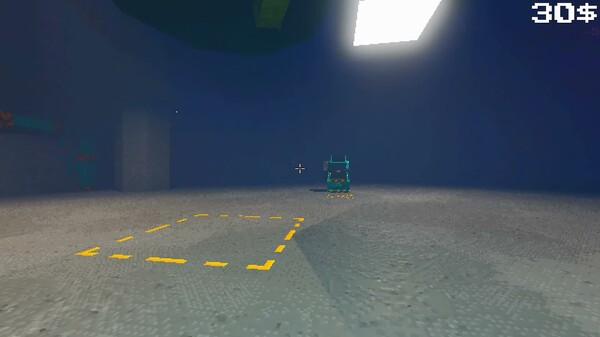
Its visual identity reinforces that uncomfortable atmosphere. The brutalist facility uses a deliberately retro PSX-inspired aesthetic, combining imposing architecture with rough, stylized visuals. The result suits both the comedy and the mystery. Industrial surroundings make the absurd production machinery feel strangely official, as though someone genuinely designed an entire corporation around feeding an insatiable hole. The retro presentation also gives the environment a distinctive personality while complementing the increasingly surreal direction of the experience.
Another strength is how naturally the satire emerges from player behavior. Automation games frequently encourage players to chase greater efficiency simply because optimization is satisfying. Here, that instinct becomes part of the joke. The company demands higher output, the Maw demands additional products, and players willingly respond by designing increasingly effective machinery. The better you become at your job, the more unreasonable that job becomes. It is an amusing commentary on endless productivity and consumerism without requiring the game to abandon its playful sandbox foundation.
There is still an intentionally repetitive element at the heart of the experience. Players fundamentally produce, manipulate, assemble, and deliver objects repeatedly, meaning those who have little interest in automation or experimentation may find the structure less appealing. Physics systems can also introduce unpredictability into carefully designed arrangements. Yet that unpredictability frequently works in the game's favor. Watching an elaborate machine barely function can be just as amusing as seeing a perfectly optimized system operate flawlessly. Failure often becomes an invitation to redesign rather than an outright punishment.
Froke deserves credit for building the gameplay and thematic ideas around the same central concept instead of treating the unusual premise as a disposable joke. Pretty Soon serves as publisher, and the overall presentation feels focused on giving this peculiar concept its own recognizable identity. The combination of first-person interaction, incremental upgrades, physical objects, automation tools, dark comedy, and environmental mystery makes the experience difficult to categorize neatly, which is ultimately one of its strengths.
Steam Deck compatibility is encouraging but deserves some qualification. Steam's compatibility-filtered search currently includes the game among titles with Steam Deck compatibility classifications, while the store also provides SteamOS and Linux support. However, the accessible store information does not clearly expose which specific Deck rating applies, so it is safer not to claim a definitive Verified or Playable badge here. The straightforward first-person controls and relatively compact sandbox structure nevertheless make it conceptually well suited to portable sessions, particularly for players interested in experimenting with production layouts away from a desktop.
Ultimately, this is an inventive indie sandbox that understands how to turn a ridiculous premise into meaningful gameplay. The satisfaction of improving production lines works alongside the pleasure of creating machines that are unnecessarily complicated, while the expanding Maw provides both a progression target and an increasingly ominous reminder of what all that productivity is accomplishing. Its humor, retro brutalist presentation, physics systems, automation mechanics, and mysterious corporate setting complement one another rather than feeling like unrelated ideas.
Players who enjoy physics sandboxes, incremental progression, automation puzzles, unconventional simulations, and dark workplace comedy should find plenty to appreciate. What begins as an absurd assignment involving rubber ducks gradually becomes a strangely absorbing cycle of invention, optimization, escalation, and curiosity. It is funny when your machinery works, often even funnier when it fails spectacularly, and intriguing enough to make feeding the Maw feel like more than another repetitive workplace obligation.
Rating: 8/10