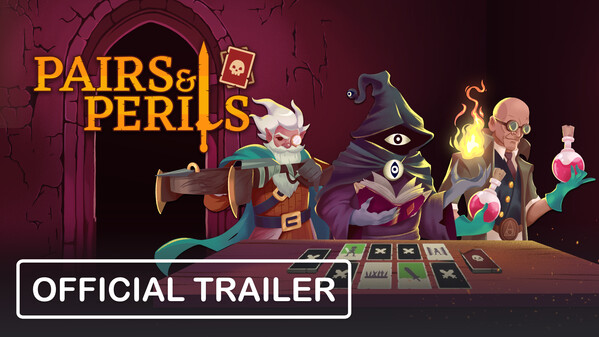
Pairs & Perils is a memory-game roguelike and dungeon crawler. Match cards to attack enemies, avoid traps, shop for relics and consumables. Sharpen your mind as you journey through the depths of the dungeon in search of The Dealer.
Modeled estimate, not a reported figure. How we estimate →
Discounts
Every price cut of more than 20% we have observed, in each market that quoted one, with this game's chart position on either side of it. These are episodes, not a model: a sale is one event, and one event cannot tell you what the next one will do.
Reviews, worldwide (the counter carries no country): 0.14/day in the week to Sep 8 → 0/day in the week after.
Reviews, worldwide (the counter carries no country): 0.14/day in the week to Jul 26 → 0/day in the week after.
For scale, across Steam · Top Sellers · Brazil over the last 30 days: the 25 chart moves that followed a price cut of more than 20% went a median of 10 places towards #1, and the 2,413 moves with no price cut behind them went 2 away. One store, one chart, one country — it is the only place we have enough observations to say even that.
Prices outside the United States have been collected since 6 August 2026 and chart positions since 19 July 2026, so a cut older than that has no market to compare and a market that joined later has no history yet. Nothing here is converted between currencies.
About


Genres
Engagement
Reviews
Themes across 42 recent reviews and how positive each mention is. A keyword signal, not full sentiment analysis.
Reviews
Match pairs is a cute concept for the premise of the game. Unfortunately, it's the same concept that causes this game's shortcomings. My memory is literally horrible so I am terrible at matching pairs, but the mechanic design of the game essentially eliminates the need for a good memory. Every time you match 3 pairs you redraw the same 6 cards. If you fail to match a pair, the timer on the enemies drop. When the timer hits 0, they attack. Conceptually, very simple and easy to grasp. In normal mode, the cards that you redraw are revealed before they are flipped over. This makes normal mode a complete joke because you can replay the same 6 cards infinitely. In hard mode, the cards that you redraw are not flipped over. However, you can still replay the same 6 cards infinitely. In the hardest difficulty, none of the cards are revealed and extra traps are added in, so this mode is completely left to chance, Even with a good initial deck, you're forced to take trap damage while struggling to heal it off, making this game mode not enjoyable. As a deckbuilding game, there is no incentive to even build a deck, because if you add just one more card to your deck, you'll redraw 8 cards instead of 6, making your run more difficult. There's even achievements for skipping all encounters except battles and beating the game without healing, so that gives you some idea of how broken the mechanics can be. I did enjoy this game, don't get me wrong - but because the gameplay feels so limited I have to lean more towards a no for recommendation. It's kind of a shame since it does seem like a lot of time and effort was put into making the game. If you don't mind the flaws, give it a try. It's a pretty fun game for a few hours.
Media

Related
Related
Price dynamics, follower growth, revenue and sales trajectories with interactive tooltips
This and every other Pro feature is free until October 20, 2026. A free account is all it takes.
Stats
All-time low is the lowest price we've recorded for this game since we started tracking it.
Languages: English*, French*, German*, Spanish - Spain*, Japanese*, Korean*, Polish*, Portuguese - Brazil*, Portuguese - Portugal*, Russian*, Simplified Chinese*, Spanish - Latin America* +2 more
Hours played at review time, across 42 reviews with recorded playtime.
positive critical· bar length = how often the theme comes up
Played once, beat once. You can get in a loop, where you make 3 matches, and the game will deal out 6 more cards to replace them, which will contain 3 more matches. From that point, as long as you only click on those 6 cards, you only have to remember 6 things.
its basically memory - that becomes pretty hard after a couple of rounds..
6/10 When I first saw this game, I was very excited about it. The art is right up my alley, the themes are cool, and the concept is new and interesting. The first few runs, I really enjoyed. It's a fun game. The more I played, the more I realized that the matching concept has a fundamental flaw. When you match 3 sets, the game gives you three more; when you play on Normal, it shows these new cards to you and so you can remember only 3 card pairs at any given time and keep cycling those. If you play on Hard, it only shows them to you at the start (and for a shorter amount of time, I think?). I am someone with a bad memory. Short or long term. So this is hard for me, yet the Normal is too easy. It's an unfortunate issue, but someone with better memory may enjoy the Hard mode more. I also think the game doesn't seem to have a lot of depth. Maybe with updates and new characters to play, it would be better. I still enjoyed it, but the gameplay life was limited.
[code] [url=https://store.steampowered.com/curator/36948155-Card-Game-KING/] FOR MORE CARD AND BOARD GAMES FOLLOW US [b]CARD GAME KING [/b][/url] [/code] Basically any classic card play has been made into a deckbuilding rogulike. Poker, Black Jack, Remmy and now even Pairs. Yes, Pairs, a game where you reveal cards and try to match them. Not the most fruitful ground for deckbuilders, but Pairs and Perils kinda still pulls it off. Revealing pairs triggers ally attacks or other bonuses, while every mistake makes enemies closer to attack. The card effects help you cheat a bit by revealing other cards or marking traps, so it's not all about memory...but most of it is. Let's be honest, if you have bad memory, you will simply do worse at the game, especially on hard difficulty which seems to be right spot for playing. In fact the game was (a bit too) revealing on how worse my ability to focus has gotten. Still, I enjoyed, if only sometimes to improve my focus. The card effects are fun, but both the relic and card effect count is quite low. The several different heroes don't offer a unique enough playstyle to support replayability. Overall, t's a fun game to try that does better that expected with such a simple concept as pairs. [h1][b]Favorite mechanics[/b][/h1] • None in particular [h1][b]The positive[/b] [/h1] + Quick to learn. + Clean UI [h1][b]The neutral[/b][/h1] * The music is sometimes great, but gets repetitive. [h1][b]The negative[/b][/h1] - Memory dependent - Low on content. - Alchemist is so weak - Stalling to heal is allowed [h1][b]Conclusion:[/b] [/h1] RLDB based on matching pairs that plays better than expected being based on such a simple concept. Still, very memory dependent. Recommended, 7/10.
评分:1/5 评测:玩法挺有意思,但是不好玩呀。游戏是个“肉鸽+翻翻看”的结合,如果配对成功就可以进入连击继续翻牌,配对失败会进入对手回合攻击。以简单模式为例,除了初始会给出的10张基础卡面,之后每回合都会补充3组卡牌,然后每配对3套牌都会再补充3套牌,所以我们只要一直记那6张牌就行了,一直两两配对,根本就轮不到对方的回合,只要一直配对就算全是1点伤害也能慢慢磨死对手,毕竟根本轮不到对手行动。而如果记忆力特差啥都记不住,一直配对失败也就完全无法攻击,只能单方面挨打,肉鸽玩法设计的毫无意义。比如改成连击最多触发3次,配对成功伤害翻倍,失败伤害减半这种规则,可能更契合构筑类游戏的玩法吧。
Pairs & Perils, developed by Little Horror Studios and published by Rogue Duck Interactive together with Gamersky Games, is a cleverly designed roguelike that distinguishes itself by reimagining the familiar dungeon-crawling formula through the lens of memory-based gameplay. Instead of relying on decks of cards, dice rolls, or traditional turn-based systems, the game builds its entire combat and progression loop around matching hidden pairs on a grid. At first glance, this may evoke the simplicity of a classic memory game, but once layered with roguelike structure, enemy pressure, and build customization, it evolves into something far more strategic and engaging than its premise initially suggests. The foundation of the experience lies in flipping cards to uncover matching pairs, each representing a specific action such as attacking, defending, or activating special abilities. The twist is that these cards are hidden, forcing players to rely on their memory to make efficient decisions. A successful match can trigger powerful effects, while a mistake wastes valuable turns and may leave you exposed to enemy attacks. This transforms what would otherwise be a straightforward system into a tense mental exercise, where every move is influenced by how well you can track information over time. The longer a battle lasts, the more complex the board becomes, and the greater the challenge of maintaining a clear mental map of card positions. What makes this system particularly compelling is how it integrates with the broader roguelike framework. As you progress through runs, you encounter a variety of enemies, each with distinct behaviors and attack patterns that must be accounted for while navigating the card grid. Many enemies operate on countdown timers, meaning they will strike after a certain number of turns, adding urgency to your decisions and preventing the gameplay from becoming too methodical. At the same time, the game introduces relics and modifiers that influence how your runs unfold. These passive upgrades can enhance your abilities, mitigate mistakes, or create entirely new strategies, encouraging experimentation and giving each run its own identity. The combination of memory-based mechanics and roguelike progression creates a layered experience where both short-term recall and long-term planning are equally important. The pacing strikes an effective balance between thoughtful play and mounting pressure. Early encounters give you space to learn the mechanics and develop your memory skills, but as the game progresses, the stakes increase. More complex card layouts, tougher enemies, and additional hazards such as traps begin to appear, forcing you to think quickly while still maintaining accuracy. This gradual escalation keeps the gameplay engaging, as it continuously tests your ability to adapt without overwhelming you with unnecessary complexity. The tension comes not from fast reflexes, but from the constant risk of forgetting a crucial card position at the worst possible moment. Visually, Pairs & Perils adopts a clean and functional art style that prioritizes readability, which is essential for a game built around memory. The card designs are distinct and easy to differentiate, helping players track information more effectively, while the overall aesthetic leans into a dark fantasy theme that complements the dungeon setting. Animations are subtle but purposeful, ensuring that the focus remains on the gameplay rather than visual spectacle. The user interface is straightforward and intuitive, allowing players to quickly understand the state of the board and their available options. While it may not be visually striking compared to larger titles, its clarity is one of its greatest strengths. Despite its originality, the game does face some limitations over extended play. Because the core mechanic remains consistent throughout, the experience can begin to feel repetitive once players have fully grasped its systems. While relics and enemy variations add some diversity, they do not fundamentally change the nature of the gameplay, which may reduce long-term engagement for some players. Additionally, the reliance on memory can become mentally taxing during longer sessions, making the game better suited for shorter, more focused playthroughs rather than marathon runs. There is also a sense that the overall content pool, while solid, could benefit from further expansion to sustain replayability over time. Even with these drawbacks, Pairs & Perils succeeds in carving out a distinct identity within the roguelike genre. It takes a simple, universally understood concept and elevates it through thoughtful design, creating a game that feels both accessible and strategically rewarding. The emphasis on memory as a core skill sets it apart from more traditional titles, offering a fresh kind of challenge that appeals to players looking for something different. It does not attempt to compete in terms of scale or complexity, but instead focuses on delivering a cohesive and well-executed experience built around a unique idea. In the end, Pairs & Perils is a smart and engaging roguelike that thrives on its originality and clarity of design. It may not have the depth or longevity of the genre’s biggest names, but it offers a distinctive gameplay loop that is both satisfying and mentally stimulating. For players who enjoy strategic thinking and are willing to put their memory to the test, it provides a refreshing take on dungeon crawling that stands out in a crowded field. Rating: 7/10
轻松惬意
A cute, unique little roguelike, but its simplicity causes it to lack much replay value. I've beat the game on normal difficulty multiple times already at just a few hours in, and not once have felt much incentive to try different strategies or optimize my deck in any way. I rarely even look at the enemies' special abilities because they don't affect my strategy at all. I'm three hours in and only see myself playing for one or two more before shelving this one.
This game is initially very fun. Seeing the cards briefly before they are flipped allows the player to memorize as much as they can and heavily rewards players that can do this well. To some extent, it might reward the player too much since they are able to complete an encounter without giving the enemy a single turn. To combat this, higher difficulties take away this ability to memorize cards at the beginning of a round. First you don't the see cards when you redraw, then you don't see them at all without stumbling around for a few moves first. This is not a good difficulty curve, as it trades the player's skill with complete luck. I got 2 encounters into my first hard mode run before I realized the game wasn't fun without this mechanic. There also doesn't seem to be much here. The encounters are pretty basic and most cards just increase or decrease a number. This feels like a demo or a very early access. If you really love match pair games and want a tiny bit of roguelike flair sprinkled on top, give it a shot, but it's not for me.
Selling now
See how fast this game is selling right now — estimated copies and revenue per day from recent review growth.
Players by region
Where this game's players are, estimated from review languages.
Related
| Game | Estimated lifetime revenue | Reviews | Review score | Price |
|---|---|---|---|---|
| $212.1K | 792 | 76% | $14.99 | |
| $2K | 34 | 82% | $1.99 | |
| — | 0 | — | — | |
| $12.1M | 23.3K | 92% | $19.99 | |
| $4.4M | 6K | 87% | $19.99 | |
| $1.4M | 3.2K | 92% | $14.99 |
Related
| Game | Estimated lifetime revenue | Reviews | Review score | Price |
|---|---|---|---|---|
| $36.4K | 74 | 62% | $19.99 | |
| $36.4K | 320 | 56% | $3.99 | |
| $36.4K | 138 | 72% | $12.49 | |
| $36.4K | 167 | 72% | $14.99 | |
| $36.4K | 230 | 96% | $9.99 | |
| $36.4K | 148 | 80% | $9.99 |