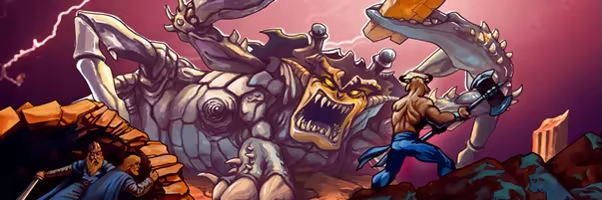
Create your own epic saga of survival, mythology and diplomacy! Rule your clan, make strategic decisions that affect the game world, win battles and expand your influence in this unique mix of RPG, strategy and story-telling.
Modeled estimate, not a reported figure. How we estimate →
Every price cut of more than 20% we have observed, in each market that quoted one, with this game's chart position on either side of it. These are episodes, not a model: a sale is one event, and one event cannot tell you what the next one will do.
For scale, across Steam · Top Sellers · Brazil over the last 30 days: the 25 chart moves that followed a price cut of more than 20% went a median of 10 places towards #1, and the 2,413 moves with no price cut behind them went 2 away. One store, one chart, one country — it is the only place we have enough observations to say even that.
Prices outside the United States have been collected since 6 August 2026 and chart positions since 19 July 2026, so a cut older than that has no market to compare and a market that joined later has no history yet. Nothing here is converted between currencies.
About

Genres
Add-ons
Each DLC is estimated with the same model as a game, then summed — a modeled figure, not reported DLC sales.
Sums Steam only; GOG publishes no volume signal, so the true total is higher by an unknown amount.
| Store | Price | Audience | Score | Chart | Est. revenue |
|---|---|---|---|---|---|
SteamYou are here | $1.79−85% | 408reviews | 80% | — | $18.2K |
| $5.99−50% | 1.1Kratings | 92% | — | not modelled |
Matched by title — a reused name can pair the wrong games. * is a critic aggregate. Prices and positions are each store's United States storefront; Epic charts worldwide. Audience and Score too, except Steam's, which is worldwide.
Engagement
Reviews
Themes across 44 recent reviews and how positive each mention is. A keyword signal, not full sentiment analysis.
Reviews
This is a text-based village survive and thrive sort of game with elements of fantasy and plenty of combat. That said, the game becomes a rather boring routine fairly quickly. You have at least a dozen choices to make, but you make the exact same dozen choices each year. Will you go to war in the summertime? Will you explore the countryside? Will you build a shrine to one of 35 gods or ignore them? My biggest issue with the game is that it is too difficult to understand which choices lead to which outcomes. I like a certain level of unpredictability, but I've been through the same dozen scenarios a handful of times now and I still get outcomes I either don't want or don't really understand. Don't assume your advisors are actually helpful with your decision-making, either. Some of them are downright stupid or deeply irritating. You get to choose which advisors stay on your "team," but choice is sort of an illusion since aspects of the game won't work as well if you don't have an advisor who worships a certain god on your team. Good luck, by the way, if a good quality advisor dies. Your game's equilibrium absolutely will be thrown off and there's no simple solution. This game also features massive blocks of text. Now, don't get cross with me for complaining about massive blocks of text in a text-based game. You'll see from my Roadwarden review that I can and do enjoy reading and I am not intimidated by a text-based game. This specific game has egregious, Anna Karenina levels of written words in it. Again, you can "choose" not to read 99% of it, but you will flop if you don't. Also? Don't expect reading to help you get the outcomes you want. You still won't. Some of these text blocks are stories about the giant pantheon, which you must memorize every detail of to succeed in the annual God Cosplay Ritual, and if you forget the slightest detail you and your entire village are screwed. I'm a person who is frequently hired as a consultant for corporations because of my attention to detail. This is not a skill issue for me whatsoever. This game is just dense. I got it for pennies, and boy am I glad. If I paid real money for it, I'd be very upset. If you're looking for something similar, I recommend Dead in Vinland.
Media

Related
Related
Price dynamics, follower growth, revenue and sales trajectories with interactive tooltips
This and every other Pro feature is free until October 20, 2026. A free account is all it takes.
Stats
All-time low is the lowest price we've recorded for this game since we started tracking it.
Languages: English**languages with full audio support
Hours played at review time, across 44 reviews with recorded playtime.
positive critical· bar length = how often the theme comes up
King of Dragon Pass might be one of the most in-depth and unique examples of a true "role-playing" game. It's unique in the extent to which you must immerse yourself in the game's lore and worldbuilding; this is not a game you loosely stumble through as your self-insert character. If the prospect of immersing yourself in deep mythology and in-game history appeals to you, look no further.
There really are not many other games quite like King of Dragon Pass, the fact this game was originally published in 1999 makes it even more fascinating. This is because the game feels ahead of its time now, let alone in the late 90s. This is partly thanks to the game being set in the world of Glorantha that feels fresh and creative (but is actually quite aged having been around since the 50's) in this post-DnD boom era where worlds closely derived from Tolkein have become oversaturated and cliche in the fantasy genre. The gameplay strikes an interesting balance between visual novel and tribal management simulation, where the main gameplay loop revolves around propitiating to the gods, learning lore to perform rituals reenacting the god's exploits during creation times, exploring and dealing with foreigners (human and inhuman) who have also moved into various corners of Dragon Pass, keeping your clan prosperous, dealing with various crises (internal and external) and warring, trading and uniting with the other clans around you. The game however does not make conquest it's main focus as many 4X games do, conquering land up to a certain point is useless and just makes your borders less defensible. Your clan will never snowball into an unstoppable economy either, inevitably splitting into smaller ones when it gets too big. You unite the lands through consent rather than conquest by creating a tribe with your neighbours, a tribe you may not always be the leader of. In the long game your ultimate goal is to lead your tribe and be crowned as King (or Queen) of Dragon Pass by everyone else by progressing the game's story and securing the loyalties of the other inhabitants of the region. Because of this, the game revolves far more around diplomacy and story telling, war becoming merely a means to these ends rather than the other way around as is common in most games of its kind. This approach towards warfare is reflected in the limited gameplay around war, battles being text based with only a few options here and there to influence their outcomes. So if you are looking for in depth warfare like in Total War games, you won't find that here. If you are looking for something a little retro with diplomacy that outdoes the rudimentary systems found in Total War and Civilisation games then you will find that here, and a lot of neat worldbuilding and story telling while you're at it. I haven't even played the original 1999 version yet as sadly it's only available on GoG not Steam, but I have seen screenshots and I think it looks even better than the Steam Port that I have already had alot of fun with.
The game poses as a fun adventure of managing your tribe, but it turns out to be Excel spreadsheet simulator... except you can't see the numbers. It's a strategy game where numbers matter the most, yes. Which normally wouldn't be a problem. But here you won't see these numbers, you won't see your chances, and you have to guess why you failed. With such a bad game design idea, I don't even know how this game earned enough money to provide for sequel. Doesn't matter if you pick the easiest difficulty, if the RNG is bad, the gods don't look favorably at you or sth, you won't save your clan unless you know what you're doing. And you won't at the start. Because the tutorial is ♥♥♥♥. Many mechanics are so obscure and poorly explained that you won't know how to manage them unless you spend hundreds of hours on trials-and-errors, or digging through walkthroughs and wikis. What strikes me positively, though, is how the game forces you to educate yourself the world lore in order to make correct decisions, especially in the case of hero quests. You can't just brute-force them. You have to know how would your hero act in the myth. I have never seen such idea in a game.
King of Dragon Pass I do enjoy a reading adventure but the other game Mechanics they put in makes the game really boring in my opinion. 3/10
King of Dragon Pass is a unique blend of strategy and role-playing, where you guide the fate of a clan through your decisions, featuring a rich narrative and immense replayability.
Trash mobile version. Lazy PC port. Supposedly adds new events, but honestly didn't get far enough to see the new events as the new art style/UI, and lack of Tula, sucks the heart and soul right out of this version. Find the classic and play that instead.
King of Dragon Pass is one of the most unique narrative-strategy hybrids ever released, a game that refuses to fit into traditional genre categories and instead builds an experience rooted in mythology, oral tradition, politics, and emergent storytelling. Developed by A Sharp and published on Steam by HeroCraft PC, it transports players to Glorantha, a richly constructed fantasy world steeped in ritual, supernatural forces, ancestral duty, and cultural memory. Rather than handing players a conquering army or a sprawling empire, the game places them in command of a single clan—small, vulnerable, idealistic, and deeply shaped by its gods. Every choice carries cultural significance, and survival hinges not on economic optimization alone but on understanding traditions, interpreting omens, negotiating with spirits, and maintaining the fragile bonds that sustain community life. The game immediately establishes that leadership in Glorantha is personal, moral, and spiritual, not merely mechanical. Gameplay unfolds through a blend of resource management, turn-based decision-making, council deliberation, exploration, and narrative-driven encounters. Each year in Dragon Pass brings harvests, raids, marriages, trade opportunities, diplomatic crises, and unpredictable mythological events. The player must balance food, livestock, magic, population, military strength, and social stability while respecting customs that govern everything from hospitality to justice. What truly defines the experience, however, is the constant stream of illustrated story events—situations that require judgment rather than calculation. A feuding family seeks mediation, a stranger offers a mysterious object, a rival clan spreads slander, or a god demands a ritual offering. Each event provides multiple responses, but there is rarely an obvious correct answer. Success depends on knowing your clan’s values, the personalities of council members, and the fickle nature of Gloranthan deities. The world feels alive because it responds not to numbers alone, but to identity, culture, and narrative continuity. The advisors form the beating heart of the experience. Each member of the clan ring comes with beliefs, talents, biases, histories, and political agendas, and they rarely agree unanimously. Some push caution, others aggression, some emphasize magic, others diplomacy. Their input isn’t simply statistical—sometimes the wisest-seeming advice leads to disaster, while the reckless suggestion succeeds due to luck or divine favor. This creates an incredibly human form of uncertainty, mirroring real governance rather than offering puzzle-like solutions. Over time, players grow attached to these characters, learning who can be trusted, who exaggerates, who hides their ambition, and who communicates with the gods most faithfully. Losing a beloved advisor to illness or battle can feel more devastating than losing troops or wealth, underscoring how deeply the game invests players in storytelling rather than conquest. Visually, King of Dragon Pass blends hand-painted art with evocative illustrations that resemble storybook panels rather than typical strategy-game graphics. Every event is paired with artwork that enhances atmosphere and reinforces Glorantha’s distinctive cultural texture. The music and sound design are restrained but effective, prioritizing mood and thematic immersion over spectacle. While the interface and presentation clearly reveal the game’s late-1990s origins, the aesthetic achieves something timeless—organic, mysterious, and grounded in myth rather than medieval-European fantasy clichés. The slow pacing, narrative framing, and deliberate decision structure invite contemplation rather than rapid action, making the world feel weighty and spiritually textured. Replayability is enormous because no two playthroughs unfold the same way. Randomized events, shifting alliances, evolving clan personalities, procedural crises, and subtle changes in divine temperament ensure that outcomes always vary. Success in one game may lead to ruin in another, even with identical strategies, because fate, interpretation, and unseen forces are fundamental aspects of Glorantha. The game encourages roleplaying—leaning into your clan’s beliefs, honoring oaths, and pursuing long-term mythic goals rather than merely chasing efficiency. Eventually, players may undertake heroquests, myth-reenacting rituals that require preparation, deep knowledge of oral history, and willingness to risk tragedy. These quests form the narrative climax of the game, transforming survival into legacy and giving the campaign an epic sense of culmination. However, the game is not without barriers. Its learning curve can be steep, especially for players accustomed to clearly defined optimization paths. Many actions offer ambiguous benefits or hidden risks, and the game rarely explains underlying systems directly, requiring experimentation or failure-based learning. Some may find the slow pacing difficult, particularly in early years when progress feels incremental. The interface, while functional, lacks modern conveniences and could overwhelm newcomers with text-heavy menus. Additionally, the reliance on random outcomes may frustrate players seeking guaranteed strategic determinism, though randomness serves thematic purpose—Glorantha is a world ruled by gods, luck, and competing myths rather than pure logic. Despite these challenges, King of Dragon Pass endures because it offers something few games attempt: leadership as storytelling, survival as cultural stewardship, and strategy as moral philosophy. It respects intelligence, patience, empathy, and imagination, rewarding players who engage with its world not as a system to exploit but as a society to understand. Even decades after its original release, no other game replicates its narrative depth, cultural design, mythic resonance, or emotional connection to community-building. For players interested in rich worldbuilding, branching narrative design, anthropological fantasy, and slow-burning strategic roleplay, it remains a masterpiece—a quiet, brilliant game that proves the most compelling victories are not achieved through domination, but through wisdom, tradition, and stories worth remembering. Rating: 7/10
[h2]Complexity Has Claimed Another Victim[/h2] King of Dragon Pass must surely be the winner of the prestigious [i]Most Game Rules per Kilobyte of Program Code[/i] competition. Its Glorantha clan-management world is astonishingly complex, mixing politics, diplomacy, trade, barter, warfare, religion, training and resource management with interactive storytelling. That complexity is simultaneously the best thing about the game and, for me, the thing that eventually kills it. The interface feels charmingly 1980s in the traditional sense: lots of text, lots of clicking, not much immediate help, and a manual which, if printed, would probably cause the average inkjet printer to quietly resign and move to Norway. Unfortunately, it also inherits some less charming old-school habits: relatively few convenience options, sometimes no obvious route back to the main menu, and no simple way to abandon a story and start again. The underlying idea is genuinely good. Simulating the life of an entire clan, including politics, trade, exchange, education and all the other things required to stop everyone dying horribly, is an ambitious concept. Who else simulates something this complicated? Wait... oh. Quite a few games nowadays. What King of Dragon Pass particularly lacks for newcomers is the ability to automate parts of the clan administration while learning the rest - essentially a living tutorial rather than being handed the tribal equivalent of the Encyclopaedia Britannica and wished good luck. This is clearly a game for people with considerable patience, plenty of time and a strong willingness to learn; previous experience with similarly complex games would certainly help. My negative recommendation is therefore very much about [i]personal taste[/i]: this degree of hands-on complexity simply does not suit me. I reluctantly have to give it a thumbs down, despite liking the basic concept. If a future successor kept that depth while smoothing out these rougher edges, I would quite happily give version two the same chance.
Разраб на приколе Сделал собственный язык программирования для того, чтобы сделать текстовую игру. Текстовая игра, код которой выглядит примерно как println("Text here") А потом сидит ноет на форуме, что ой перевод на другие языки это очень дорого и вообще не выгодно Не можешь сам перевести игру - не мешай другим переводить твою игру Не хочешь? Значит не удивляйся почему твою игру в пике играло 30 человек и не ной о финансах на форуме.
Selling now
See how fast this game is selling right now — estimated copies and revenue per day from recent review growth.
Players by region
Where this game's players are, estimated from review languages.
Related
| Game | Estimated lifetime revenue | Reviews | Review score | Price |
|---|---|---|---|---|
| $18.2K | 89 | 78% | $6.99 | |
| $18.2K | 128 | 89% | $7.99 | |
| $18.2K | 208 | 78% | $5.99 | |
| $18.2K | 67 | 97% | $13.99 | |
| $18.2K | 174 | 82% | $2.99 | |
| $18.2K | 74 | 93% | $12.99 |
Related
| Game | Estimated lifetime revenue | Reviews | Review score | Price |
|---|---|---|---|---|
| — | 1.1K | 92% | $5.99 | |
| $4.2M | 13K | 88% | $19.99 | |
| $237.4K | 473 | 95% | $18.99 | |
| — | 0 | — | — | |
| $249K | 1.2K | 85% | $19.99 | |
| $222.5K | 475 | 95% | $9.89 |