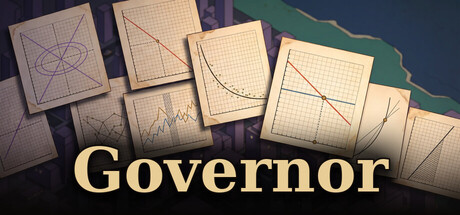
An economic strategy game where you run the central bank. Built on the IS–PC–MR macroeconomic model. The policy rate, unemployment, inflation, the trade balance. Can you keep the economy clear of overheating and slumps?
Modeled estimate, not a reported figure. How we estimate →
About
Governor runs your economy on the Carlin–Soskice three-equation model — the one macroeconomics is taught from in upper-year university courses.
IS — Demand. The dearer money is, the less a country spends and invests — but with a lag. Add to that the exchange rate, the government's budget, and how freely banks are allowed to lend.
PC — Inflation and unemployment. An overheated economy pushes prices up faster than a slump pulls them back down. And down is the hard direction: wages are almost never cut.
MR — The monetary policy rule. The game derives the best rate not from a curve, but from what costs you more — missing the inflation target, or unemployment you didn't have to have.
You set the nominal rate. The real price of money is what's left once expected inflation is taken out — and what people and markets expect depends on how far they trust you. Hit the target and credibility accumulates; miss it several quarters running and it crumbles, and the very same rate starts working noticeably weaker. The rate has a floor. If the central bank answers to the government, inflation drifts upward on its own: markets price in the abuse before it happens. Unemployment is tied to output, and banks add their own markup on top of your rate — borrowers pay more than you announced.
Out of your decisions a long-run picture assembles itself: economic growth (Solow), equilibrium unemployment, inequality (Gini), public debt, the exchange rate and the trade balance — and financial bubbles that inflate and burst if nobody is watching them.
1931, the golden fetters — hold the gold standard, or let the currency go so the economy can breathe.
1971, Camp David — close the gold window, or defend Bretton Woods with reserves.
1979, Volcker — crush inflation with the rate, or take the road of price controls.
2008, the Lehman weekend — put a shoulder under the banking system, or let it fall.
2021, "is inflation transitory?" — wait the price spike out, or hit it early.
The 1929 crash, three waves of bank panics, a war in which the Fed holds rates wherever the Treasury needs them, Bretton Woods, the OPEC embargo, the Volcker disinflation, Black Monday, the Asian crisis, the dot-com bust, 2008, the pandemic and the inflation of 2021–2022 — all of it arrives on schedule. Only one question stays open: what will you do about it?
A full tutorial and a short one, to get the basic economic concepts and the links between them.
The state of the economy is drawn as a city on the world map. Buildings rise and multiply as the country grows richer; traffic in the streets shows how hard the economy is running; the city's colours warm up in an overheat and go cold in a slump; cranes work when money is cheap and the future looks good. You will see a crisis in the skyline before you open a chart.
Around it — a world map with historical borders by era and up to 24 rival countries, each with a central bank of its own. They trade with you the more willingly the closer and richer you are; tariffs and trade wars tear those ties apart. A separate mode, off by default, switches on spheres of influence: blocs, satellites, and debt dependency between countries.
If you would rather have numbers than pictures, there is the terminal: tables, charts, and a breakdown of every move in inflation — by cause, with figures. Plus the influence map: 106 variables of the model and 276 links between them, all on one screen.
Gather famous economists into an association of your own.
Once a year the Economic Association meets and takes your policy apart. You appoint the Chair — and with them a school of thought: it grants your economy one permanent bonus and one permanent penalty.
From two players — over Steam or a local network. Each has their own country and a full copy of the model; after every turn the worlds are reconciled, so your surplus is somebody else's deficit. Credit to a neighbour is a lever too, and debtors know it.
No toy models, no random numbers standing in for an economy, no "correct" playthrough, and no story that will pull you out of a stagflation you arranged yourself. There is a model, a hundred years of history, and the price of a mistake you set for yourself.
Genres
Stats
All-time low is the lowest price we've recorded for this game since we started tracking it.
Add-ons
Each DLC is estimated with the same model as a game, then summed — a modeled figure, not reported DLC sales.
Engagement
Reviews
非常有特色的游戏。对于经济学是很好的模拟教材。 建议可以把归因做的更明确一些。影响图这个界面很有潜力,但是目前无法让我直接归因一个数值到操作。比如“我的利率已经设置为0了但是为何通胀率仍然始终保持不变,如何调整其他指标来优化通胀目标”。或者“我的通胀预期锚定程度下降太快了,如何恢复预期”。我仍然只能靠截图和打字向AI来求助。如果能够通过影响图更快捷地识别出需要进行的行为,对于当前这个复杂程度地游戏会很有帮助。 另外如果可以把存档导出 json 给 AI 读取的话,为何不直接在界面上加一个按钮复制当前所有指标给 AI 让他快速读取全局数值,而非我每次都要通过不完整的截图(无法反映所有可操作指标)来向 AI 提供输入。 还有一些交互上的问题,比如通过色彩指引区分哪些是可操作指标,哪些是只读指标。还可以简化操作界面,提供简易模式和复杂模式的两种界面设定,毕竟其实真正需要的操作并不是很多。 最后还是点赞,瑕不掩瑜,非常好的创意! Translation: >This is a highly distinctive game and serves as an excellent simulation teaching tool for economics. >I would suggest improving causal attribution clarity. The influence‑diagram interface shows great potential, yet it currently does not allow me to directly trace a numerical outcome back to specific actions. For instance: “I have set my interest rate to zero, but why has inflation remained unchanged? What other levers should I adjust to hit my inflation target?” Or: “Inflation‑expectation anchoring is deteriorating too quickly. How can I restore expectations?” Right now I still have to rely on screenshots and typed text to ask an AI for help. Enabling faster identification of required actions directly within the influence diagram would add substantial value for a game of this complexity. >Additionally, if save files can already be exported as JSON for AI parsing, why not add an in‑game button that copies all current metrics to the clipboard for AI consumption? This would eliminate my need to supply incomplete screenshots that fail to capture every adjustable parameter. >There are also several UI‑interaction points to refine. Color‑coding could distinguish editable parameters from read‑only values. Interface complexity could be reduced by offering two preset layouts: a simple mode and an advanced mode, since the actual set of necessary operations is not overly large. >All that said, this is an outstanding concept; minor flaws do not detract from its overall quality. Well‑done!
Media

Related
Related
Price dynamics, follower growth, revenue and sales trajectories with interactive tooltips
This and every other Pro feature is free until October 20, 2026. A free account is all it takes.
Languages: English, Russian, Simplified Chinese
Hours played at review time, across 32 reviews with recorded playtime.
这也叫深度模拟?本质是一款赛博滑动变阻器,能调利率就调利率,超出利率控制范围了就去调财政,然后各种危机来了调各自的滑条,除了注意一下有滞后以外,完全无脑……片山阿姨玩了这游戏做梦都要笑醒 还有谁家斯拉夫做题区啊?老子毕业这么久了,不开启你这个做题模式还拿不了成就?过个几十回合就要做一个题,不知道的以为在给纳比乌林娜阿姨训练湿件计算机
我玩不懂但我非常喜欢!它填补了游戏行业宏观经济模拟器的空白
不是哥们,你怎么把经济学教材搬上来了???
For now I don't understand anything, in the training scenarios the indicators react sensibly (lowering policy rate + QE revives the economy, the reverse slows it down), in the campaign I either get to hyperinflation which doesn't react to absurd rates (like 25%) or deflation trap that doesn't stop despite negative interest rate and deficit spending. It seems that either of the death spirals are extremely difficult to escape, and easy to fall into. But, I'm also bad at the game and not knowledgeable about economics, so there's that. Jokes aside, the game is made well for what it's designed to do (teach economics) and is very replayable, it just has a bit of a learning curve and it's not clear what most levers do (and not all of them are explained in the tutorial).
有点太专业了
这不是“游戏”,只是个包装成游戏的图标。
the mother of all spreadsheet simulators, thanks be to god. requires extensive economic knowledge which i do not have (oops), but half the point is that this is a teaching game. wanna learn hardcore macroeconomics + play a quirky government sim where you handle economic policy for an IRL country based on legit economic data? this is for you. looking for something else? something whimsical, forgiving, fun? probs not the right game for you. if you enjoy getting things right via trial and era, learning/practicing your macroeconomic knowledge, this is a good game. if you're hoping to get it right the first time, look elsewhere. the first few times i played the economy immediately melted down and people probably massacred my little fed governor in the streets. it'll get better, i assume.
Ну, как бы интересная задумка и очень подробный ликбез по экономике, но онлайн не работает от слова совсем. Просто посмотрели с другом на карту
[h1]今天我说了算——《Governor》[/h1] 一进游戏,游戏分为沙盒模式和剧本模式。 在剧本模式中,你将体会到美国时期,从1925年大萧条时代到罗斯福新政,再到疫情通胀这一时期。 每个时期都具有不同的难度,当你熟悉后,可以直接选择宏大战役。体验1925-2025年的美国历史。 游戏汇总,可以说很是复杂,设计非常多的知识,但是你也可以将它看作是历史的学习。 在布雷顿森林体系中,你将清楚的看到当时的情景、对局、世界与贸易、金融与住房、结构等。 这部分介绍,可以说非常专业。 就拿劳动力市场买方垄断,无竞争市场,工会谈判,工资向下刚性等,都非常有代表性。 而进入游戏,一个使命展现在你面前,比如你的主要杠杆是政策利率。要求通胀回到2.0。 先不说别的怎么样,现在右下角换上一个好听的电台,来个美国管弦乐队。 伴随着舒缓的音乐,各项具体信息展现在面前。 财政、货币银行、市场等等,都呈现在你面前。 而在过程中,如美联储协议调整,主席任命等等。 过程中,还有各类事件,比如朝鲜战争,或者是岔路事件。 举个例子,大炮与黄油,你需要决定是否用税来买单。 不加税是历史验证,立即加征战争附加税则会带来不同后果。 而整个游戏,其实就在抉择以及实时调控中不断变化,最终随着时间的流逝,你将迎来最终结局,成功/失败。 可以说,《Governor》这款游戏,给玩家带来无限可能,如果你喜欢经济相关的游戏,可以一试! [quote]欢迎关注我们的鉴赏家:[url=https://store.steampowered.com/curator/35402982/]走心评测[/url] ←遵从内心,写出真实感受 欢迎加入我们Steam组:[url=https://steamcommunity.com/groups/ZXPC]走心评测[/url]←点击加入,一起探索游戏的乐趣 喜欢这篇评论,也麻烦点个赞,让更多人能够看到![/quote]
Selling now
See how fast this game is selling right now — estimated copies and revenue per day from recent review growth.
Players by region
Where this game's players are, estimated from review languages.
Related
| Game | Estimated lifetime revenue | Reviews | Review score | Price |
|---|---|---|---|---|
| — | 0 | — | — | |
| $997.7K | 1.4K | 80% | $24.99 | |
| $18.2K | 29 | 45% | $14.99 | |
| $4.6K | 12 | 100% | $9.99 | |
| $1.6K | 3 | 67% | $13.99 | |
| — | 0 | — | — |
Related
| Game | Estimated lifetime revenue | Reviews | Review score | Price |
|---|---|---|---|---|
| $18.5K | 61 | 70% | $14.99 | |
| $18.5K | 151 | 26% | $4.19 | |
| $18.5K | 289 | 85% | $4.49 | |
| $18.5K | 127 | 74% | $7.99 | |
| $18.5K | 76 | 95% | $12.99 | |
| $18.5K | 52 | 87% | $9.99 |