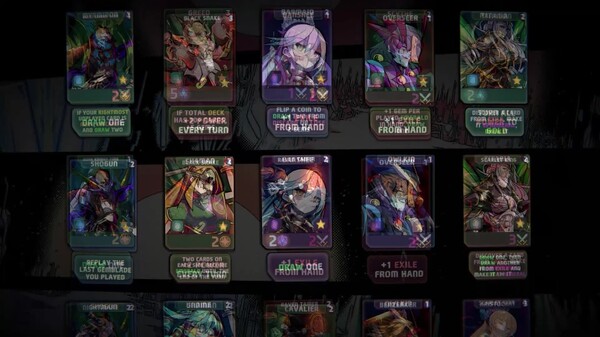
Gemblades approaches the roguelike deckbuilding formula from the perspective of a classic tabletop deckbuilder, putting greater emphasis on recruiting heroes, generating resources, and gradually constructing an increasingly efficient collection of synergistic cards. Rather than treating every card as a conventional attack, defense, or spell, the design revolves around heroes who contribute to a larger strategic engine. You play cards to produce resources, use those resources to recruit stronger heroes, and then exploit the interactions between them to overcome increasingly dangerous opposition. The structure is immediately understandable, but there is enough room for optimization to make thoughtful deck construction the centerpiece of the experience.
The fantasy premise provides a simple framework for this system. Players assemble a collection of magical warriors and send them against the forces of Onyxion, the Dragon Lord, whose invasion threatens the world. The narrative is deliberately secondary to the card mechanics, functioning more as motivation for the battles than as an elaborate story campaign. This works well for a game primarily interested in repeated strategic play. Instead of interrupting the deckbuilding with lengthy exposition, it keeps attention on recruiting characters and discovering combinations capable of producing increasingly powerful turns.
One of the strongest ideas is the division of heroes into distinct Gemtypes. Emerald represents growth and balance, making it thematically suited to steady development and flexible strategies. Ruby embodies warriors eager to enter combat and willing to sacrifice themselves for their allies, suggesting a more aggressive style built around immediate impact and selfless interactions. Sapphire represents knowledge and legendary tactical ability, giving its characters a more calculated identity. These distinctions provide players with recognizable strategic directions without reducing deck construction to a single obvious path.
The recruitment system is particularly important because it creates a satisfying sense of progression during play. Resources are not merely numbers accumulated for their own sake; they become the means of acquiring stronger additions to the deck. This creates a constant tension between immediate effectiveness and long-term development. A modest hero can still have considerable value when its ability produces the resource or interaction required to recruit something significantly more powerful later. Successful decks therefore feel constructed rather than simply handed to the player, and seeing an initially limited collection evolve into an interconnected engine provides much of the satisfaction.
Synergy is consequently more important than evaluating cards individually. The strongest strategy is not necessarily to collect every impressive hero available, but to understand how abilities interact and determine whether a new recruit actually improves the existing structure. That philosophy captures the appeal of physical deckbuilding games, where purchasing and playing cards are intertwined parts of the same strategic puzzle. It also encourages experimentation because a card that appears unimpressive in isolation may become valuable when combined with the appropriate Gemtype or supporting abilities.
The roguelite influence provides additional incentive to understand these relationships rather than relying on one rigid solution. Repeated play naturally encourages experimentation with alternative combinations and different approaches to resource generation. This is where the relatively focused rules become an advantage. The game does not need excessive layers of secondary mechanics when the fundamental pleasure comes from improving efficiency and finding combinations that transform several ordinary effects into a powerful sequence.
Global leaderboards add another dimension to the single-player structure. Defeating enemies can be satisfying on its own, but leaderboard competition gives experienced players a reason to pursue greater efficiency after becoming comfortable with the basic systems. It transforms optimization into a measurable objective and fits naturally with a game built around mastering combinations. Steam achievements, statistics, cloud support, and leaderboard integration further complement the replay-focused nature of the experience.
Visually, the fantasy, hand-drawn, anime, and comic-book influences complement the tabletop card-game inspiration. The emphasis on illustrated heroes gives recruitment more personality than a system based entirely on anonymous numerical upgrades. Distinct Gemtypes also help establish recognizable character identities, making the mechanical differences easier to associate with particular themes. The presentation does not need extravagant spectacle because cards and their relationships remain the primary focus.
The biggest limitation is that this is a deliberately concentrated interpretation of a genre already filled with exceptionally elaborate competitors. Players expecting enormous narratives, sprawling exploration systems, or countless secondary progression mechanics may find its priorities narrower than anticipated. Its success instead depends on the quality and longevity of the card interactions. Fortunately, the resource economy, recruitment mechanics, Gemtype identities, and emphasis on combinations provide a solid foundation. The straightforward rules also make it more approachable for players who enjoy deckbuilding but do not necessarily want to memorize an overwhelming number of interconnected systems.
Steam Deck compatibility currently deserves some caution. Steam lists the game's Steam Deck compatibility status as Unknown rather than Verified, Playable, or Unsupported. This means Valve has not provided an official compatibility assessment, so handheld players should not interpret the absence of a warning as confirmation of seamless Deck operation. The card-based interface and turn-oriented style could conceptually suit portable play well, but until an official Steam Deck rating is available, compatibility and control behavior should be treated as unconfirmed.
Ace Benoff serves as both developer and publisher, and the resulting game has a clear mechanical focus rather than trying to stretch its concept across unrelated features. Its strongest qualities are the accessible resource-and-recruitment loop, clearly differentiated Gemtypes, opportunities for synergistic deck construction, and competitive leaderboard component. The experience is most appealing to players who enjoy building an efficient strategic engine and watching carefully chosen cards become substantially more powerful through interaction. It may be relatively focused in scope, but that concentration gives its core deckbuilding mechanics room to remain the main attraction.
Rating: 8/10