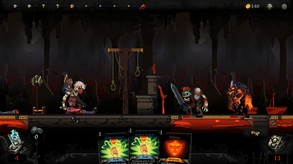
This card game combines elements of roguelike and deckbuilding. During the game, you shall strive ahead, gathering cards to build a unique deck and use it to defeat the enemies getting in your way. You will have to choose between escaping or try to defeat Death, who is relentlessly pursuing you.
Modeled estimate, not a reported figure. How we estimate →
Prices
The United States storefront in every case, so this compares stores and not countries.
About
Genres
Stats
All-time low is the lowest price we've recorded for this game since we started tracking it.
Languages: English, Simplified Chinese, Japanese, Polish, French, Russian, Traditional Chinese, Portuguese - Brazil, Korean, German
Sums Steam only; App Store publishes no volume signal, so the true total is higher by an unknown amount.
| Store | Price | Audience | Score | Chart | Est. revenue |
|---|---|---|---|---|---|
SteamYou are here | $14.99 | 663reviews | 81% | — | $224.4K |
| $2.99 | 21ratings | 89% | — | not modelled |
Matched by title — a reused name can pair the wrong games. * is a critic aggregate. Prices and positions are each store's United States storefront; Epic charts worldwide. Audience and Score too, except Steam's, which is worldwide.
Engagement
Reviews
Themes across 41 recent reviews and how positive each mention is. A keyword signal, not full sentiment analysis.
Reviews
Oui.
O_O
[h1]推荐指数:7.0[/h1] Recommendation index:7.0 虽然制作简陋,内容也有限,玩起来能明显感觉到制作产量不足,作者也有意靠多周目让你多次体验仅有的游戏流程。但是特有的[u]剩余卡牌就是你的血量[/u]玩法很独特。很值得体验。每场战斗在固定回合会出现死神让你需要在尽量的几个回合就结束战斗,让整个节奏非常紧凑。 但如果想要体验游玩,最好直接体验它的续作:血牌2。与其说本游戏是小而美的独立游戏,不如说是作者拿来练手的完成度较高的demo。 ———————————————————————————— Although the production is simple and the content is limited, it is obvious that the production is not enough to play, and the author also intends to let you experience the only game flow many times by relying on multiple weeks. However, the unique [u] remaining card is your HP [/u], and the gameplay is very unique. Well worth the experience. Each battle has a Grim Reaper on a fixed turn, so you need to end the fight in as few turns as possible, making the whole rhythm very tight. But if you want to experience the game, it's best to go straight to its sequel: Blood 2. It's not so much that this game is a small and beautiful indie game.,It's better to be a demo with a high degree of completion that the author used to practice.。
Media

Related
Related
Price dynamics, follower growth, revenue and sales trajectories with interactive tooltips
This and every other Pro feature is free until October 20, 2026. A free account is all it takes.
Hours played at review time, across 42 reviews with recorded playtime.
positive critical· bar length = how often the theme comes up
кажется, что разрабы игру перестали поддерживать - тк в игре даже перестали выдаваться достижения. А жаль - до сих пор захожу в игру поностальгировать...
有创意但不多,牌少了血不够,牌多了抽不到,牌不能成形。作者肯定自己都没怎么玩。
A fun twist on the deck-building rogue-like genre. Play Slay the spire for a more polished and balanced experience, but this one is very fun too.
This is a worthy successor to Slay the Spire -- hard, but winnable. A nice difference is that instead of your character following a path, you have a predetermined number of regular & elite enemies, stores, and events, and you can use your 11 picks to visit them in any order. There are a few more than 11 so you'll always be skipping something. IMO this is an improvement over STS. Minor suggestions for improvement: It's annoying that you have to click the screen to start your character moving; it'd be nice if this were automated. There's nothing else to do on the start screen but start moving. Related to that: Why bother with movement at all? The background corridors are all pretty similar. I'd rather spend less time transitioning between combats and just start the next one immediately.
Blood Card, developed and published by Pixel Cattle Games, is an inventive roguelike deck-building game that twists the conventions of the genre by linking the player’s health directly to the size of their deck. Instead of relying on a traditional health meter, every card in your deck represents a fragment of your vitality. When enemies damage you, you lose cards, and when your deck runs dry, death arrives to claim you. It’s an elegantly simple idea that reshapes the rhythm of every battle and adds constant tension to even the smallest encounters. Each decision—whether to add a new card, remove a weak one, or play aggressively—becomes an act of survival. The result is a fast-paced, strategic experience that feels both familiar to fans of roguelike deck-builders and refreshingly distinct in execution. The game begins much like others in the genre, with a modest starter deck, a choice of cards, and a series of battles against random enemies. But it doesn’t take long for Blood Card’s defining mechanic to make itself known. Every action, every draw, and every wound chips away at your total number of cards, and with each loss, you edge closer to oblivion. The player must weigh the value of expanding their deck for flexibility against the danger of diluting it with weaker cards that reduce efficiency. It’s a fascinating inversion of the genre’s usual logic—instead of streamlining your deck to maximize combos, you often want to bulk it up to preserve your health. This balance between survival and optimization forms the heart of the game’s strategy. The pressure escalates further when Death himself appears mid-run, functioning as a grim timer that grows more aggressive as battles drag on. If you don’t defeat enemies quickly enough, Death joins the fight, ensuring that prolonged indecision is punished swiftly. Combat is turn-based, fast, and deceptively simple. You draw from your deck to play attack, defense, and special effect cards, managing energy resources and aiming to build synergies that can handle increasingly difficult foes. What separates Blood Card from many of its contemporaries is the constant awareness that every mistake or unlucky draw has permanent consequences. Damage isn’t just temporary—it eats away at your options for future turns, creating an almost existential tension. The more cards you lose, the fewer tools you have to recover. This dynamic encourages aggressive but calculated play, pushing you to experiment with strategies that balance offense, defense, and deck preservation. The game’s large selection of cards—over two hundred in total—offers enough variety to support multiple playstyles, from brute-force attacks to intricate, combo-driven decks. Because of its roguelike structure, no two runs play out quite the same, and each victory feels hard-earned. Visually, Blood Card embraces a grim, gothic aesthetic that complements its theme of mortality and decay. The art style is simple yet evocative, with dark tones, muted palettes, and stylized depictions of grotesque monsters and otherworldly figures. The presentation recalls classic dungeon-crawler motifs but filtered through a minimalist indie lens, emphasizing atmosphere over detail. The user interface is clean and functional, though at times the card art and animations can feel repetitive. The soundtrack reinforces the mood with somber, tension-filled loops that underscore the inevitability of death’s approach. It’s a world that feels both oppressive and strangely hypnotic, mirroring the game’s mechanics: a struggle for survival in a system that’s designed to consume you. As you progress, the game introduces new challenges and unlocks. Different characters, cards, and events gradually expand the available strategies and potential builds. Random encounters on the world map offer small choices that can lead to powerful rewards or devastating consequences, maintaining the sense of risk that defines the genre. The randomness works in the game’s favor, as it forces adaptability and ensures that no two runs feel identical. However, this same reliance on luck can sometimes frustrate players, particularly when poor draws or unlucky events end promising runs. Like many roguelikes, Blood Card rewards persistence more than perfection; failure is part of the learning process, and each death teaches you something new about managing your deck and your limited time. The balance between innovation and frustration is where Blood Card finds both its strength and its weakness. The central concept—the deck as life—is brilliant in theory and engaging in practice, but the game’s difficulty can be punishing. The reaper mechanic that acts as a ticking clock during battles forces quick decisions, and while this urgency adds tension, it can also feel unfair when you’re building momentum only to be undone by bad luck. The game doesn’t always communicate its systems clearly, and some cards feel unbalanced, making certain builds far more effective than others. These issues don’t ruin the experience, but they can make it uneven. The developers’ ambition is evident, but the polish doesn’t always match the ingenuity of the design. Despite its flaws, Blood Card offers a deeply satisfying loop for players who enjoy mastering complex systems through trial and error. Each run feels like a self-contained puzzle—how to make the most of your cards, how to survive just one more battle, how to find the perfect combination of aggression and restraint. The roguelike structure encourages short bursts of play, and the ever-present sense of danger keeps even quick sessions engaging. The thrill of finally conquering a difficult boss or surviving with just a handful of cards left is immensely rewarding. It’s a game that demands patience and strategic thinking but rewards them generously with a sense of hard-earned accomplishment. Blood Card’s minimalism extends to its storytelling, which is more thematic than narrative-driven. There’s no elaborate plot or cast of characters; instead, the world’s personality emerges from its mechanics and tone. The player’s journey is a metaphor for endurance against inevitable defeat—a struggle to hold onto what little you have for as long as possible. The grim atmosphere, the constant presence of Death, and the haunting repetition of battles all reinforce this existential undercurrent. It’s rare for a deck-building game to feel this thematically cohesive, and while the execution isn’t flawless, the design philosophy is unmistakably deliberate. In the end, Blood Card succeeds because it dares to rethink what a deck-building roguelike can be. It strips the genre down to its essence and rebuilds it around a single, striking idea: survival through sacrifice. Every mechanic serves that vision, and the result is a game that feels fresh even in a crowded field of card battlers. Its rough edges—uneven difficulty, repetitive visuals, occasional imbalance—are overshadowed by the creativity of its central concept and the tension that permeates every decision. For fans of games like Slay the Spire or Monster Train who are looking for something darker, leaner, and more experimental, Blood Card delivers an experience that is both punishing and deeply satisfying. It is a roguelike where death is not just a consequence but the core of the design, and in embracing that inevitability, it finds its own grim beauty. Rating: 8/10
딱히...재미는 없는듯;
Selling now
See how fast this game is selling right now — estimated copies and revenue per day from recent review growth.
Players by region
Where this game's players are, estimated from review languages.
Related
| Game | Estimated lifetime revenue | Reviews | Review score | Price |
|---|---|---|---|---|
| $12.1M | 23.3K | 92% | $19.99 | |
| $1.1M | 1.5K | 76% | $19.99 | |
| $710 | 3 | 67% | $7.99 | |
| $20.2M | 218.5K | 97% | $6.24 | |
| $4.4M | 6K | 87% | $19.99 | |
| $109K | 302 | 85% | $14.99 |
Related
| Game | Estimated lifetime revenue | Reviews | Review score | Price |
|---|---|---|---|---|
| $224.4K | 1.2K | 82% | $8.99 | |
| $224.5K | 1K | 77% | $19.99 | |
| $224.4K | 495 | 84% | $19.99 | |
| $224.4K | 497 | 75% | $19.99 | |
| $224.6K | 562 | 84% | $19.99 | |
| $224.3K | 4.7K | 97% | $2.99 |