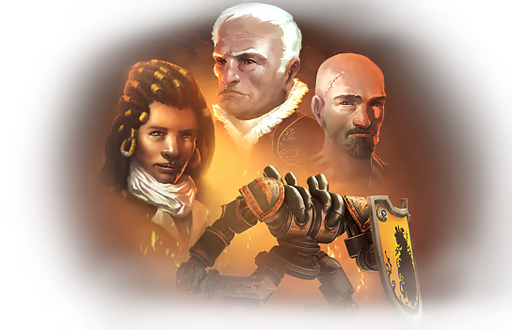
Acaratus, developed and published by Nodbrim Interactive, is an ambitious turn-based tactical RPG that combines steampunk aesthetics, modular mech customization, and card-driven combat into a distinctive, if sometimes uneven, strategy experience. Set in a war-torn world ruled by an oppressive empire, the game places players at the head of a growing rebellion that relies on powerful steam-driven battle suits to challenge tyranny. From the outset, Acaratus makes it clear that it values strategic depth and player experimentation over streamlined accessibility, positioning itself as a game that rewards patience, planning, and a willingness to learn through failure.
The narrative frames the experience around resistance and liberation, following a cast of characters united against an authoritarian ruler whose regime has pushed the world into despair. While the story leans on familiar tropes of rebellion and revolution, it provides enough context to give weight to each mission and to justify the escalating scale of conflict. Dialogue and story progression are largely text-driven, which allows for world-building and character exposition but can occasionally feel heavy or unevenly paced. The plot does not always deliver dramatic highs, yet it serves its purpose by anchoring the tactical battles within a broader struggle and giving players a sense of forward momentum as they push deeper into enemy-controlled territory.
Where Acaratus truly distinguishes itself is in its combat systems. Battles unfold on grid-based maps and follow traditional turn-based rules, but the real complexity emerges from how players build and equip their units. Rather than assigning characters to fixed classes, the game allows full customization of battle suits, with interchangeable parts that affect movement, defense, attack range, and special capabilities. This modular approach encourages creative problem-solving, as no two units need to function the same way. Players can craft heavily armored frontline bruisers, agile skirmishers, or long-range artillery platforms depending on their strategic preferences, and these choices have a tangible impact on how encounters play out.
The card-based ability system adds another layer of tactical depth. Cards represent special actions, buffs, and tactical maneuvers that can be deployed during combat, effectively functioning as a flexible toolkit rather than a static skill list. Managing these cards becomes a game in itself, as players must decide which abilities to bring into battle and when to use them for maximum effect. This system introduces moments of improvisation and adaptation, particularly in longer or more challenging encounters, but it also contributes to the game’s steeper learning curve. New players may initially feel overwhelmed by the number of systems at play, though those who invest the time to understand them are rewarded with a highly customizable and satisfying combat experience.
Visually, Acaratus embraces a colorful steampunk style, with its mechanized battle suits standing out as the clear highlight. The mechs are expressive, varied, and visually distinct, helping players quickly identify unit roles and capabilities on the battlefield. Animations are serviceable and convey the weight and power of the machines, even if they lack the polish of higher-budget tactical RPGs. Environmental visuals and character portraits are more modest by comparison, sometimes feeling sparse or repetitive, but they rarely interfere with gameplay clarity. The overall presentation reflects the game’s indie roots, prioritizing functional design and mechanical readability over cinematic flair.
The difficulty curve in Acaratus can be unforgiving, especially in the early stages. Encounters often demand careful preparation and thoughtful unit composition, and mistakes are punished swiftly. Missions that appear straightforward can escalate into tense battles if positioning or ability usage is misjudged. However, this challenge is also one of the game’s strengths, as it reinforces the importance of experimentation and adaptation. Losses frequently serve as learning opportunities, encouraging players to revisit their loadouts, rethink their strategies, and refine their approach rather than brute-forcing progress.
Pacing is another area where Acaratus shows both strengths and weaknesses. Tactical battles are dense and deliberate, often requiring extended focus and careful planning, which will appeal to fans of slower, more methodical strategy games. At the same time, the combination of lengthy encounters and text-heavy storytelling can occasionally make progression feel sluggish. Players looking for quick sessions or rapid narrative payoffs may find the experience demanding, while those who enjoy sinking time into layered systems and long-term strategic thinking are more likely to appreciate its structure.
Overall, Acaratus is a bold and systems-driven tactical RPG that stands out for its deep customization and strategic flexibility. It is not a game that prioritizes accessibility or narrative spectacle, and its rough edges—particularly in pacing and presentation—may limit its appeal for some players. However, for fans of turn-based tactics who enjoy experimenting with builds, mastering layered mechanics, and overcoming demanding encounters, Acaratus offers a rewarding and distinctive experience. Nodbrim Interactive delivers a game that may not be universally polished, but one that clearly values player agency and strategic depth, making it a memorable entry within the niche of indie tactical RPGs.
Rating: 5/10