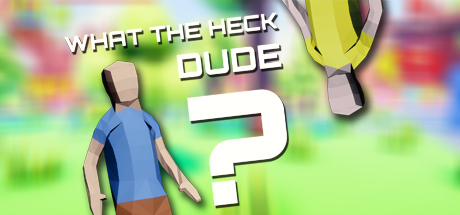
What The Heck, Dude?, developed and published by The_Kiddy, is a physics-driven sandbox brawler that leans heavily into absurdity and unpredictability. It presents itself less as a structured game and more as a chaotic playground where players are free to provoke fights, interact with the environment, and create their own moments of disorder. Rather than guiding players through a defined progression or narrative, it throws them into loosely designed scenarios and lets the systems—or lack thereof—carry the experience.
The core gameplay revolves around simple interactions: moving through environments, engaging with non-player characters, and initiating fights that quickly spiral into clumsy, physics-based chaos. The intention is clear—create humor through exaggerated motion, unpredictable collisions, and unscripted outcomes. In short bursts, this approach can be entertaining. Watching characters stumble, react erratically, or unintentionally cause chain reactions has a certain novelty, especially for players who enjoy sandbox-style experimentation. However, this novelty wears off quickly, largely because the game offers little in the way of evolving mechanics or meaningful objectives.
Combat, which should serve as the centerpiece of the experience, is extremely basic and often inconsistent. Attacks lack precision, and the feedback from hits feels unreliable, making it difficult to develop any sense of control or mastery. Instead of feeling like a deliberate system, combat often comes across as something players endure rather than engage with strategically. Enemy behavior does little to improve this, as opponents tend to react in simplistic or erratic ways, further contributing to the lack of depth. What could have been chaotic fun instead becomes repetitive and, at times, frustrating.
The sandbox design attempts to compensate for this by offering a variety of environments and situations. Each level presents a different setting, giving players new spaces to explore and disrupt. While this adds some visual variety, the underlying gameplay remains largely unchanged, which limits the impact of these different scenarios. The idea of complete freedom—being able to do anything within the world—is present, but without systems to support meaningful interaction, that freedom often feels empty rather than empowering.
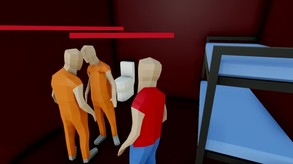
Visually, the game adopts a minimalistic, low-poly style that emphasizes bright colors and simple shapes. This aesthetic can initially give the game a playful and approachable look, but the lack of detail and polish quickly becomes apparent. Animations are stiff, transitions can feel abrupt, and the overall presentation lacks the refinement needed to maintain immersion. The audio design does little to elevate the experience, with sound effects that feel disconnected from the action and fail to reinforce the chaotic tone the game aims to achieve.
One of the most noticeable aspects of What The Heck, Dude? is how quickly its limitations become apparent. Without progression systems, meaningful goals, or varied mechanics, the experience struggles to maintain player interest beyond its initial moments. The game relies almost entirely on emergent humor and randomness, but these elements are not strong enough on their own to sustain engagement. As a result, it feels more like a prototype or experimental project than a fully realized game.
Ultimately, What The Heck, Dude? is a niche experience that may provide brief amusement for players looking for something intentionally unstructured and absurd. Its sandbox approach and physics-based interactions offer moments of chaotic fun, but the lack of depth, polish, and direction prevents it from evolving into something more substantial. It serves as a reminder that freedom in a game needs to be supported by meaningful systems, otherwise it risks becoming aimless.
Rating: 4/10