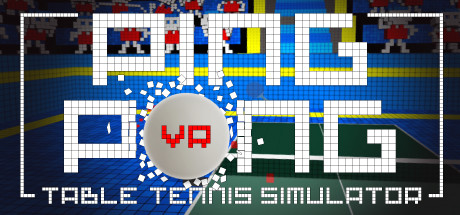
VR Ping Pong, developed by Reddoll Srl and published by IV Productions and Silver Lining Interactive, is one of the earliest attempts to bring the familiar sport of table tennis into the world of virtual reality. Built for motion-controlled systems, it offers players the chance to experience fast-paced ping pong matches in a fully three-dimensional environment where every swing of the paddle feels physical and immediate. Rather than aiming for photorealism, the game opts for a stylized presentation with simple, voxel-like graphics and bright colors, creating a visually clean and comfortable environment that keeps players focused on gameplay rather than spectacle. Its goal is clear and modest: to provide an accessible, immersive, and accurate representation of ping pong that captures the tactile pleasure of the sport while taking advantage of VR’s unique sense of presence.
From the moment a match begins, VR Ping Pong demonstrates a strong grasp of what makes virtual sports engaging. The controls are intuitive, translating your real-world paddle movements into digital actions with convincing precision. Every serve, spin, and smash relies entirely on your motion, allowing for a sense of natural feedback and physical skill that quickly becomes second nature. The physics engine deserves particular praise for how it handles ball movement; the ball behaves with realistic weight, spin, and bounce, making each rally feel dynamic and unpredictable. Subtle differences in the angle and strength of your swing can completely alter the trajectory of the ball, requiring the same reflexes and focus that a real ping pong table demands. When the mechanics click, the illusion is remarkably convincing—you forget about the abstraction of the environment and simply react, moving and striking instinctively.
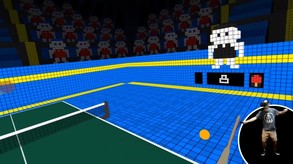
One of the most distinctive aspects of VR Ping Pong is its visual approach. The game’s environments and spectators are deliberately minimalistic, composed of blocky shapes and bright hues reminiscent of early 3D arcade titles. This art style may seem simplistic at first glance, but it serves a practical purpose. By reducing unnecessary visual noise, the developers ensure that the player’s attention remains on the table, the paddle, and the ball. The sparse presentation also minimizes VR-induced discomfort, offering a stable and easy-to-read environment that avoids motion sickness. This aesthetic decision aligns with the game’s design philosophy—simplicity over spectacle—and helps keep performance smooth and responsive, even on mid-range hardware.
The gameplay experience is divided across several modes that provide both structure and variety. Practice mode allows players to refine their technique without pressure, while single matches and tournaments pit them against AI opponents of varying difficulty. Each opponent behaves differently, forcing you to adapt your playstyle as you progress. Some are cautious and defensive, while others play aggressively, testing your timing and positioning. There are also arcade-style challenges that deviate from standard matches, introducing unique objectives or altered rules for a more playful take on the sport. These additional modes give the game a bit of extra longevity and serve as a refreshing change of pace between standard matches. Unfortunately, one major omission at launch was multiplayer support, which left many players wishing they could test their skills against real human opponents. In a game that so naturally lends itself to friendly competition, this absence is felt deeply.
Despite its strong mechanical foundation, VR Ping Pong is not without its flaws. While the ball physics are generally satisfying, the hit detection can occasionally feel inconsistent. Some players report moments where a clear swing fails to register, breaking the flow of a rally. The AI, while competent in most situations, can behave erratically, alternating between uncanny precision and clumsy mistakes. The camera perspective and depth perception can also take some getting used to, especially for newcomers to VR, as judging distance in virtual space doesn’t always translate perfectly to real-world movement. Over time, however, most of these issues become minor annoyances rather than deal-breaking flaws, particularly once you’ve adjusted to the rhythm and responsiveness of the system.
From a technical standpoint, the game performs well and remains stable even during fast-paced rallies. Because the visuals are low in complexity, frame rates stay consistent, which is crucial for VR comfort. The developers clearly prioritized performance and playability over graphical extravagance. The sound design complements this approach with minimal but effective cues—the thwack of the ball against the paddle, the echo of serves, and the soft applause of the audience all combine to create a believable soundscape that enhances immersion without overwhelming the senses. The subtle environmental audio reinforces the illusion that you are standing in a small indoor arena, surrounded by the quiet tension of a live match.
While VR Ping Pong succeeds at replicating the physical sensation of table tennis, its replayability depends largely on how much you enjoy the core mechanic. With no online play and limited customization options, the experience can eventually feel repetitive once you’ve mastered the AI. The difficulty levels, though adjustable, don’t always scale smoothly, which can make matches either too easy or abruptly punishing. Still, for players who treat it as a casual exercise or a quick pick-up-and-play VR experience, it remains enjoyable in short bursts. It’s the kind of game that excels as a showcase for VR’s potential to simulate tactile sports without requiring complicated systems or high budgets.
Ultimately, VR Ping Pong is a commendable effort that captures the spirit of its real-world counterpart through clever design and effective use of virtual reality. Its charm lies in its simplicity: there’s no need for elaborate menus or unnecessary distractions, just a paddle, a ball, and the satisfying rhythm of a rally. The stylized visuals, intuitive controls, and responsive physics make it one of the more authentic early VR sports titles, even if its limited scope holds it back from greatness. For players seeking a pure, physical experience that blends exercise with entertainment, VR Ping Pong delivers a convincing and enjoyable simulation. Though later titles would expand on its foundation with richer features and online play, this game remains an important stepping stone in showing how well virtual reality can bring familiar, real-world activities to life.
Rating: 7/10