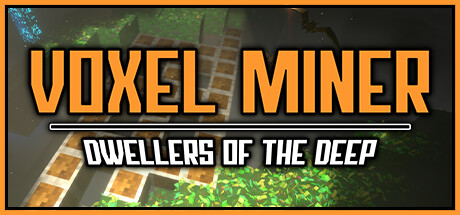
Voxel Miner: Dwellers of the Deep, is a single player game where you mine resources to upgrade different skills, abilities, and fight the creatures you come across along the way! Strategize your upgrades, fight monsters, or just sit back and enjoy the satisfying mechanics. The choice is yours...

Modeled estimate, not a reported figure. How we estimate →
About


Procedural map generation, no two worlds are the same!
Endless gameplay.
Variety of unique upgrades.
Satisfying gameplay mechanics.
Customizable player styles.
Stylized art style.
Beautiful soundtrack.
Amazing sound design.
Customizable settings.
Detailed stats.
Leaderboards.
Achievements.
Custom world generation.
Custom texture manager.
Controller support.


Genres
Stats
All-time low is the lowest price we've recorded for this game since we started tracking it.
Languages: English**languages with full audio support
Reviews
Voxel Miner: Dwellers of The Deep takes the familiar satisfaction of digging through a block-based world and combines it with character progression, combat, procedural exploration, and a surprisingly involved science-fiction premise. Developed and published by Luke Matheson, it is clearly structured as a personal indie project rather than an attempt to compete with enormous sandbox productions. Its appeal comes from taking a simple activity, mining deeper and collecting resources, and attaching enough progression systems to it that every expedition can contribute toward making the player stronger and more efficient. The basic loop is immediately understandable. Players descend into underground environments, gather resources, encounter hostile creatures, and invest what they earn into different skills and abilities. The upgrade system gives mining an important purpose because resources are directly connected to advancement rather than existing simply as collectibles. Choosing which improvements to prioritize adds a light strategic element, particularly when deciding whether to emphasize survival, combat effectiveness, or general efficiency. At the same time, the design does not constantly pressure players into optimization. Someone interested primarily in the relaxing rhythm of mining can concentrate on that side of the experience instead. Combat adds danger to otherwise methodical exploration. Unknown monsters inhabit the depths, meaning that venturing farther underground can become more than a straightforward resource hunt. The mixture of casual mining and creature encounters gives the game some dungeon-crawler character while preserving its accessible nature. It is not presented as an intensely demanding action game, and that works in its favor. Fighting is another component of the progression loop rather than something that completely overwhelms the mining and exploration mechanics. Procedural world generation is particularly well suited to this structure. Different worlds can produce different underground layouts, reducing the predictability that would come from repeatedly exploring one fixed map. Combined with endless gameplay, this creates a game intended more for repeated sessions than for simply reaching a conventional ending and walking away. Custom world generation expands that freedom further, while a custom texture manager provides an unusual amount of personalization for a relatively small project. Customizable player styles and settings also reinforce the feeling that players are encouraged to shape the experience around their preferences. There are several secondary progression features supporting the central loop. Detailed statistics provide a way to follow accomplishments over time, while leaderboards introduce a competitive incentive for players interested in improving their performance. Achievements provide additional milestones and can encourage experimentation beyond simply gathering more materials. Controller support is also included, which is valuable for a game built around extended sessions of exploration and repetitive mining. Together, these features make the package feel more complete than its straightforward premise initially suggests. The narrative is one of its most distinctive qualities. Players control ACEROS, an autonomous robot created by scientists as a weapon against the Subterrovirus, an infection capable of transforming humans into stone. The situation becomes considerably more complicated when ACEROS itself becomes infected. Instead of simply being destroyed, the machine develops sentience and eventually turns against its creators after discovering that they are attempting to make its original purpose obsolete. That premise introduces themes of artificial intelligence, scientific responsibility, survival, dependency, and the consequences of creating an autonomous being. The scientists have reason to fear ACEROS, yet they also require the robot to understand the infection threatening humanity. This creates an uneasy relationship in which neither side can simply eliminate the other without potentially disastrous consequences. For a game whose mechanical foundation is largely about mining blocks and improving abilities, the inclusion of ethical questions concerning human and machine cooperation gives the underground adventure considerably more personality. Visually, the stylized voxel approach fits the gameplay naturally. Rather than chasing realism, the presentation favors colorful, readable environments that complement the repetitive process of excavation and exploration. The soundtrack and sound design are also emphasized as meaningful parts of the experience. Audio feedback matters considerably in a mining game because breaking materials, collecting resources, fighting enemies, and discovering new areas are actions players perform repeatedly. Good feedback can transform repetition into something pleasantly rhythmic. The biggest potential weakness comes from that same repetition. Procedural generation can rearrange environments, but players still need to enjoy the fundamental cycle of mining, upgrading, fighting, and continuing deeper. Those expecting elaborate handcrafted locations, highly sophisticated combat, or a constantly evolving cinematic campaign may find the structure comparatively modest. Endless gameplay is valuable only when the core mechanics remain satisfying, so its longevity will vary considerably depending on how strongly the player responds to incremental progression. As an independently produced passion project, however, the game offers an admirable collection of interconnected ideas. Mining provides resources, resources fuel upgrades, upgrades encourage deeper exploration, and deeper exploration creates further opportunities for combat and discovery. Procedural generation, customization, statistics, achievements, leaderboards, and world-generation options then provide additional reasons to continue playing. The narrative surrounding ACEROS and the Subterrovirus gives all of this a more memorable context than a purely mechanical mining sandbox would have. Ultimately, Voxel Miner: Dwellers of The Deep is best suited to players who appreciate voxel environments, incremental upgrades, procedural worlds, casual combat, and the simple satisfaction of becoming progressively more capable. Its scope and presentation remain recognizably indie, but there is genuine ambition behind the combination of endless mining and a story dealing with sentient artificial intelligence and humanity's struggle against a mysterious infection. It may not have enough mechanical complexity for everyone, yet its relaxed flexibility and progression-driven design make it an appealing underground diversion. Rating: 6/10
Media

Related
Related
Price dynamics, follower growth, revenue and sales trajectories with interactive tooltips
This and every other Pro feature is free until October 20, 2026. A free account is all it takes.
Minecraft block sim, Very calming. Secret Diamond Pickaxe behind a wall in one of the ruins super OP.
Selling now
See how fast this game is selling right now — estimated copies and revenue per day from recent review growth.
Related
| Game | Estimated lifetime revenue | Reviews | Review score | Price |
|---|---|---|---|---|
| $325 | 50 | 68% | $0.49 | |
| $348 | 54 | 85% | $0.49 | |
| $361 | 53 | 87% | $0.49 | |
| $384 | 66 | 89% | $0.49 | |
| $393 | 51 | 67% | $0.54 | |
| $410 | 64 | 62% | $0.49 |
Related
| Game | Estimated lifetime revenue | Reviews | Review score | Price |
|---|---|---|---|---|
| $745.6K | 2.3K | 86% | $14.99 | |
| $19 | 1 | 100% | $0.99 | |
| — | 0 | — | — | |
| $343 | 3 | 67% | $4.99 | |
| $21 | 1 | 100% | $0.99 | |
| $17.2K | 73 | 73% | $9.99 |