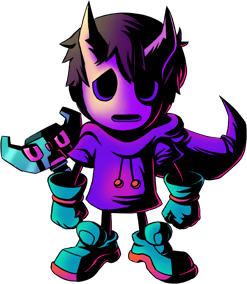
Underhero is an RPG-platformer where the chosen hero has failed, and an underling of the evil king takes his place as the new hero. Use timing-based combat to defeat enemies as you venture across the land, face off against quirky bosses, and save the kingdom from your own evil boss, Mr Stitches!
Modeled estimate, not a reported figure. How we estimate →
Discounts
Every price cut of more than 20% we have observed, in each market that quoted one, with this game's chart position on either side of it. These are episodes, not a model: a sale is one event, and one event cannot tell you what the next one will do.
Reviews, worldwide (the counter carries no country): 0.14/day in the week to Aug 7 → 0.43/day in the week after.
For scale, across Steam · Top Sellers · Brazil over the last 30 days: the 25 chart moves that followed a price cut of more than 20% went a median of 10 places towards #1, and the 2,413 moves with no price cut behind them went 2 away. One store, one chart, one country — it is the only place we have enough observations to say even that.
Prices outside the United States have been collected since 6 August 2026 and chart positions since 19 July 2026, so a cut older than that has no market to compare and a market that joined later has no history yet. Nothing here is converted between currencies.
About

Genres
Sums Steam only; PlayStation, GOG, Nintendo publish no volume signal, so the true total is higher by an unknown amount.
| Store | Price | Audience | Score | Chart | Est. revenue |
|---|---|---|---|---|---|
SteamYou are here | $14.99 | 1.2Kreviews | 87% | — | $366.5K |
| $14.99 | 66ratings | 87% | — | not modelled | |
Engagement
Reviews
Themes across 47 recent reviews and how positive each mention is. A keyword signal, not full sentiment analysis.
Reviews
shut up. stop what your doing, and play this game, its amazing
Overall very dull, the few moments moments that aren't dull are usually disappointing if not rage-inducing. As the store page mentions, "Enemies consider you their ally", so you can talk to them before deciding whether to attack them or not... except that's not really true: you can talk to them once in "combat" but you can't leave without killing or bribing them, you can't just walk away even when story-wise there's no reason for them to stop you. The whole system feels odds, especially towards the end as World 4 is populated exclusively by enemies you can't talk to or bribe then World 5 is populated by enemies you're heavily encouraged to bribe and not kill [spoiler]despite learning at the end of World 4 that those guys are disposable clones just like every other enemy you killed before, so why is it suddenly a big deal?[/spoiler] The story is a mess, up to the end of World 4 the whole thing is super generic and would play out almost identically if you were controlling any generic hero, World 4 introduces the twist spoilered above (which doesn't really impact anything and seems to exist just to make you feel better about your past actions), and the last twists in World 5 and the ending turn the whole thing way too meta in the least interesting way possible while also introducing serious contradictions: [list] [*][spoiler]What even is Mr. Stitches' plan across the game? Everything he has you do from World 1 to 3 is nonsense in light of him trying to keep the Hero cycle going and the ways in which he did so in the past.[/spoiler] [*][spoiler]How is a cycle even supposed to go normally? Some parts of the game say the Hero is supposed to win and Mr. Stitches returns at a later time, some parts say that Mr. Stitches defeats the Hero...[/spoiler] [*][spoiler] First Puzzleman tells you in the quiz show that defeating Mr. Stitches will not end the world, then tries to end the world after you go and do that, sure he could have been lying the first time but then his whole claim of nudging you in the right direction with the quiz show is nonsense; However you look at it, the whole reveal of Puzzleman as the big bad is incoherent[/spoiler] [/list] On the rage-inducing side, you have things like a rhythm minigame with controls so bugged and poorly explained it takes a community guide to even know which four buttons you're supposed to be using (for bonus rage, one of those four buttons isn't used anywhere else in the game) (for bonus bonus rage, remapping your keys and using a controller both make the minigame unplayable, each in its own unique way of course).
Media

Related
Related
Price dynamics, follower growth, revenue and sales trajectories with interactive tooltips
This and every other Pro feature is free until October 20, 2026. A free account is all it takes.
Stats
All-time low is the lowest price we've recorded for this game since we started tracking it.
Languages: English
| $14.99 |
| 29ratings |
| 84% |
| — |
| not modelled |
| $14.99 | — | — | — | not modelled |
Matched by title — a reused name can pair the wrong games. * is a critic aggregate. Prices and positions are each store's United States storefront; Epic charts worldwide. Audience and Score too, except Steam's, which is worldwide.
Hours played at review time, across 47 reviews with recorded playtime.
positive critical· bar length = how often the theme comes up
Great Story, Rewarding Gameplay, Unique Battle system... this Game is a real Surpise hit :D
Great story, gameplay could've got more polishing but it was still fun, only minor bumps in the road. VERY recommended
From a technical perspective, Underhero has quite a few issues: - Resolutions are broken on 4K screens, one must manually select a 1080p resolution in Windows before starting Underhero. VSYNC is also broken: With VSYNC, the game is unplayably laggy, without VSYNC, there is awful tearing. Even NVIDIA overrides (force VSYNC/GSYNC) don't fix this. - Controls are pretty floaty and unprecise, particularly with an analog stick gamepad. For instance, climbing ropes makes you inadvertently toggle sides, and one of the minigames regularly misses button presses---changing over to keyboard input fixes both problems. In a similar vein, collision detection (e.g. at platform edges) is quite glitchy. - Usually, I am good at rhythm games (say, Crypt of the Necrodancer). Underhero does have some rhythm features (for critical attacks and one minigame), but I haven't been able to get them to work reliably. Luckily, the game still plays well if you ignore the background rhythm altogether. - Pixel art varies greatly in quality, from okay-ish (main characters, worlds 2 and 3) to simple (wall tiles in world 1) to programmer's art (some enemy and background sprites). The combination of different pixel art resolutions makes the overall look yet more messy. Also: Who in their right mind comes up with the idea to rescale pixel art? Even with nearest-neighbor texel filtering, the results are horrible. - There are some minor bugs and annoyances in scripting: At one point, the game tells you that you are locked in, but you aren't. Your low-health indicator keeps popping up during cutscenes. Some dialogue lines skip by without any input. You can backtrack, but there is nothing new to be found---while outdated and now unfitting dialogues still play (with Liz, mainly). - The first world (up until the tree) is a long, boring tutorial that feels like the devs themselves were learning along the way. Yet, in spite of all these issues, I still had quite a lot of fun with Underhero. The basic gameplay mechanics are simple, but fresh and enjoyable. The world building is interesting, the soundtrack fitting. Some of the events and ideas made me chuckle ([spoiler]the tree basement event, the graveyard, the special lava[/spoiler]), some made me laugh harder than I'd like to admit ([spoiler]the puzzle guy, the chieftain's son, the hat story and its conclusion[/spoiler]). The final boss fights and the ending scenes were heartwarming and gave the entire game a satisfying conclusion---quite a lot of games could learn from this! Thinking about it, had I played Underhero on the SNES as a kid, it'd probably have been one of my favorites.
I love this game. The encounters, level platforming, and overarching story are great fun. I revisit it to replay. If they made a sequel I'd buy it immediately. Go into this blind, if you can!
Underhero is a creative 2D RPG and platforming adventure that takes one of fantasy gaming’s oldest formulas and approaches it from an unexpectedly amusing direction. Developed and published by Paper Castle Games, the game places players in the role of the Masked Kid, an insignificant servant working for the villainous Mr. Stitches. The kingdom’s designated hero has already met an unfortunate end, leaving the traditional adventure without the person who was supposed to complete it. Through an unlikely sequence of events, this ordinary enemy underling inherits a much greater responsibility and sets out across the Chestnut Kingdom alongside Elizabeth IV. What follows is a humorous yet surprisingly sincere adventure that combines platforming, exploration, RPG progression, unusual combat mechanics, and a story that gradually becomes more meaningful than its playful opening might suggest. One of Underhero’s greatest strengths is how effectively it uses its reversed hero-and-villain premise. The Masked Kid begins as someone who would normally exist merely to be defeated by the protagonist, yet here this disposable minion becomes the center of the entire story. Because he belongs to Mr. Stitches’ forces, many creatures encountered throughout the kingdom do not immediately regard him as an enemy. Players can communicate with opponents, hear their thoughts, discover hints, and learn more about the world through conversations that would rarely exist in a conventional platforming RPG. This makes even relatively minor characters feel connected to the setting. The writing frequently relies on absurd humor and eccentric personalities, but beneath the comedy is a developing mystery surrounding Elizabeth IV, Mr. Stitches, the failed hero, and the Masked Kid’s increasingly complicated position. Combat gives Underhero another important element of individuality. Rather than relying on a conventional turn-based system where characters simply exchange attacks according to menus and statistics, battles demand active participation. Players must watch enemies carefully, react to their attacks, dodge incoming threats, parry at appropriate moments, and determine when it is safe to launch an offensive move. As a result, combat feels like a mixture of RPG decision-making and action-oriented timing. Learning enemy behavior becomes important because careless aggression can quickly create problems. The system gives ordinary encounters a more involved rhythm than traditional menu-driven battles and ensures that improving the character does not completely replace the need for player skill. Music is incorporated directly into this combat structure through the ability to perform Groovy attacks. Striking enemies in time with the musical rhythm can result in critical hits, rewarding players for paying attention to the soundtrack rather than treating it merely as background decoration. The original soundtrack by Stijn van Wakeren therefore becomes closely connected to the gameplay itself. This mechanic fits naturally alongside dodging and parrying because all three systems emphasize timing. Boss encounters are particularly well suited to this design, requiring players to understand attack patterns while finding opportunities to retaliate. Battles can consequently feel almost like small performances in which movement, defensive reactions, attacks, and music work together. The platforming side of Underhero is equally important to the overall experience. Players travel through different portions of the Chestnut Kingdom while navigating environmental challenges, searching for secrets, meeting unusual inhabitants, and progressing toward the larger objective. Exploration is structured rather than completely open-ended, but environments contain enough hidden material to encourage curiosity. This approach prevents the adventure from becoming a simple sequence of battles connected by corridors. Platforming, exploration, dialogue, and combat constantly alternate, giving the game a pleasant sense of variety. The relatively focused structure also works in its favor because the developers concentrate on distinctive locations and interactions instead of attempting to create an unnecessarily enormous world. Its colorful pixel-art presentation complements the humorous atmosphere particularly well. Character designs are expressive and intentionally cartoonish, making the Masked Kid, Elizabeth IV, Mr. Stitches, and the supporting cast visually recognizable without requiring elaborate graphical technology. Environments similarly embrace the exaggerated fantasy style, giving the Chestnut Kingdom plenty of personality. There is an obvious affection for classic console RPGs and platformers throughout the visual presentation, but Underhero generally avoids feeling like a simple imitation. The unusual protagonist, conversational enemies, rhythm-assisted combat, and strange narrative circumstances establish a personality that belongs to the game itself. Players who are sensitive to flashing imagery should nevertheless take the included photosensitive epilepsy warning seriously, since certain sequences contain flashing visual effects. Underhero also benefits from maintaining a relatively clear sense of scope. It is fundamentally a single-player adventure rather than an enormous RPG built around countless systems. Character progression exists alongside exploration and combat, but the experience is more interested in delivering a carefully paced journey than overwhelming players with extensive customization. This can also be considered one of its limitations. Anyone searching for complex party management, highly tactical turn-based battles, enormous skill trees, or a vast open world may find the experience more straightforward than expected. Similarly, players attracted specifically by the RPG label should understand that successful combat frequently depends on reflexes and timing rather than statistics alone. The combination of genres may occasionally create uneven moments because players who enjoy the RPG portions might not necessarily enjoy precision-oriented platforming or reactive combat to the same degree. The battle system can also require adjustment because it behaves differently from what players may expect after seeing traditional RPG terminology associated with the game. Nevertheless, these unconventional decisions are ultimately responsible for much of Underhero’s charm. Paper Castle Games clearly wanted combat to feel interactive rather than passive, and the resulting mixture of dodging, parrying, rhythm, resource management, and offensive timing gives the game a recognizable mechanical identity. Underhero succeeds because it understands its inspirations while refusing to depend entirely on them. Its colorful pixel art, quirky characters, secret-filled environments, active battle system, rhythmic attacks, and inverted fantasy premise come together to create an adventure with considerable personality. It may not provide the enormous scale or mechanical complexity associated with larger RPGs, but its focused design is arguably better suited to what Paper Castle Games wanted to accomplish. For players who enjoy imaginative indie RPGs, humorous storytelling, platform exploration, unconventional combat, and games willing to experiment with familiar fantasy conventions, Underhero is a charming and inventive journey that deserves attention. Rating: 8/10
A solid game with a fun twist on the typical hero formula. Full disclosure - the hour count is a bit inflated from leaving it running, so I didn't get as far as the numbers suggest. But what I played was enjoyable and well-made. Worth checking out if the premise catches your eye.
second time i buy it, i adore this game
https://youtu.be/8retiBl9I2A Plenty of style and humor but the combat system is over designed enough to feel out of place against the other elements.
Selling now
See how fast this game is selling right now — estimated copies and revenue per day from recent review growth.
Players by region
Where this game's players are, estimated from review languages.
Related
| Game | Estimated lifetime revenue | Reviews | Review score | Price |
|---|---|---|---|---|
| $366.5K | 1.4K | 86% | $9.99 | |
| $366.5K | 1K | 72% | $12.99 | |
| $366.5K | 1.9K | 89% | $9.99 | |
| $366.4K | 1.9K | 73% | $6.49 | |
| $366.7K | 976 | 78% | $9.99 | |
| $366.3K | 2.4K | 89% | $6.49 |
Related
| Game | Estimated lifetime revenue | Reviews | Review score | Price |
|---|---|---|---|---|
| $1.7K | 18 | 100% | $4.99 | |
| — | 0 | — | — | |
| $18K | 44 | 95% | $14.99 | |
| — | 0 | — | — | |
| — | 0 | — | — | |
| $2.1M | 6K | 94% | $14.99 |