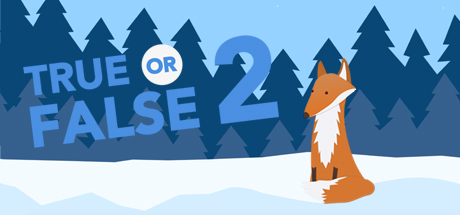
True or False 2, developed and published by Vladimir Maslov, is a minimalist trivia experience that continues the concept of the original True or False game, presenting players with a steady stream of statements and challenging them to decide whether each one is fact or fiction. It is the kind of title that doesn’t rely on flashy visuals or complex systems but instead on the universal appeal of curiosity—testing what players think they know against the often surprising reality of the world. Designed for short bursts of play rather than marathon sessions, it embodies a relaxed and accessible form of entertainment that manages to be both educational and lighthearted.
At its most basic level, the game is a simple binary challenge: the screen presents a statement, and the player must select “true” or “false.” Once an answer is given, the game reveals the correct response, often accompanied by a short explanation or humorous remark. This straightforward structure keeps the pacing brisk and ensures that players are never bogged down in menus or unnecessary distractions. Each question becomes its own self-contained puzzle, lasting only seconds but tapping into that primal itch for knowledge and certainty. Some of the statements draw on historical trivia or scientific facts, while others delve into bizarre or counterintuitive claims that blur the line between truth and absurdity. The variety is what keeps the experience engaging, as you never quite know whether the next prompt will make you nod in recognition or question everything you thought you knew.
One of the game’s most enjoyable aspects is its sense of surprise. Many of the statements are crafted to play on assumptions, leading you to choose the seemingly obvious answer only to be proven wrong by some obscure or delightful fact. This pattern of expectation and reversal becomes its own rhythm—half challenge, half comedy. It’s not uncommon to laugh at your own mistake or marvel at a ridiculous-sounding fact that turns out to be real. That blend of education and amusement defines the game’s personality. There’s no scoring pressure or timer to rush you, which makes the experience relaxed and welcoming. It’s the kind of game that can appeal to players of all ages, serving as both a quick mental exercise and a casual source of entertainment.
Visually, True or False 2 keeps things clean and unadorned. The interface consists of simple colors, large readable text, and minimal animation. The lack of complexity suits the format perfectly—everything exists to facilitate quick comprehension and response. The presentation carries a faint charm in its simplicity; nothing distracts from the central focus on reading and decision-making. The background music and sound effects maintain a mellow tone, providing just enough ambiance to make the process engaging without ever overwhelming the experience. This kind of restraint speaks to the developer’s understanding of the game’s purpose: it’s not meant to dazzle but to entertain quietly, almost meditatively, through repetition and discovery.
In terms of structure, there isn’t much beyond the endless stream of statements and the optional achievements. The sequel expands the roster of facts and adds more variety compared to its predecessor, but the gameplay remains identical. That means it lacks deeper systems—there’s no overarching progression, narrative framing, or unlockable content outside of the trivia pool itself. For some, this barebones approach will be refreshing; for others, it might feel limiting. Once you’ve seen the bulk of the questions, there’s little reason to return except for achievement hunting or to revisit amusing facts. The game’s replay value comes primarily from memory—trying to recall what was true or false in previous playthroughs—which adds a touch of self-competition but not enough to sustain long-term engagement.
The humor behind the writing also helps carry the experience. Many explanations are laced with dry wit or playful absurdity, giving the trivia a personality that separates it from sterile quiz formats. Even incorrect answers often feel rewarding because the explanations can be clever or ridiculous enough to be entertaining in their own right. However, this tone isn’t always consistent—some statements are purely factual, others lean heavily into silliness, and a few miss the mark entirely. This unevenness can make certain segments feel repetitive, but it also contributes to the game’s unpredictability. You never quite know whether the next line will educate or amuse you, and that uncertainty is part of the fun.
The short length of the experience makes it ideal for players looking for something light to fill a few minutes between larger games. Most playthroughs last less than an hour, and even though the format doesn’t evolve, it’s long enough to satisfy that sense of curiosity without overstaying its welcome. The low price point reinforces this design philosophy—it’s meant to be a small, easily digestible experience rather than a major time investment. On Steam, the game has been met with generally positive reception, with players praising its relaxing tone, random humor, and trivia variety while noting that it’s more of a novelty than a deep game.
Ultimately, True or False 2 thrives on its simplicity. It doesn’t try to reinvent trivia, nor does it need to. Its charm lies in its straightforward execution, its quick-fire pacing, and its ability to surprise. It’s a digital equivalent of a conversation with a friend who constantly throws strange facts your way, sometimes accurate, sometimes questionable, but always entertaining. For those who enjoy learning obscure information, testing themselves, or simply killing time in a laid-back environment, it’s a small but satisfying addition to the casual gaming space. It may be brief and minimal, but within that minimalism lies a certain purity of design—a reminder that sometimes, all a game needs to be enjoyable is a good question and the curiosity to answer it.
Rating: 8/10