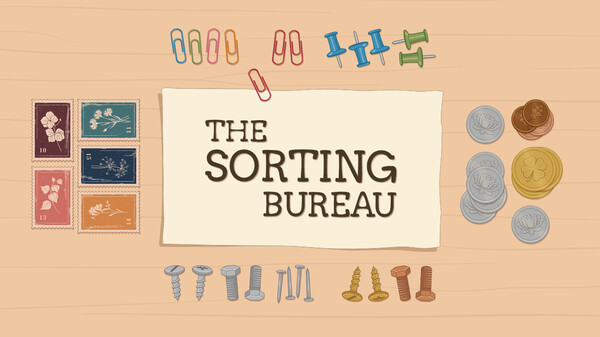
A cozy sorting game set in a quiet Tokyo workshop. Clients bring you boxes of clutter: buttons, coins, gears, stamps. Sort them, group them, and put everything back in its place, to satisfying ASMR clicks. No timers. Mistakes cost nothing. Just the joy of tidying up.
Modeled estimate, not a reported figure. How we estimate →
About

Genres
Stats
All-time low is the lowest price we've recorded for this game since we started tracking it.
Engagement
Reviews
Themes across 279 recent reviews and how positive each mention is. A keyword signal, not full sentiment analysis.
Reviews
A wonderfully chill game, I love organising things and I love how I can kind do my own thing for some - takes a lot of the stress out of everything. I love the little details of the desk space and being able to take photographs!
The Sorting Bureau is a cozy organization-focused puzzle game that finds enjoyment in an activity most games would treat as background work: taking a collection of miscellaneous objects and putting everything into its proper place. Developed and published by Apelsinka Games, it is designed around calm observation rather than speed, competition, or demanding mechanical execution. Its small sorting workshop in Tokyo establishes an intimate atmosphere where customers bring boxes filled with personal belongings, leaving the player to examine the contents and restore order. The concept is deliberately uncomplicated, but that simplicity is central to the experience rather than a limitation the game attempts to disguise. Each assignment begins with a collection of objects that needs to be organized according to an appropriate pattern or rule. The assortment can include coins, buttons, stamps, tools, gears, sweets, artistic supplies, and many other everyday or collectible items. Instead of constantly providing dramatic new mechanics, the game explores how different collections can create their own miniature organizational puzzles. Players need to pay attention to characteristics such as shape, appearance, purpose, material, and other relationships between objects. With hundreds of individual items spread across numerous themed desks, there is considerable room for visual variety despite the straightforward foundation. A major part of its appeal is the complete absence of unnecessary pressure. There are no timers demanding immediate decisions, no high-score system dictating how efficiently a desk must be completed, and no harsh penalties for experimenting with an incorrect arrangement. Players are free to inspect the available pieces and gradually discover the intended logic. This makes it accessible to people who enjoy puzzles but dislike being rushed. It also changes the emotional tone of problem solving because an error is simply an invitation to reconsider the arrangement instead of a reason to restart or worry about losing progress. The tactile character of sorting is strengthened considerably by the sound design. Different materials are represented with distinctive noises when objects are handled and positioned, producing clicks, clinks, rustles, and other subtle responses. The ASMR-inspired approach makes ordinary interactions feel more satisfying than they might appear from screenshots alone. Sound is therefore not merely atmospheric decoration; it supports the central fantasy of physically handling a box of assorted possessions. Players who enjoy detailed audio feedback should get additional value from using headphones, especially during quieter sessions. There is also more personality behind the clutter than the basic premise initially suggests. Customers are represented through the belongings they bring into the bureau, allowing the player to learn small details about their interests, professions, and routines through environmental storytelling. A collection associated with a watchmaker naturally communicates something different from the belongings of an artist or pastry chef. This approach prevents the objects from feeling like completely arbitrary puzzle pieces. Every box potentially becomes a tiny portrait of its owner, giving the repetitive act of organizing a modest narrative purpose. Visually, the colorful hand-drawn 2D presentation is a sensible match for the relaxed gameplay. The Tokyo workshop feels intentionally small and comfortable rather than spectacular, and charming environmental touches help give it a recognizable identity. The art also needs to perform a practical function because players must distinguish many small objects from one another. Keeping the presentation clean and readable is therefore important, and the point-and-click interaction complements that clarity by keeping controls straightforward. It is the type of interface that should be understandable quickly without requiring a lengthy mechanical tutorial. The biggest concern is repetition. No matter how many unusual possessions, customers, and themes appear, the fundamental loop remains centered on examining items and sorting them. Players who need frequent mechanical escalation could eventually find the experience too restrained. Its lack of scoring, punishment, and time pressure can similarly be interpreted in two very different ways. Cozy-game enthusiasts may appreciate the freedom, while players seeking demanding puzzle progression might feel there is insufficient tension. The game's longevity consequently depends on how effectively new sorting rules, object combinations, and customer stories keep the core interaction fresh. Its structure appears especially appropriate for shorter sessions. Completing a desk or several requests and then returning another day should suit the experience better than approaching it as something that must constantly deliver escalating excitement for hours at a time. Steam Achievements provide additional goals for players interested in completion, while Steam Cloud support is useful for maintaining progress across systems. The large selection of supported interface and subtitle languages also makes the otherwise visually intuitive concept accessible to a wider audience. For Steam Deck users, The Sorting Bureau does not currently have an official Valve Steam Deck compatibility rating displayed as Verified or Playable. That means it should not be described as officially Steam Deck Verified. Its lightweight-looking 2D presentation and mouse-oriented point-and-click design suggest that running the game on Deck may be technically feasible, particularly through the touchscreen, trackpads, or customized controller layouts, but actual compatibility can depend on factors such as text readability, input behavior, Proton support, and interface scaling. Until Valve provides an official classification or compatibility is sufficiently established, it is safest to regard Steam Deck support as unverified rather than guaranteed. Ultimately, The Sorting Bureau succeeds by understanding that organization itself can be entertaining. Its combination of carefully arranged objects, soothing audio feedback, gentle visual design, small character stories, and pressure-free puzzles creates an experience aimed squarely at players who find satisfaction in turning disorder into neat arrangements. The premise will naturally appeal to a narrower audience than a traditional puzzle adventure, but it has a coherent identity and does not dilute its relaxing intentions with unnecessary systems. For anyone who enjoys cozy games, inventory organization, tactile interactions, or methodically putting everything where it belongs, it has the ingredients for a pleasantly absorbing experience. Rating: 8/10
Media

Related
Related
Price dynamics, follower growth, revenue and sales trajectories with interactive tooltips
This and every other Pro feature is free until October 20, 2026. A free account is all it takes.
Related
| Game | Estimated lifetime revenue | Reviews | Review score | Price |
|---|---|---|---|---|
| $124.5K | 648 | 82% | $7.99 | |
| $124.5K | 389 | 64% | $12.99 | |
| $124.4K | 212 | 94% | $17.99 | |
| $124.4K | 250 | 84% | $24.99 | |
| $124.4K | 647 | 94% | $11.99 | |
| $124.5K | 538 | 85% | $12.99 |
Related
| Game | Estimated lifetime revenue | Reviews | Review score | Price |
|---|---|---|---|---|
| — | 0 | — | — | |
| $1.6M | 19.1K | 92% | $5.99 | |
| $21.7K | 445 | 86% | $1.99 | |
| $18.2K | 90 | 77% | $6.99 | |
| $1.9K | 14 | 100% | $3.99 | |
| — | 0 | — | — |
Languages: English, French, Italian, German, Spanish - Spain, Traditional Chinese, Simplified Chinese, Korean, Polish, Portuguese - Brazil, Russian, Turkish +3 more
Hours played at review time, across 280 reviews with recorded playtime.
positive critical· bar length = how often the theme comes up
It make my monkey brain very happy with the simplicity, peacefulness, and quiet. Can be repetitive, sure, but it's nice to relax to when you're trying to turn your brain off. Don't expect puzzles like A Little to the Left. But overall this game make monkey brain go brrrt Ambience is very nice, rain is my fave sound. Also the sounds when setting down items is a nice clicky sound. Cute kitty to look at, too :)
A nice and relaxing game that doesn't tell you what to do, it gives you the freedom to do what you feel like. 10/10
I haven't put a ton of time into this game yet, but it is already well worth the investment. I love a good cozy organizing game, but even more, the joy I experienced this evening when my 9 year old daughter plopped down next to me tonight and demanded we sort things together and take turns until it was bedtime. She was instantly hooked and I even had to make her start her own game so she would stop playing all of mine lol. Super cute, simple, fun, with just the right amount of challenge. I look forward to continuing on my own and with my kid. A perfect little gem of a puzzle game.
Очень добрая и красивая игра, чтобы чиллово посидеть вечером!
You are a new member of the Sorting Bureau, whose job is to put things into order. Your workstation consists of a table in front of a window overlooking the city, with shelves where you receive boxes containing sorting orders. Each box contains a collection of items and instructions on how they need to be sorted. Sometimes the task is to sort items by type, other times by color, category, or something else entirely. For example, you might have to separate buttons from paper clips, tackle the slightly harder task of sorting leaves into summer and autumn leaves, or divide items into warm and cold colors. Regardless of the task, each box comes with several smaller boxes marked with icons, so you know exactly what belongs in each one. Sorting is simple. You click on an item and drag it to the appropriate box, or flick it toward the box, which will automatically grab it. If an item does not belong, it flies back onto the table. The smaller boxes are lined up at the top of the table, but you can change their position by clicking and moving them. You can also bring them closer to the items, shortening the distance you have to move things. How you approach each task is entirely up to you. You can simply work with whichever items are closest, regardless of their box, or focus on completing one box at a time. Once a box contains all the required items, it closes, so you no longer have to worry about it. The game is quiet and has no music. Instead, all of the sounds come from outside the window. One of the nicest touches is that the time of day changes with each completed box, so the atmosphere outside changes as well. You might hear a train during the day or crickets at night. Your otherwise empty workspace also gradually gains new objects as you progress, such as a cat and a photo album. You also learn more about the people sending you sorting jobs, as each section of the shelf belongs to a different client. Occasionally, a box is replaced by a sheet of paper with outlines showing where the appropriate objects should be placed. The exact position usually does not matter, and there are no hidden solutions involving patterns or colors. Every task has a single intended solution, and you cannot make a mistake. Another small twist comes from items that have been cut into pieces. Before sorting them, you first have to put the pieces back together. Later in the game, you will have many more items covering the table. Thankfully, the game handles this very well with a feature that allows you to combine identical items by dropping them on top of one another. If you have a large pile, you can place one item on top and then keep clicking it to connect the rest. Each click connects one item, and the process continues as long as the items are touching. My main criticism is that the game can become repetitive because you handle the same types of items across multiple days and boxes. There are always buttons, leaves, paper clips, coins, and other familiar objects. Although clients occasionally introduce new types of items, the first few can overstay their welcome because they appear so frequently. This repetition is made more noticeable by the number of days you have to play through, with far too many boxes spread across the four seasons. For that reason, I would recommend playing only a few boxes at a time rather than trying to complete the entire game in one sitting. Taken in smaller doses, the relaxing atmosphere, satisfying sorting mechanics, and gradual changes to your workspace make for a pleasant experience. However, the repetitive nature of the later sections can make playing through everything at once feel like more of a chore than a relaxing sorting game should.
So to preface I'm not a sorting game enthusiast, I bought this on a whim and this might be the first one I've played/liked. So I won't be able to go into the nuance of sorting game features or comparisons. That being said: It's a cute little game. You have a quiet little desk. Eventually there's a cat and a photo album. There's some achievements for leaving your desk in certain states. While the people's "dialogue" (which comes in the forms of letters) isn't the most interesting it is cool to see the different personalities tied to certain tasks. There's an engineer seeming guy who gives you bolts to sort. A photo album guy. A leaves girl. And they introduce different mechanics and that was fun. The main guy that keeps telling me to take my time, not to rush and doing nothing is okay really set the tone of the game. The sounds are minimalistic but satisfying. Nice little pops and blips. Good work on the sound side of things. The sorting system is easy to use and understand. Bonus points for when I found the "Spread out the pile" button on the pause screen. (I think that button would be better suited in the corner of the game or something but I understand why it's there) My only criticisms come from item variety(which honestly have gotten used in satisfying enough ways that the complaint is minor) and the "See how it went" button not being a true replay (which as an indie dev myself does seem like a lot of work on the devs end for the scale of this game) I don't think anyone is getting a massive amount of time out of this game but it has been a funny little wakeup and have coffee game and a unexpectedly fun dive into a new genre.
A very cozy game. It's like A Little To The Left, but far more relaxed. Sorting is slower, sorting types is varied and sometimes completely free form, and it's less of a puzzle and more a leisurely stroll. I nice game to chill out with. My only negative is that sometimes the stacking feature that is meant to save time simply doesn't work, which can be frustrating. hoping to see this fixed in a future patch!
Yes/No - but more on the no side due to inaccessibility Whilst it's a sorting game with a storyline, which is very cute Having to use a touchscreen is a struggle, and there's no high contrast around the items, so you cannot see what you're actually picking up a lot of the tim I had to stop playing because I just couldn't attach a stem to a leaf for the guts of 5 mins, even whilst using mouse controls Some of the mechanics like "flicking" the item into the box, just don't seem to work half the time It has a great premise to it, and absolutely will be chill But it's not one for me unfortunately
Selling now
See how fast this game is selling right now — estimated copies and revenue per day from recent review growth.
Active players
Estimated daily and monthly active players (DAU/MAU) modeled from peak concurrency.
Players by region
Where this game's players are, estimated from review languages.
Players also reviewed
The games this title's players most often review too — audience affinity.