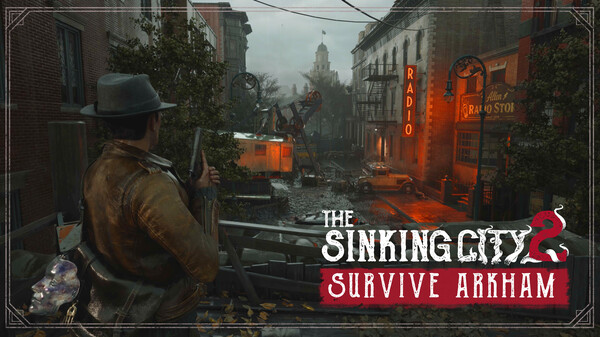
Set in the Roaring '20s, The Sinking City 2 is a survival horror steeped in Lovecraftian dread. Defy an eldritch deity and explore the drowned alleys of Arkham, stalked by the dead, as you weigh one life against an entire city.
Modeled estimate, not a reported figure. How we estimate →
Prices
Each in the currency that store quoted — not converted: the gap between two rows is the publisher's pricing, not an exchange rate.
Availability
We put this game to every storefront we collect. A market that answered not sold has told us something about the game; a market we never asked has not, and the two are never drawn the same.
About
The Sinking City 2 is a third-person survival horror set in 1920s Arkham. Deliberate, tense, and resource-lean: pressure builds as you push deeper, relief comes in brief refuge, and fear is something you manage. Mind your inventory, take on unnerving puzzles, and double back via unlocked shortcuts for supplies and upgrades.
A Roaring ’20s port city buckling under a supernatural flood. Tide-stained avenues and battered Art Deco. Speakeasies gone dark. Districts feel lived-in and water-worn, with routes by foot and skiff, shortcuts behind collapsed seawalls, and secrets tucked in boarded parlors. You’ll navigate a hospital where science hides its face, a fish market where the merchandise bites back, and descend deep below the city to where eldritch horrors stir.
A ritual gone wrong trapped her soul in the Dreamlands, and now malevolent forces have stolen her body. To rescue the woman you love, you must walk a dangerous path through catastrophe to the source of the flood — her presence always felt, but rarely seen.
The Slither animate the dead. Deep Ones surge from dark water. Shadows bend space and test nerves. Some fights must be met head-on; others demand a retreat to rearm, retune your build, and return better prepared. Or take on an optional investigation and come back with an upgraded gun.
Exploration is the key to survival. Read ritual residues, sift through grisly clues, decode journals that shouldn’t exist, and pry at masks that won’t come off. Optional cases never gate progress — but they unlock safer routes, hard supplies, and upgrades that change how you endure the next encounter.
The Sinking City 2 draws on Frogwares’ detective roots to deliver survival horror that runs deep and hits hard. Shaped by studio obsession and community feedback, it’s a faithful Lovecraft experience: myths made manifest, and the inconceivable fear that results.

Add-ons
Each DLC is estimated with the same model as a game, then summed — a modeled figure, not reported DLC sales.
Sums Steam only; Xbox, GOG, Epic, PlayStation publish no volume signal, so the true total is higher by an unknown amount.
| Store | Price | Audience | Score | Chart | Est. revenue |
|---|---|---|---|---|---|
SteamYou are here | $49.99 | 1.8Kreviews | 83% | — | $2.5M |
| $49.99 | 330ratings | 88% | — | not modelled | |
Updates
Build ids and update times come straight from Steam's PICS — the same source SteamDB reads. Patch history grows as we record new builds.
Engagement
Reviews
Themes across 1075 recent reviews and how positive each mention is. A keyword signal, not full sentiment analysis.
Reviews
Don't become one of my stories. This is Mushroom Jack, signing off.
Más juegos así por favor. Como fan de H.P. Lovecraft tengo que decir que el equipo de desarrollo ha hecho un trabajo a la altura: ambientación, historia...todo muy logrado. Hay luces y sombras pero muy recomendado.
Media

Related
Related
Price dynamics, follower growth, revenue and sales trajectories with interactive tooltips
This and every other Pro feature is free until October 20, 2026. A free account is all it takes.
14 of 15 markets; the rest we haven't asked for this title, not markets where it is unavailable.
14 on sale1 answered “not sold”0 we did not ask
The 1 “not sold” market is read from the Steam price pass of Sep 4: that day the store answered for this game elsewhere and gave no price there. The 14 priced markets are the same rows as the table above — each the latest price we hold, dated here when it is older than that pass. The 0 marked “not asked” were not put to this store at all — either it has no storefront there or we do not collect it yet, and neither is a statement about the game. A refusal is a refusal on one day; a store can list a title again tomorrow.
Genres
Stats
All-time low is the lowest price we've recorded for this game since we started tracking it.
Languages: English*, French, Italian, German, Spanish - Spain, Arabic, Czech, Japanese, Korean, Polish, Portuguese - Brazil, Simplified Chinese +3 more
| $49.99 |
| 57ratings |
| 78% |
| — |
| not modelled |
| $49.99 | — | — | #25 | not modelled |
| $49.99 | 0ratings | 0% | — | not modelled |
Matched by title — a reused name can pair the wrong games. * is a critic aggregate. Prices and positions are each store's United States storefront; Epic charts worldwide. Audience and Score too, except Steam's, which is worldwide.
Hours played at review time, across 1.1K reviews with recorded playtime.
positive critical· bar length = how often the theme comes up
感觉这一作在1代的基础上优化了很多,不论是3C还是gameplay还是关卡(特别是关卡)都有了很大进步。但是基础战斗有点牢...世界观的塑造和呈现还是比较有意思的,整体故事上来说,只有克苏鲁风味的皮,停留在猎奇上,有点遗憾结尾还是落在了一个比较俗套的结局上。
The Sinking City 2 has imagination. What it lacks is the discipline and polish required to turn that imagination into a consistently good game. I finished it in exactly 11 hours. There are moments here that briefly suggest something much better: the opening relationship between rain, flooding, worms, corpses and the creatures emerging from them; the wonderfully strange Devil’s Reef Hotel; an alien presence inside a hospital; and a surprisingly strong ending that is bleak, visually striking and gives the central relationship more thematic weight than I expected. Those moments are why the overall experience frustrated me so much. The game repeatedly finds a fascinating horror premise, then converts it into an arena fight, an unclear puzzle or another delivery of unexplained terminology. The early hours bury the player beneath names such as the Tenebrous Soul, Ult’hkandor, the Pnakotic Manuscripts, Silver Key’s Veil, N’kai, Cthylla, Tsog-Nar and Yig. Many of these come from Lovecraft or the wider Cthulhu Mythos, and the game seems to assume that the player already understands their significance. I did not, and I suspect most players will not arrive with that level of familiarity. I enjoy dense lore, but terminology is not worldbuilding by itself. Without enough context, relationships or dramatic grounding, these ideas stop feeling mysterious and become a queue of capitalized nouns. Mystery should create questions. Gibberish only creates distance. The writing repeatedly has this problem. It wants to sound portentous more often than it wants to communicate something precise. At one point Faye asks Calvin to find something with “occult power,” as though he should check how many watts a supernatural artifact supports. Then a mysterious figure introduces herself with: “My friends call me Ma Fishface.” Combat is another major problem. It is not merely underdeveloped; it is used far too often for something so shallow. Encounters regularly seal you inside arenas and throw waves of enemies through multiple entrances. Movement and enemy readability become chaotic, weapon feedback is inconsistent, and fights mostly involve circling the room while shooting whichever weak point is currently visible. The developers appear to have realized that a survival-horror resource economy cannot support this many mandatory enemies, because arenas contain infinitely replenishing ammunition and healing. Preparation becomes irrelevant. Scarcity disappears precisely when it should matter most. The encounters are not especially challenging because the Infinite Pharmacy is always nearby, but they remain tedious because you must repeat the same actions until the game decides enough enemies have died. It has the encounter structure of Doom without Doom’s speed, precision, weapon pleasure or aggression economy. It is an arena shooter awkwardly wearing the controls and inventory system of a survival-horror game. The audio may be the most shocking part of the production. The pistol initially sounded like a short burst of treble and midrange with almost no bass, particularly indoors. Many effects sounded as though they had passed through aggressive early-2000s MP3 compression. Smashing worms and destroying enemy pustules produced sounds that would not feel out of place in a Nintendo 64 game. After finding other players reporting muffled audio, I enabled Windows Spatial Audio. Somehow this improved the presentation even though I had not intended to use a spatial mix. Guns acquired more bass indoors, environmental cues became clearer and the world felt somewhat more immersive. That did not make the audio good. It made a broken presentation more manageable. One deliberately disturbing sequence repeatedly played an extremely sharp and disproportionately loud burst of static. It was so physically uncomfortable that I immediately stopped and lowered the volume, the first time any game sound has made me react that way. After closing the game, I opened Qobuz to make sure my headphones were not malfunctioning. They sounded immaculate. It was all coming from the game. This would be bad in any genre. In horror, where sound creates spatial awareness, physical presence and half the atmosphere, it is devastating. The puzzles range from average to genuinely defective. One safe code relies on associations so loose that I understood most of its clues but never would have reached the final connection without help. The brain-frequency puzzle presents mathematical statements alongside claims about each speaker’s reliability, but never clearly establishes what being “half-correct” applies to. A later investigation lets you correctly identify someone in a mural, then expects you to attack his painted head to reveal a hidden item. Nothing indicates that the item is concealed behind his likeness. The mural has no established interaction language, and no previous puzzle teaches you to damage paintings. I found and connected every clue, returned to the mural and had no rational reason to begin punching or shooting it. Identifying the person is deduction. Attacking the picture is an arbitrary verb the designers forgot to communicate. Even the directions become questionable. During one arena battle, Calvin is told to pull the “red lever.” The lever is not red. It is closer to a wall switch with a red light above it, and even calling it a lever feels generous. That sounds trivial until you are running around a busy arena trying to locate the supposedly red object while monsters attack from every direction. The optional Tales of Arkham radio broadcasts further weaken the pacing. Rather than deepening the place I was exploring, they often felt like shallow shock-horror fables playing while I searched rooms for supplies. The game has lore everywhere, but surprisingly little of it becomes a world I could inhabit. There are exceptions. The Devil’s Reef Hotel is easily the game’s best section. Its stage, decorations, abandoned rooms and bodies quietly reveal what happened before Calvin arrived. It communicates Arkham’s psychological collapse far more elegantly than another document announcing that people have gone mad. The hospital has another excellent underlying premise involving alien medical technology and a clinical outside observer, even if the chapter itself becomes another maze of stations, keys, codes, mandatory battles and backtracking. The ending is considerably better than the journey leading to it. Without spoiling it, Calvin and Faye’s devotion finally acquires thematic weight. Their love remains sincere, but that sincerity becomes dangerous because both are willing to sacrifice anything for the other. It is bleak, visually striking and surprisingly moving. I genuinely liked it and sat with it afterward, which is more than I expected from the preceding eleven hours. But a strong ending cannot repair the experience leading to it. It does not fix the audio, make the arenas interesting, supply the missing puzzle logic or deepen the shallow radio stories. It gives the narrative a stronger final shape, but the bad still overwhelms the good by a comfortable margin. I know Frogwares developed this under circumstances far more difficult than those facing most studios. I have enormous sympathy and respect for the people who made it. That context may explain why some elements arrived in this state, but I still have to judge the game that was released and sold. There is real imagination here. The flood-to-worm horror ecology, the hotel, the alien hospital and the ending all belong to a version of The Sinking City 2 I would have loved. Unfortunately, they are surrounded by weak writing, broken audio, poorly constructed puzzles and a combat structure that repeatedly exposes the limitations of its own systems.
When it became clear that this game was taking cues from the current Resident Evil games, I was excited. The tense over-the-shoulder shooter is probably my favorite subgenre of action game at this point. I can't say I'm much of a Cthulhu person, but whatever. Whereas the first one looked intriguing because it at least seemed interested in emulating the idea of a survival horror game, even if it didn't fully commit, this one looked like it actually would. Relievedly, the opening hours seemed to sell the idea that they got it. Yes, the shooting itself is somewhat unpolished, but it still understands the assignment better than the most recent Alone in the Dark. The level design stays atmospheric and unnerving, but in such a matter-of-fact way that you can't help but become enthralled by the general bizarreness of the apocalypse on display here. The first level, which is literally a sinking city, is beautiful in its detail and in how the different areas build on each other. There's also clear progression in the key puzzles that keeps the pace moving as far as the actual gameplay is concerned. Level design, though, is really where the game excels—and that's pretty much all it excels at. As the game goes on, the level design never stops being good. It does stop being "fresh." The game shows its cards early and never gets a new hand. It's a good hand, but eventually everything starts to blur together, and it isn't helped by the fact that the combat never really feels like it has any sense of progression. The weapons, in general, all feel like ♥♥♥♥. Tolerable ♥♥♥♥, but ♥♥♥♥ nonetheless. They're missing the punch and weight of a good Resident Evil handgun while sounding like farts. For all their RE aping, the understanding of its combat seems to stop at, "There's a specific spot you should shoot, and we use that to create tension as the enemy approaches." There's a clear misunderstanding of how weapons should feel because, in the end, they either all feel mostly the same in terms of power and effect, or they're the worst shotgun I've ever used in a video game. And there's just so much combat that, eventually, I resorted to something I hate: running away. Maybe that's the point. I'm not sure. But I wasn't running because I was scared or because I felt tension. Thanks to a very generous dodge button, getting away is beyond easy. I was running because the combat had become tedious. Enemies seem to respawn, take a bunch of damage, or simply aren't fun to fight. Fighting them started to feel pointless. The investment just wasn't worth it. Yet I would still recommend the game to people like me who just love RE4-likes and have played basically all of them. The opening hours are genuinely good. The level design kept me engaged, whether through the visuals or the escalation, and there are actual creepy—and occasionally genuinely scary—scenes in this game. The sound design can be incredibly unnerving. There's a good game in here. It's just one whose strongest ideas are established early, while its weakest element—the combat—keeps demanding more and more of your time.
I bought a Frogwares game expecting a detective experience, much like the previous Sinking City or the Sherlock Holmes games. Instead, what I got was a Resident Evil/Silent Hill clone with a Lovecraftian backdrop. I understand that they were going for something different and that it is at the very least passably executed, but I have to say that this will probably not appeal to fans of their previous detective games. One thing that is really different to the previous entry is how casually the main character approaches the occult. This is not in keeping with the Lovecraftian theme whatsoever. Eldritch horror should be more subtle and fill the audience with unease, whereas the main character frequently makes jokes about his situation. Given that the main gameplay loop relies heavily on combat, it is odd that most of the combat can actually be avoided simply by dodging and putting enough distance between you and the enemy. I wish there was more opportunity to conduct investigations, like in the previous game where you needed to draw conclusions and made deductions. In this entry the investigation mechanic is dumbed down to a "connect the evidence menu", which is completely unnecessary since you don't need to actually make any deductions in order to progress the story. I recommend the game overall, although it will not appeal to the audience of the original game.
Not the first and not the last to say it, but at this point second entry in The Sinking City world is a cheap Resident Evil clone. Everything here is just the same: same gameplay loop, same map style (even using the same colors lol), same equipment and same weapon mechanics, etc. The one and only difference here is setting being early nineteen-hundreds Lovecraftian city. The core piece of Frogwares' titles is almost gone. Investigation is non existent, it's basically just 'connect the clues' type minigame. No suspects to interrogate, no crime scenes to investigate. Its's just sad, that they only picked and kept the worst mechanic from first title- shooting (while making it the most important thing in the sequel). I mean- even world building is weak. In the first title, we could explore the city, get to know a lot of different races and fractions, the motives that drove them. Graphics looked much worse, but exploring and overall atmosphere of that world was peak. Sure, it's a good game, but I expected something way different...
Загалом, гра дуже навіть вартує уваги і своїх грошей. Як вірний прихильник творчості Лавкрафта, я чудово розумію, що будь-яка спроба перевтілити твори маестро на екран або дисплей це надзвичайно важка, але тонка праця. Чи вдалося це вітчизняним розробникам? Більше так, аніж ні. Відмова від псевдо відкритого світу (як в першій частині) на користь більш лінійного Resident Evil-like геймплею пішло проєкту лише на користь. Потвори зображені непогано, атмосфера Аркхему теж мені була до вподоби. Є питання до оптимізації. Всю гру я відбігав ще більш-менш, але от битва з шогготом при 6-7 фпс, то ще те випробування. Сподіваюсь, що наступна гра серії теж колись вийде. А це вперше, коли я зробив передзамовлення і не пожалкував. P.S. я звісно все розумію, але якщо ви беретеся за міфи Ктулху чи іншу йог-сототщину, то банальний сюжет про нещасного чоловіка, що шукає свою кохану ну аж ніяк туди не вписується. Якщо ви читали маестро, то маєте розуміти, що людським емоціям в його творчості дуже мало місця.
This is a weird one. I think the team making it really wanted to do a passion project. I have no ties to the first game, so I went in blind. This felt like a medium-budget Resident Evil-style game. Except... it was a bit dull. It starts off interesting enough. I like the opening with our main character trying to wake up his wife, who's in some type of coma. The world they're in is half underwater, making for a spooky feel and look to the game. The bad guys are basically similar to the Resident Evil 4 type, where they slither their way into dead bodies and reanimate them. It's also got little alien-looking creatures that can hop and jump at you. Most of the gameplay relies on you gathering pieces in an area and getting to the next area. Except...it lacks urgency. The gunplay is solid at best, but uninspiring. The creatures you fight are kind of just...there. The survival horror is real, and it'll make you panic over missing one single shot, but if you don't find the gunplay too fun, well then, this is a bit dull. Again, I think fans of the survival horror genre should give this a go. But for me, it lacked the scare factor, the exciting gunplay we've gotten in most horror games now, and I've never been a huge fan of going back over places and backtracking to find pieces. So, a 5.5–6 out of 10.
Мені сподобалось. Гра схожа на Resident Evil, й це насправді зовсім непогано. Атмосфера, Лавкрафт, кохання, горрор - все є. Гра не змушує блукати чи проходити через одні й ті самі локації багато разів. Шкода тільки, що пригода вийшла закороткою. Хотілося ще трохи більше, тож чекаю на третю частину. Я люблю ігри Frogwares й радий, що вони не бояться експериментувати з жанрами
Selling now
See how fast this game is selling right now — estimated copies and revenue per day from recent review growth.
Active players
Estimated daily and monthly active players (DAU/MAU) modeled from peak concurrency.
Players by region
Where this game's players are, estimated from review languages.
Players also reviewed
The games this title's players most often review too — audience affinity.
Related
| Game | Estimated lifetime revenue | Reviews | Review score | Price |
|---|---|---|---|---|
| $2.5M | 4.3K | 97% | $16.49 | |
| $2.5M | 4.2K | 88% | $14.99 | |
| $2.5M | 3.8K | 80% | $23.99 | |
| $2.5M | 5.2K | 85% | $19.99 | |
| $2.5M | 2.3K | 94% | $29.99 | |
| $2.5M | 2.1K | 84% | $29.99 |
Related
| Game | Estimated lifetime revenue | Reviews | Review score | Price |
|---|---|---|---|---|
| $816 | 3 | 100% | $9.99 | |
| $5.1K | 20 | 100% | $9.99 | |
| $125 | 1 | 0% | $5.99 | |
| — | 0 | — | — | |
| — | 0 | — | — | |
| — | 0 | — | — |