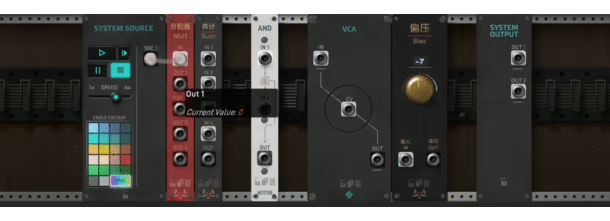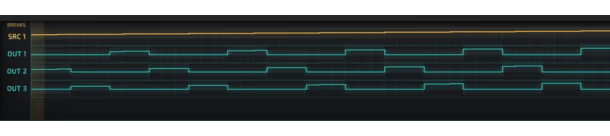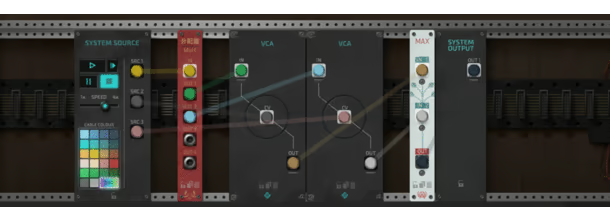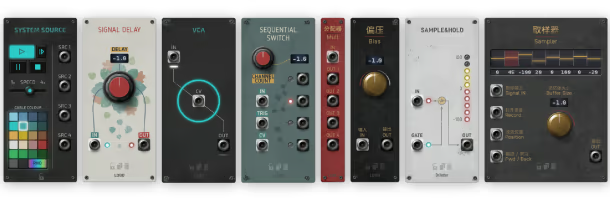
Set in a post-apocalyptic future, The Signal State puts your logic skills to the test with complex puzzles inspired by modular synthesizers. Repair machines, rebuild an abandoned farm, and be part of a revolution that will change the fate of agriculture once and for all.
Modeled estimate, not a reported figure. How we estimate →
Prices
The United States storefront in every case, so this compares stores and not countries.
Discounts
Every price cut of more than 20% we have observed, in each market that quoted one, with this game's chart position on either side of it. These are episodes, not a model: a sale is one event, and one event cannot tell you what the next one will do.

Reviews, worldwide (the counter carries no country): 0/day in the week to Sep 3 → 0/day in the week after.
Reviews, worldwide (the counter carries no country): 0.13/day in the week to Jul 21 → 0/day in the week after.
For scale, across Steam · Top Sellers · Brazil over the last 30 days: the 26 chart moves that followed a price cut of more than 20% went a median of 7 places towards #1, and the 2,400 moves with no price cut behind them went 2 away. One store, one chart, one country — it is the only place we have enough observations to say even that.
Prices outside the United States have been collected since 6 August 2026 and chart positions since 19 July 2026, so a cut older than that has no market to compare and a market that joined later has no history yet. Nothing here is converted between currencies.
About


Genres
Sums Steam only; GOG publishes no volume signal, so the true total is higher by an unknown amount.
| Store | Price | Audience | Score | Chart | Est. revenue |
|---|---|---|---|---|---|
SteamYou are here | $19.99 | 651reviews | 87% | — | $408.3K |
| $7.19−64% | 26ratings | 92% | — | not modelled |
Matched by title — a reused name can pair the wrong games. * is a critic aggregate. Prices and positions are each store's United States storefront; Epic charts worldwide. Audience and Score too, except Steam's, which is worldwide.
Engagement
Reviews
Themes across 56 recent reviews and how positive each mention is. A keyword signal, not full sentiment analysis.
Reviews
I like everything about this game!
(no spoilers in review) This game is... shall we say... "heavily inspired" by Shenzhen I/O. Quite a few things are maybe too on-the-nose, from the music to the conversations. That said, its hook is different enough that this is worth playing. Shenzhen I/O, despite being "board design" and somewhat mixed signal still relies heavily on writing firmware. There's none of that here, it's a lot more on the analog side of mixed-signal design and has some interesting hardware that works totally differently. There are some minor annoyances, the dialog/plot is too intrusive and isn't smart enough to realize that you're leading it into loops so if you choose some of the more interesting options you might repeat some lines. You also may force yourself to redo dialog if you continue the game to a problem you haven't solved (I think this is avoidable by going to the level select directly, but I don't always remember to do that). The biggest thing I think that's lacking is that in Shenzhen (and other Zachtronics games) you often have to choose a different solution because the most obvious one is somehow precluded by limited resources. You can't fit all your code into one microcontroller so you have to split it across two. Or maybe the board just isn't big enough for the components you want. I didn't really run into that in The Signal State. There's obviously no code, so that's one set of constraints you're never up against. And at least as far as I've gotten, there's always vastly more rack space than you need. Contrast that with running into resource limits almost from the first stages in Zachtronics games. Whether that's interesting to you is probably a personal preference, but it is a noticeable difference in approach. You still get the leaderboards to compare your solutions to the world, and while I think that wire length is not that interesting of a thing to optimize, it is always nice to see how your solution stacks up. It might hint that there's a completely different approach for you to find. The other minor thing I have is that I think component cost (Shenzhen) is a more interesting optimization metric than rack space (Signal State), this is also down to preference. If you like the Zachtronics puzzle solving games, this is likely to be right up your alley. The comparisons do more to reinforce how good Zachtronics is rather than to take anything away from The Signal State, which is a great game in its own right.
Media

Related
Related
Price dynamics, follower growth, revenue and sales trajectories with interactive tooltips
This and every other Pro feature is free until October 20, 2026. A free account is all it takes.
Stats
All-time low is the lowest price we've recorded for this game since we started tracking it.
Languages: English, Spanish - Spain, Korean, Russian, Simplified Chinese, Spanish - Latin America, Traditional Chinese, German, Japanese
Hours played at review time, across 56 reviews with recorded playtime.
positive critical· bar length = how often the theme comes up
大脑除锈爽
nice puzzles with some story
A good puzzle game to play, it can be a bit hard to solve the puzzles. But there are some great guides for how to solve them.
Interesting messaging, but it is subtle enough to not care about that. The puzzles, however, are amazing. I really liked formulating custom logic gates to solve some of the achievements, and this has grown my desire to learn more about computer science given the limits to how you are allowed to transfigure inputs.
不需要管那些乱七八糟的线,你只要知道,这玩意能跑就行了:)
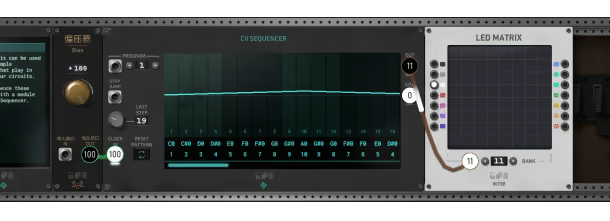
It's a pretty neat zach-like, though a bit on the shorter side, even including the optional puzzles. It's also not that hard, I finished it in one sitting. There were like two or three optional puzzles that took me 30-60 minutes, but those were outliers, with most of non-trivial puzzles taking me around 15 minutes. In the game, you manipulate analog signals with various modules connected with cables. You have an input signal (or signals) and a target output, kinda like in Shenzhen I/O. Each of the modules does a specific "thing" with the signal, and you have to combine their effects to reach your goal. At the beginning, the game spends a pretty long time teaching you its mechanics and basic modules. It's probably a good thing, though it can be a bit tedious if you're a quick learner, or have some prior knowledge about logic gates and such. On the other hand, I feel like the game only tutorializes how the modules work on a pretty basic level. To give an early example, when the basic logic modules are introduced, you're only shown how they interact with binary signals, but knowing how they work with analog signals is essential to progress further in the game. Now, I do like figuring things out on my own, but i also think that a game's tutorials should spend more time on things that are harder to understand, rather than very basic ones. One thing that was left mostly unexplained, and the source of a lot of my confusion, was the way that the game's tick/timing system works. I kind of dislike it. On the surface, it looks like all of the modules work concurrently, you might even think that one module can do one "action" per tick, since that's kind of what it looks like when playing back your solution, but that's not really the case, If you make a feedback loop in some way, you'll see that a module will keep performing actions, until its input stabilizes. My main problem with it is that it's really hard to debug your solutions in that case, since you can only step forwards one "tick" and not one "action". It also leads to situations where a display on a module can show wrong information, which for me, caused a lot of confusion. The game has a hint system if you ever get stuck. They're a mixed bag. Sometimes you get something helpful, sometimes its an annoying "you can use the module that does X thing to do X thing" I really like the visuals. The modules look really stylish. A really nice touch is that each one of them has a manufacturer with a distinct visual style, it adds a bit of personality to the modules. It's also really fun to sometimes take a step back and look at the mess you've made with all the cables and stuff, though admittedly it rarely gets to that point. You usually have plenty of space for your solution, and dont need that many modules to solve a puzzle. The ending of the game was pretty abrupt. I don't mean the ending of the story, mostly I mean that the game ends on a relatively simple puzzle, there's no difficult end-game puzzle that tests your complete understanding of the game. There's also no extra optional puzzles after you beat the game. You just unlock the ability to use every module in previous puzzles. I feel like the last optional puzzle of the game would work better as a "capstone" puzzle, if it was unlocked after the ending. On the level select screen it sits right before the comparatively easier final puzzle, and that doesn't really sit right with me. All that being said, it's still a fun game and I liked playing it, though i'd probably recommend grabbing it during a sale.
离散信号模拟小系统
bad translation, bad instructions
Selling now
See how fast this game is selling right now — estimated copies and revenue per day from recent review growth.
Players by region
Where this game's players are, estimated from review languages.
Related
| Game | Estimated lifetime revenue | Reviews | Review score | Price |
|---|---|---|---|---|
| $407.8K | 765 | 77% | $19.99 | |
| $407.5K | 601 | 75% | $29.99 | |
| $407.4K | 618 | 75% | $29.99 | |
| $409.2K | 4K | 60% | $6.99 | |
| $407.4K | 1.7K | 92% | $14.99 | |
| $409.2K | 517 | 62% | $19.99 |
Related
| Game | Estimated lifetime revenue | Reviews | Review score | Price |
|---|---|---|---|---|
| $443 | 3 | 100% | $3.99 | |
| $199.5K | 321 | 92% | $14.99 | |
| $109.2K | 158 | 93% | $12.59 | |
| $69K | 110 | 80% | $19.99 | |
| $1.3K | 8 | 88% | $7.99 | |
| $138 | 2 | 100% | $1.99 |