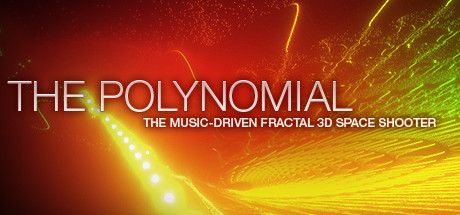
The Polynomial – Space of the Music, developed and published by Dmytry Lavrov, is an unusual experiment that blurs the boundaries between art, music, and gameplay. At its heart, it is a first-person flight shooter, but to define it simply as that would be misleading. It’s more of an interactive audiovisual experience—a journey through dynamically shifting worlds that pulse and transform in perfect harmony with sound. Every track you play, whether part of the built-in soundtrack or imported from your personal collection, becomes the engine that drives a cosmic ballet of color and geometry. The game takes the familiar act of listening to music and transforms it into something immersive, spatial, and almost meditative, giving players the sense that they are flying through the very essence of the music itself.
What immediately stands out about The Polynomial is its visual identity. The environments are built from mathematical equations, fractal geometry, and particle effects that render an ever-changing universe of glowing tendrils, spirals, and waves of light. Each world feels alive, constantly evolving and morphing in time with the rhythm and texture of the music. The result is stunning—a constantly shifting kaleidoscope that manages to feel both organic and synthetic at once. Whether you’re gliding through a tunnel of luminous particles or soaring across vast, colorful nebulae, the visual experience is hypnotic. The game allows you to adjust nearly every visual aspect, from color saturation and symmetry to the density of fractal effects, which makes it as much a tool for creative exploration as it is a game. On modern systems, the visuals remain mesmerizing, still capable of evoking awe more than a decade after release.
The gameplay itself is simple, functioning as a framework for the audiovisual spectacle rather than its centerpiece. You pilot a small ship through abstract three-dimensional arenas, shooting at enemies that emerge from the environment and collecting power-ups while avoiding damage. The controls are intuitive, emphasizing smooth movement and flow rather than twitch precision. Combat takes a back seat to the sensation of flight, and many players will find themselves more focused on the rhythm of motion and the unfolding visuals than on achieving high scores. There are different modes that allow for both combat-oriented play and peaceful exploration, the latter letting you drift freely through the landscape and simply enjoy the interplay between light, color, and music. This versatility ensures that The Polynomial can be whatever you want it to be—an arcade-style shooter, a meditative relaxation tool, or even a personal music visualizer.
One of the most appealing features of the game is its adaptability to the player’s own taste in music. You can import your own MP3s, and the game’s algorithm interprets the rhythm, tone, and intensity of the track to alter the world’s movement and lighting. Fast, bass-heavy tracks produce wild bursts of energy, while slower ambient pieces give rise to more serene and drifting landscapes. This level of responsiveness transforms every session into a unique experience, bound to the soundtrack you choose. The built-in music, composed by Dmytry Lavrov himself, is also excellent—spacey electronic tracks that perfectly complement the game’s surreal aesthetic. It’s easy to lose track of time while playing, as the audiovisual harmony creates an almost trance-like state, a kind of synesthetic immersion where sound and sight become indistinguishable.
However, the game’s greatest strength also highlights its limitations. As an artistic experiment, The Polynomial succeeds spectacularly, but as a traditional game, it can feel lacking. The core mechanics—shooting, dodging, collecting points—are functional but basic, offering little depth or variation beyond the initial thrill of discovery. There’s no real sense of progression or narrative direction; it’s an experience meant to be felt rather than conquered. For players who crave structure, goals, or challenge, this open-endedness may come across as repetitive. Once the novelty of the visuals and music synchronization wears off, there isn’t much to pull you back beyond the desire to experiment with new songs or visual settings. It’s a title that prioritizes atmosphere and emotion over complexity, making it more comparable to an interactive art installation than a conventional video game.
From a technical perspective, The Polynomial performs well considering its visual intensity. The engine handles vast numbers of particles and effects with surprising smoothness, though the performance can fluctuate depending on hardware and graphical settings. The inclusion of stereoscopic 3D support and other customization options was forward-thinking for its time, further demonstrating Lavrov’s ambition to create not just a game but a sensory canvas. The minimalist interface and absence of clutter enhance the feeling of immersion—there are no distractions, just you, the music, and the endless, luminous expanse of the digital cosmos.
In the end, The Polynomial – Space of the Music stands as a unique and enduring piece of interactive art. It’s less about skill and mastery and more about sensation and discovery. The fusion of sound, mathematics, and motion creates an experience that can be deeply personal, even transcendent for those who surrender to its rhythm. It’s a game that doesn’t demand anything of the player except attention and openness—a rare quality in an era dominated by systems and objectives. For those who appreciate audiovisual experimentation, ambient gaming, or simply the idea of turning their favorite songs into living worlds, The Polynomial offers something truly singular. It may not be for everyone, but for the right player, it delivers a mesmerizing voyage through the infinite geometry of music itself.
Rating: 7/10