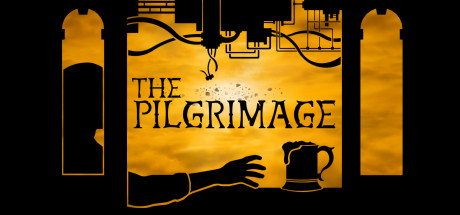
One thousand years beyond the fall of Earth, one last drink may yet be your epitaph, in this post-post-apocalyptic hangover odyssey by a novelist you've never heard of! A parser-driven text adventure for the ages! Or at least a weekend! Fun for all the family (except the kids)!
Revenue comes from in-game items and microtransactions, which our price-based model doesn't estimate. The player count below is how many people own it, not what they spent.
About
Genres
Stats
Languages: English**languages with full audio support
Reviews
I have not played many text-based interactive games so I did not know what to expect when I first played The Pilgrimage but this game exceeded my expectations. It looks simple to play on the surface with a few commands that you used to interact with the environment around you but is deceptively difficult, especially when it comes to the puzzles that this game consists of which are very rewarding when you finally work out how to complete them and further progress the game. It is clear that this is a passion project as there is so much intricate detail to each of the scenes and it is described in such a way to keep you hooked even if there are no visuals (the writing alone allows you to imagine the scenes in great detail, even to those with limited imagination). I first started with the books written by the same author who did this game and every single component of the Eddawielm Universe is amazing!! I am looking forward to future works to read and enjoy!!
"The Pilgrimage" is a text adventure from 2023. I'm no advocate for AI Slop, but when AI Slop outperforms your ability to create games, it may be time to reconsider career choices. Anyway, yeah... an old and dead genre, somehow here on Steam. And breaking another fundamental rule of game design... if it can be done in a web browser, it doesn't need to be in your Steam library. Steam isn't here to compete with Chrome and Firefox. This text adventure is particularly mediocre... if you're hoping for Zork or Hitchhikers Guide to the Galaxy, you'll be understandably disappointed (although if you came to Steam looking for text adventures I suspect your life is already full of disappointment). It's probably better than most RPG Maker high school fanfictions, the "author" behind this has published a couple of books to middling success, but it's not winning any awards, and when an author isn't finding success as an author and needs to break out into doing text adventures, well... here we are. There's no real subtle way to put this, but gaming is a visual medium and has been for decades. Failing to understand that was a big contributor to the failure of the game to attract gamers despite having no up-front cost. If developers want to succeed, they must understand that visuals are not an area for compromise (or skipping altogether). Pricewise, nothing demonstrates a developers belief in themselves and their work than giving it away without any remuneration. This is a service to themselves, and the gaming industry, and should be applauded. Of course, just because something is free, doesn't necessarily mean it's valuable. Even though this is "free", it failed to appeal to the 120 million+ gamers on Steam. SteamDB showed the game peaked at only 4 concurrent players... this is a dismal public reception. This was so bad they couldn't even give it away. Bearing in mind that free games don't add +1 to your game collector count, should you bother adding this to your library and downloading it? Nope. This isn't worth downloading. I don't understand why this isn't a web page. Search Engine Optimisation is too hard? Nothing has less visibility than the bottom end of the Steam shovelware section. [quote][url=https://partner.steamgames.com/doc/store/reviews]Developer Response![/url][/quote]The developer has weighed in to inform everyone they didn't read the [url=https://partner.steamgames.com/doc/store/reviews]Developer Usage Rules[/url] for Steam "partners", or they deliberately ignored the part where Valve says: [quote]Though it may be tempting, not every review needs to be responded to. A developer response will frequently draw more attention than the original statement, potentially turning a small issue into a much larger community discussion. It's also not a good idea to use this feature to refute customer opinions. Your direct attention can be seen as validation or a defensive attempt to silence your customers.[/quote] The developer responds with a garbled word salad that goes a long way to explaining why he wasn't particularly successful as an author. I suppose good writing is more than just eating a thesaurus and then rearranging whatever gets thrown up the next day. But there's some important information in the breach of Valve guidelines that gamers should be aware of, and it's to do with wilful lack of ethics. See, this isn't a complete text adventure, it's just an advertisement for a text adventure that the developer hasn't worked out how to finish yet. I was incorrect in assigning any degree of nobility to the developer here, this is intended ultimately to be a cash grab, an attempt to garner interest in the full product should it ever arise. Not, as I originally and mistakenly assumed (giving the benefit of the doubt where it was ultimately not due), a genuine full game. Here's the process for publishing advertisements and demos on Steam [b]which the developer deliberately chose not to follow:[/b] https://partner.steamgames.com/doc/store/application/demos While it might seem like an inocuous mistake, publishing demos and advertisements as if they are full games is misleading and in some ways harmful. This advertisement is taking up marketing space and visibility that would be better made available to a developer that's done the right thing and created a full game. Instead, that visibility is given over to a demo/advert that's been published incorrectly and is polluting the marketplace. It makes it harder for gamers to find those genuinely, ethically made, and completely finished products. So, this is harmful and unethical behaviour. While I am sure the developer is smug that he got to advertise his product before it's even finished, ZERO consideration has been made for what's good for gamers, or even for other developers. I cannot recommend adverts to gamers. I cannot recommend incomplete products to gamers. I cannot recommend products from unethical developers who do the wrong thing, on purpose, regardless of the harm it does, just for their own ego. And it's quite clear the developer is definitely "The Main Character"... otherwise he may consider what's good for other people besides himself. The developers final parting shot indicates he not only cannot write, he also can't read. It should be obvious from the wording of my review: I mentioned the writing was only mostly awful, and I didn't like that it's a text adventure. This is not complicated. But game reviews are not here to instruct developers on how to make games properly. They should know this before they start. Once more the Main Character fails to understand that reviews are for gamers, not for his personal instruction. Nothing in the developers pointless breach of Valve guidelines changes any of the objective facts of my review, although it has made things considerably worse as the developers wilful and harmful actions are now evident. My review stands unaltered. I cannot recommend this advertisement to anyone.
Media

Related
Related
Price dynamics, follower growth, revenue and sales trajectories with interactive tooltips
This and every other Pro feature is free until October 20, 2026. A free account is all it takes.
I'm not done but so far I am enjoying the game. Some moments seem almost eldritch while the rest is pure comedy. Sometimes I stumbled finding the right words or phrasing but still an enjoyable read/play.
I really like the humor and setting for this game. Taking place in a far-off future(?) setting out on the edge of an unknown solar system, The Pilgrimage really puts us in a place where there's a lot of leeway for what's possible. It's a bit of a jokey game (the first puzzle involves you fighting a vat full of semi-sentient meat with a spatula), but it seems really well put together from what I've played of it so far. Even though it's set in the future, the initial town definitely has a very medieval/renaissance type of vibe to it. The parser is really complete, letting you look at, use, and talk to just about everything you can lay your hands on, and the writing is entertaining without being too full of itself. This is a longer game, I didn't finish it on my first playthrough, and I feel like there's a fair amount still to go. Also, it's free! Check it out.
Dünyanın çöküşünden bin yıl sonra, adını hiç duymadığınız bir romancının yazdığı bu kıyamet sonrası akşamdan kalma macerasında, son bir içki mezar taşınız olabilir! Çağlar boyunca ayrıştırıcı odaklı bir metin macerası! Ya da en azından bir hafta sonu! Tüm aile için eğlence (çocuklar hariç)!
Жена сказала, что если на этом обзоре наберётся 10 лайков и 5 наград, то она подарит ящик пива. Мужики, выручайте!
I'm far from done with the game, but I am having a great time so far! I stumbled across this game while searching for something completely unrelated. I saw Obey The Fist's review and your response, and I then knew that the game narration was going to be snarky and eloquent in the best ways.
The Pilgrimage is a text-driven adventure that embraces the traditions of classic interactive fiction while placing its story inside an eccentric post-apocalyptic science-fiction world. Rather than relying on elaborate graphics, combat systems, or cinematic sequences, it builds its identity through descriptive writing, typed commands, conversations, exploration, and player experimentation. Developed and published by Nicholas Brakespear, the game is clearly aimed at players who enjoy using their imagination and interacting with a fictional world through language. Its deliberately old-fashioned design makes it a niche experience, but it also gives the adventure a personality that would be difficult to reproduce through a more conventional interface. The story follows an enigmatic traveler known as the Pilgrim, who reaches the monastery town of Firesend approximately a millennium after the collapse of Earth. His supposed purpose is spiritual: visiting sacred locations, praying, reflecting upon his mysterious past, and perhaps finding some measure of redemption. Those noble intentions quickly fall apart after a visit to a local drinking establishment. He awakens the next morning in an embarrassing situation, unable to remember everything that happened and confronted with several immediate problems, including an unhappy landlord and an absence of money. It is an amusingly undignified beginning that establishes the game's combination of mystery, bleakness, and irreverent humor. The opening chapter, The Porcelain Crown of Regret, uses this disastrous morning as the foundation for a much broader adventure. What begins as an attempt to recover from the previous night's mistakes gradually develops into exploration involving unusual inhabitants, hidden stories, questionable activities, puzzles, mysteries, and opportunities to uncover information about Firesend itself. The narrative does not rush toward a straightforward heroic objective. Instead, it encourages wandering, investigating and experimenting, making seemingly insignificant details potentially worth examining. Its defining gameplay system is the text parser. Players type instructions rather than simply choosing every action from predetermined menus. Commands can contain different verbs, objects, descriptions, and combinations of words, giving interaction a sense of freedom uncommon in modern adventures. The parser is designed to cope with variations in language, including imperfect commands and spelling mistakes. This does not eliminate every limitation associated with parser-based games, but it makes experimentation much less intimidating. Part of the entertainment comes from wondering whether an unusual command has been anticipated and then testing it. Character interaction follows the same philosophy. Conversations allow players to introduce topics and investigate what different people know rather than simply progressing through a fixed chain of dialogue choices. Asking about relevant subjects can reveal clues, background information and optional stories, while stranger questions can produce humorous responses. This encourages players to treat conversations as exploratory systems instead of exposition screens. The large emphasis on written interaction means patience and curiosity are rewarded more consistently than quick reactions. Puzzles and environmental investigation provide additional structure. A journal records useful information and helps organize discoveries, which becomes increasingly valuable as conversations and locations introduce more details. The game also turns failure into something worth exploring. The Pilgrim can meet his end through numerous unfortunate decisions, with deaths producing collectible epitaphs. It is a playful way of encouraging risky experimentation because discovering another terrible outcome can itself become a reward. Instead of always reloading immediately after failure with frustration, players may deliberately search for additional ways to get themselves killed. The presentation is intentionally sparse, meaning the writing carries most of the atmosphere. Anyone expecting detailed environments, sophisticated animation, or continuous audiovisual spectacle will need to adjust considerably. Much of Firesend exists through description and imagination. This minimalist approach works because it complements the interactive-fiction format, but it inevitably limits the game's audience. Reading is not supplementary material here; reading is essentially the primary method through which the world exists. Its humor is another important part of the experience. The game frequently mixes serious world-building with absurd situations, sarcasm, inappropriate behavior, alcohol-related mishaps, and adult themes. The contrast between the Pilgrim's supposed spiritual journey and his frequently embarrassing circumstances gives the protagonist an amusingly imperfect identity. The setting can therefore communicate darker or more mysterious ideas without becoming relentlessly grim. The episodic approach also leaves room for the larger story to grow. The first chapter establishes the setting and protagonist while functioning as an introduction to a broader narrative. Players can continue exploring after reaching the main conclusion, making it worthwhile to return to locations, investigate missed conversations, experiment with additional commands, and search for optional content. This is particularly appropriate for a parser adventure because simply completing the primary objective does not necessarily mean that everything interesting has been discovered. Steam Deck compatibility is best described as playable with compromises rather than perfectly suited to the hardware. The game's dependence on typed commands means the Deck's virtual keyboard may be necessary, making interaction slower than using a physical keyboard. Some text can also be relatively small on the handheld display. Players willing to use the on-screen keyboard should still be able to experience the adventure, but a desktop or laptop setup with a physical keyboard provides the more natural control method. The largest obstacle is ultimately whether the player enjoys traditional interactive fiction. Parser systems can occasionally create situations where the intended solution seems obvious but finding suitable wording becomes part of the challenge. The abundance of text also makes the experience unsuitable for anyone wanting fast action or minimal reading. Conversely, players who appreciate language-driven adventures may find considerable charm in discovering how many actions, conversations, jokes, failures, and optional details have been anticipated. The Pilgrimage succeeds because it commits completely to its unusual identity. It combines science-fiction world-building, dark comedy, puzzle solving, exploratory conversations, typed interaction, collectible deaths, and an intentionally flawed protagonist into an adventure that rewards imagination and curiosity. Its minimalist presentation and keyboard-oriented gameplay will narrow its appeal, yet those same qualities make it refreshing for enthusiasts of classic text adventures. It is an entertaining reminder that a compelling fictional world does not necessarily require elaborate graphics when strong writing and meaningful interaction can persuade players to construct that world in their own imagination. Rating: 7/10
«The Pilgrimage» — это атмосферная инди-игра с элементами головоломок и исследований. Сюжет разворачивается в мире, где игроку предстоит преодолеть испытания, чтобы найти смысл жизни. Графика минималистична, но создаёт уютную атмосферу. Музыка и звуки усиливают ощущение одиночества и медитативности. Игровой процесс спокойный, с акцентом на размышления и решение логических задач. Однако сюжет может показаться слишком абстрактным для некоторых. В целом — отличный выбор для любителей тихих приключений и философских отсылок.
spashu vas?
Selling now
See how fast this game is selling right now — estimated copies and revenue per day from recent review growth.
Related
| Game | Estimated lifetime revenue | Reviews | Review score | Price |
|---|---|---|---|---|
| $0 | 0 | 76% | Free | |
| $157.9K | 677 | 90% | $14.99 | |
| $0 | 15 | 100% | Free | |
| $714.8K | 1.9K | 94% | $19.99 | |
| $36.1K | 72 | 99% | $12.99 | |
| $9.3K | 21 | 81% | $14.99 |